Hot-Dip Galvanizing vs Zinc Spray (Thermal Spray) vs Sherardizing: Which Zinc Coating Process for Steel
For overseas B2B buyers sourcing fabricated steel from China, the choice of zinc coating process often decides whether a structure stands for 15 years or 50. The same steel grade, the same weld quality, the same machining tolerance can deliver wildly different field performance depending on how zinc is applied. Yet many RFQs we receive list only “galvanized” without specifying which galvanizing, leaving both cost and durability on the table.
This guide compares the three zinc coating routes most relevant to fabricated steel exports from China: hot-dip galvanizing (HDG), zinc spray (also called thermal spray or metalizing), and sherardizing (dry zinc diffusion). It gives you the spec numbers, service-life data, and inspection criteria you need to specify coating correctly on your next order.
1. Why Zinc Coating Matters: Corrosion Protection Fundamentals
Untreated carbon steel loses roughly 0.05 to 0.5 mm of section per decade in temperate rural air, and far more in marine or industrial environments. Corrosion costs the global economy an estimated 3 to 4 percent of GDP each year, and the dominant loss mechanism for fabricated steel is uniform atmospheric oxidation of the iron surface.
Zinc protects steel through three mechanisms that work simultaneously:
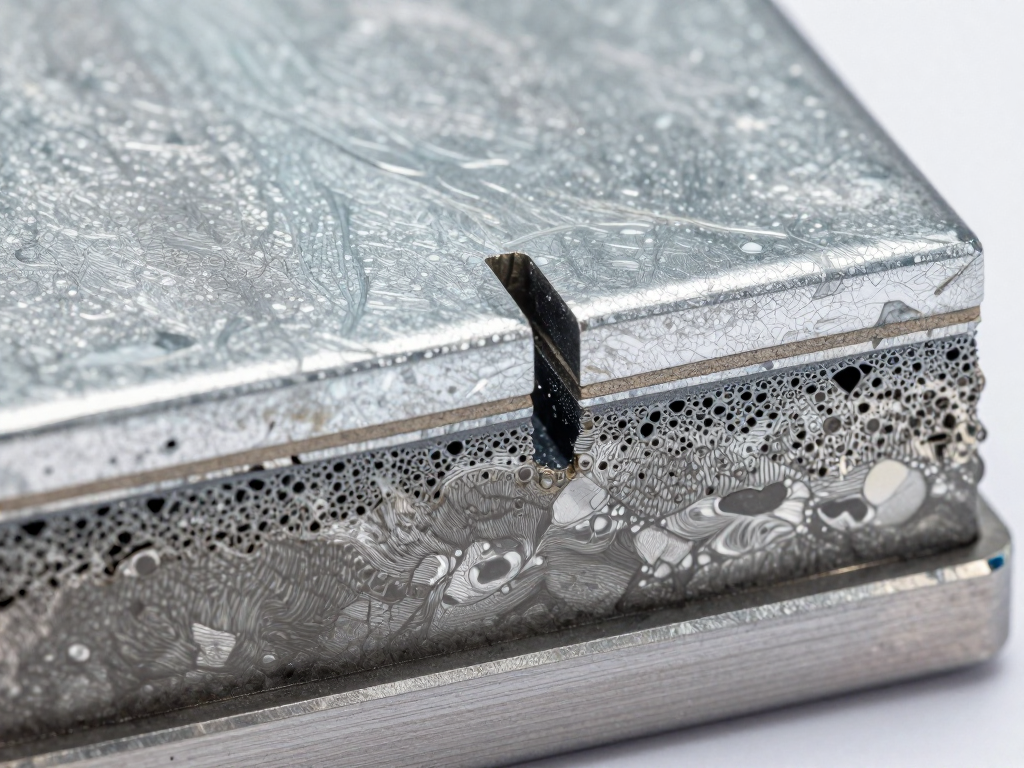
- Barrier protection. A continuous zinc layer physically separates steel from oxygen and moisture. As long as the layer is intact, the steel underneath does not corrode.
- Galvanic (sacrificial) protection. Zinc is more electrochemically active than iron (zinc potential about -0.76 V vs iron at about -0.44 V on the standard hydrogen scale). Where the coating is scratched or cut, the surrounding zinc becomes the anode and preferentially corrodes, protecting the exposed steel. This is why a cut edge on galvanized sheet rarely rusts.
- Zinc patna formation. In atmospheric exposure, zinc reacts with oxygen, water, and carbon dioxide to form a dense, insoluble layer of zinc carbonate and zinc oxide. This patina slows further zinc loss dramatically after the first year or two of exposure.
The practical consequence is that zinc coating life is roughly proportional to coating mass (g/m²) in a given environment. Doubling the zinc thickness roughly doubles the time to first rust. That makes the choice of process, which controls achievable thickness and adhesion, the single most important durability decision in a steel RFQ.
2. Hot-Dip Galvanizing (HDG): The Industry Standard – ASTM A123
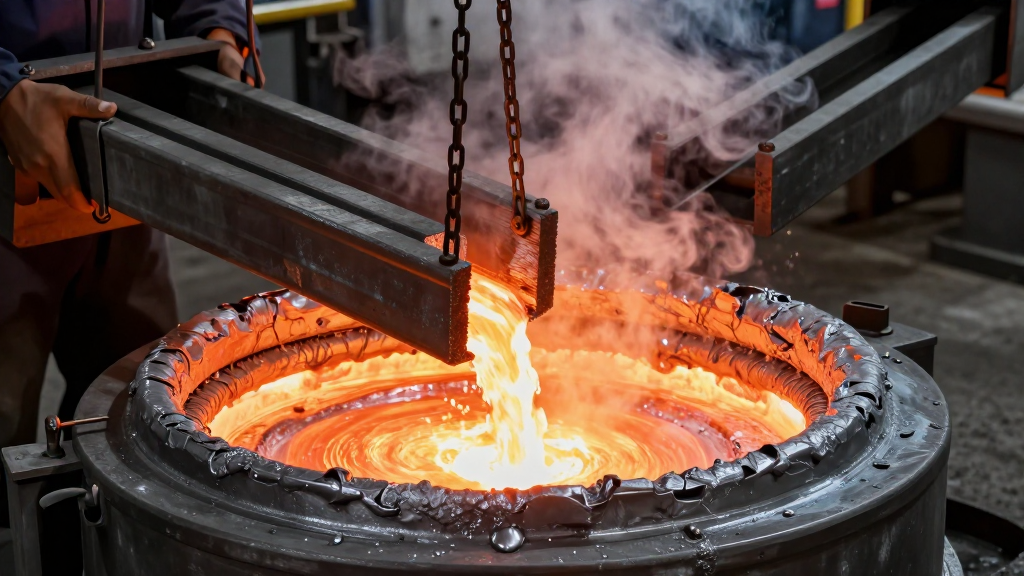
Hot-dip galvanizing is the dominant zinc coating process for structural steel worldwide. The galvanizing process involves cleaning the steel (degreasing, acid pickling, rinsing, fluxing), then immersing it in a bath of molten zinc held at approximately 450 degrees Celsius (840 degrees F). The zinc reacts with the steel surface to form a series of zinc-iron intermetallic alloy layers (gamma, delta, zeta) topped by a free-zinc eta layer. The result is a coating that is metallurgically bonded to the steel, not merely stuck to it.
Spec reference: ASTM A123 / A123M
For structural steel and iron fabricated items, the controlling North American standard is ASTM A123 (A123/A123M). It specifies minimum average coating thickness (or mass) by steel thickness category. Representative minimums for structural shapes and plate are:
- Steel 1.5 mm thick or less: 45 micrometers (1.4 mils, 320 g/m²)
- Steel over 1.5 to 3 mm: 65 micrometers (2.3 mils, 460 g/m²)
- Steel over 3 to 6 mm: 75 micrometers (3.0 mils, 530 g/m²)
- Steel over 6 to 12 mm: 85 micrometers (3.4 mils, 600 g/m²)
- Steel over 12 mm: 100 micrometers (4.0 mils, 705 g/m²)
The international equivalent is ISO 1461, which uses the same thickness-band logic. Both standards also define sampling, acceptance criteria, and repair procedures.
Strengths and limitations of HDG
HDG’s biggest advantage is uniform, complete coverage including the inside of hollow sections, the back of angles, and the threads of fasteners (when spun). The alloy bond gives excellent adhesion, and coating thickness is consistent and predictable. Service life in a moderate urban environment (ISO 9223 category C3) typically reaches 50 to 75 years for a 75 micrometer coating.
The main limitations are practical. The steel must physically fit in the zinc kettle, which in most Chinese job shops limits single-dip length to about 8 to 13 meters. Long beams may require double-dipping, which can leave a visible overlap. Thin sheet (under 1 mm) may warp or distort at 450 degrees C, and reactive steels (high silicon, over 0.04 percent) can produce thick but brittle coatings. Venting and drainage holes are mandatory on hollow fabrications to prevent explosion and zinc pooling. Finally, HDG produces a characteristic bright or spangled finish that may be undesirable for architectural parts.
3. Zinc Spray / Thermal Spray Metalizing: When HDG Won’t Fit
Zinc spray, also known as thermal spray or metalizing, applies zinc without a molten bath. In twin-wire arc spray, two zinc wires are fed together, an electric arc melts their tips, and compressed air atomizes and propels the molten droplets onto the blasted steel surface. In flame (combustion) spray, an oxy-fuel flame melts zinc wire or powder and the same air-blast carries it forward. Substrate temperature stays below roughly 150 to 260 degrees C, so there is no thermal distortion of the steel and no risk to heat-sensitive components.
Because there is no metallurgical reaction, the bond is mechanical: molten zinc droplets key into the grit-blasted surface profile. This requires a clean, near-white metal blast (typically Sa 2.5 / SSPC-SP10) with a surface profile of 50 to 75 micrometers.
Coating thickness and standards
Typical zinc spray thickness on structural steel is 100 to 250 micrometers, and it can be built up in multiple passes to 350 micrometers or more. The relevant standards are ISO 2063, AWS C2.2, and SSPC-CS23.0. Because the coating is porous (porosity 10 to 20 percent), it must be sealed with a low-viscosity sealer (vinyl, epoxy, or polyurethane) before any topcoat is applied. Sealing also extends service life by closing the pore network to moisture.
When to specify zinc spray
Specify metalizing when the fabrication is too large for any kettle (bridge members, large tank sections, wind tower internals), when distortion of thin material is unacceptable, when only certain faces need coating, or when work must be done on site after erection. Zinc spray is also the standard repair method for damaged HDG in the field.
The trade-offs are real: zinc spray is line-of-sight only, so it cannot coat the inside of closed tubes or blind holes. Adhesion (typically 5 to 15 MPa pull-off) is lower than HDG’s alloy bond. Material and labor cost per square meter is higher than HDG for the same thickness, and the finished surface is matte grey rather than bright.
4. Sherardizing (Dry Zinc Diffusion): The Niche but Growing Option
Sherardizing is a dry, tumbling process. Cleaned parts are loaded into a sealed rotating drum with zinc dust and an inert diluent (typically sand), then heated to 330 to 400 degrees C. At this temperature zinc diffuses into the steel surface, forming a continuous zinc-iron alloy layer with no free-zinc eta layer. The process is governed in Europe by BS EN 13811.
The resulting coating is typically 15 to 75 micrometers thick, thinner than standard HDG but uniform even on complex geometries. Threads, recesses, and blind holes all receive the same coating because the zinc dust reaches every surface in the tumbling drum. The pure-alloy, diffusion-bonded structure gives excellent adhesion and abrasion resistance, and the process does not introduce hydrogen, so there is no hydrogen embrittlement risk for high-strength fasteners.
Best-fit applications
Sherardizing is the natural choice for small to medium parts: fasteners, springs, clips, chain, brackets, small castings, and threaded components where HDG would build up the thread and require chasing. The matte grey finish accepts paint well, so duplex systems (sherardize plus powder coat) are common on architectural hardware.
Limitations are size and thickness. Parts are limited to what fits in the drum (commonly up to about 1.5 meters and 50 kg, depending on the shop). Coating thickness is capped by diffusion kinetics, so for severe environments (C4/C5) sherardizing alone is usually under-specified and a duplex topcoat is needed.
5. Coating Thickness, Adhesion, and Service Life Compared
The three processes produce coatings with fundamentally different structures, and that drives different performance. The table below summarizes the key technical differences.
| Property | Hot-Dip Galvanizing (HDG) | Zinc Spray (Thermal Spray) | Sherardizing |
|---|---|---|---|
| Typical coating thickness | 45 to 120 micrometers | 100 to 350 micrometers | 15 to 75 micrometers |
| Bond type | Metallurgical (zinc-iron alloy) | Mechanical (porous, sealed) | Diffusion (zinc-iron alloy) |
| Adhesion strength | Very high (cannot peel) | Moderate (5 to 15 MPa pull-off) | Very high (alloy diffusion) |
| Coating structure | Alloy layers + free zinc | Pure zinc, porous | Pure alloy, no free zinc |
| Process temperature | ~450 degrees C | Substrate below 260 degrees C | 330 to 400 degrees C |
| Service life, C3 urban, years | 50 to 75 (at 75 micrometers) | 50 to 80 (at 150 micrometers) | 20 to 35 (at 50 micrometers) |
| Uniformity on complex shapes | Good, with drips at low points | Line-of-sight only | Excellent, all surfaces |
| Governing standard | ASTM A123 / ISO 1461 | ISO 2063 / AWS C2.2 | BS EN 13811 |
Service life figures assume the ISO 9223 atmospheric corrosivity categories. As a rule of thumb, zinc loss rates in the first 10 years of exposure are roughly: C2 (rural) 0.1 to 1.0 micrometers per year; C3 (urban) 1 to 5; C4 (industrial/coastal) 5 to 15; C5 (marine/industrial) 15 to 50. Because the alloy layer in HDG and sherardizing corrodes somewhat slower than pure zinc, those coatings can outperform zinc spray of equal thickness in some environments, but for severe service the higher achievable thickness of zinc spray usually wins on raw life-to-first-rust.
6. Cost, Size Limitations, and Lead Time by Process
Cost, maximum part size, and lead time often drive the practical choice as much as corrosion performance. The comparison below reflects typical Chinese export shop practice.
| Factor | Hot-Dip Galvanizing | Zinc Spray | Sherardizing |
|---|---|---|---|
| Relative cost per m² (at 75 micrometers) | Low (baseline) | High (1.8 to 2.5x HDG) | Medium (1.2 to 1.6x HDG for small parts) |
| Maximum single-part size | Limited by kettle (commonly 8 to 13 m) | No practical limit; field-appliable | Limited by drum (commonly under 1.5 m) |
| Minimum batch size | Single items OK | Single items OK | Drum batch preferred (50 to 500 kg) |
| Typical lead time add-on | 3 to 7 days (subcontract kettle) | 5 to 10 days (blast + spray + seal) | 4 to 8 days (single drum cycle ~6 to 12 hours) |
| Distortion risk | Moderate (thin material) | None (cold process) | Low (gentle heating) |
| Field repair compatibility | Limited (zinc-rich paint per ASTM A780) | Excellent (re-spray in place) | Limited (zinc-rich paint) |
For most structural fabrications under 12 meters, HDG remains the lowest total cost option. Zinc spray becomes cost-justified when the part cannot be kettled, when distortion is unacceptable, or when a duplex system (zinc spray plus paint) is specified for C5 service. Sherardizing is rarely the right answer for large members but is highly economical for high-volume small parts where thread protection and uniform coating matter.
7. Which Process for Which Application (by Environment)
Rural and light urban, C2 to C3
Standard hot-dip galvanizing per ASTM A123 at 70 to 85 micrometers is the default and usually the lowest-cost answer. Expect 50-plus years to first maintenance in temperate inland climates.
Industrial and coastal urban, C4
Specify HDG at the upper thickness band (100 micrometers for thick material) or zinc spray at 150 to 200 micrometers. For visible architectural steel, a duplex system (HDG plus powder coat or wet paint) extends life by a factor of 1.5 to 2.3 times the sum of the individual systems, per the well-known duplex synergy effect.
Marine and severe industrial, C5 to CX
Heavy zinc spray (200 to 300 micrometers) sealed and overcoated with an epoxy intermediate and polyurethane topcoat is the standard long-life system for offshore and coastal structures. HDG alone at 100 micrometers may give only 15 to 25 years in C5; a duplex HDG plus paint system is a viable alternative where kettle size allows.
Fasteners, springs, and threaded parts
Sherardizing is the preferred route. Coating thickness of 25 to 50 micrometers protects threads without dimensional interference, the absence of free zinc avoids galling, and there is no hydrogen embrittlement. For higher corrosion classes, specify sherardize plus topcoat.
Oversized fabrications beyond kettle length
Bridge girders, large tanks, penstocks, and wind tower internals are the classic domain of zinc spray. Specifying HDG on these is impractical because double-dipping produces a weak overlap and a visible seam. Metalizing plus sealer gives continuous, weldable, field-repairable protection.
Field repairs and retrofits
Any damaged zinc coating, regardless of original process, is best repaired with zinc-rich paint (for small spots per ASTM A780) or zinc spray (for larger areas). Metalizing is the only process that can be applied on an erected structure to repair a coating of comparable thickness.
8. Quality Inspection: Magnetic Thickness Gauge, Adhesion Test, Uniformity Test
Acceptance inspection should be specified in the RFQ and verified at the inspection stage before shipment. Three tests cover the great majority of acceptance criteria.
Magnetic thickness measurement
Coating thickness is measured non-destructively with a calibrated magnetic induction gauge per ASTM E376 or ISO 2808. Take a minimum of five readings per reference area and report the average. For HDG, ASTM A123 requires the average of the readings in each sample to meet the minimum thickness for the steel category. For zinc spray and sherardizing, thickness is verified against the specified minimum, typically with the same magnetic gauge. Note that magnetic gauges read the total non-magnetic coating, so on a duplex system they cannot distinguish zinc from paint; in that case use a coulometric or cross-section method for the zinc layer alone.
Adhesion test
For HDG, adhesion is normally confirmed by a bend or knife-tap test: the coating should not flake or peel when struck or bent. ASTM A123 accepts coatings that show no peeling after a sturdy knife thrust. For zinc spray, use a pull-off adhesion test per ISO 4624 or ASTM D4541; a properly metalized coating should exceed 5 MPa and typically reaches 7 to 12 MPa. Sherardizing’s diffusion bond is rarely tested destructively because it cannot be peeled; a knife test is normally sufficient.
Uniformity (continuity) test
The Preece test (ASTM A239) immerses the part in copper sulfate solution; any exposed steel plates out as a red copper deposit, revealing bare spots or thin areas. It is most useful for HDG on small parts and for verifying that internal surfaces of hollow sections were coated. For zinc spray, visual inspection under strong light for pinholes, plus a holiday test if a sealer or topcoat is applied, is the practical equivalent.
Always require that inspection results, including the calibration certificate for the thickness gauge, are recorded on the mill test certificate or coating inspection report and shipped with the goods.
9. Repair and Maintenance of Damaged Zinc Coatings
Even with good process control, zinc coatings get damaged: lifting slings scrape them, welds burn them back, and field modifications expose bare steel. ASTM A780 defines the accepted repair methods for damaged hot-dip galvanizing, and the same logic applies to zinc spray and sherardizing.
Repair methods
- Zinc-rich paint. For small areas under 250 mm² or narrow scratches, a zinc-rich organic or inorganic paint (typically 75 percent zinc by dry film weight) applied at 75 to 125 micrometers per coat is the standard repair. Two coats are recommended for outdoor exposure. This is the cheapest and most field-practical method.
- Zinc spray repair. For larger areas (above 250 mm²) or where a metallurgically equivalent repair is required, re-metalizing the blasted spot restores coating comparable to the original. This is the only method that achieves the same thickness and galvanic performance as the surrounding zinc spray.
- Zinc-alloy solder. For cosmetic repair of small visible defects on HDG, a tin-zinc or zinc-cadmium solder stick can be rubbed onto the heated spot. This method is less common in field practice today but appears in ASTM A780.
Maintenance strategy
For long-life assets, plan an inspection cycle every 5 to 10 years depending on environment. Measure coating thickness at fixed reference points and track the rate of zinc loss. Once coating thickness falls below roughly 50 percent of the original, schedule overcoating. A duplex system (galvanizing plus paint) can be overcoated with compatible paint systems multiple times, effectively giving indefinite life. Plain zinc spray, properly sealed, can be re-sealed every 10 to 15 years to extend life at low cost.
10. RFQ Checklist: Specifying Zinc Coating Correctly
Ambiguous coating specifications are the single biggest cause of disputes in galvanized steel trade. The following checklist ensures your RFQ produces comparable quotes and predictable product.
- State the process. Name it: hot-dip galvanizing, zinc spray (thermal spray), or sherardizing. “Galvanized” alone is not a specification.
- Cite the standard. For structural HDG, cite ASTM A123 or ISO 1461 with the applicable thickness class. For zinc spray, cite ISO 2063 and specify thickness and sealer. For sherardizing, cite BS EN 13811 and the coating grade (e.g., 25, 35, 50 micrometers).
- Specify minimum coating thickness in micrometers (or g/m² mass) and the steel thickness category, since ASTM A123 minimums depend on it.
- Provide the steel grade and thickness for each part, including silicon content if known. Silicon above 0.04 percent or between 0.15 and 0.25 percent produces reactive, thick HDG coatings that may be brittle.
- State part dimensions and weight so the supplier can confirm kettle or drum capacity.
- Specify surface preparation for zinc spray: near-white blast (Sa 2.5 / SSPC-SP10) with 50 to 75 micrometers profile.
- Specify post-treatment. State whether chromate passivation, clear passivation, or no passivation is required, and whether a sealer or topcoat is included.
- Specify appearance requirements. Note whether surface defects (drips, ash, gross roughness) are acceptable or must be dressed.
- For duplex systems, specify the paint system by brand or generic type (epoxy primer, polyurethane topcoat), DFT for each coat, and color.
- Require documentation. Specify that a coating inspection report with thickness readings, gauge calibration certificate, and standard reference be shipped with the order.
- Define repair limits. State the maximum area of acceptable bare spots and the repair method per ASTM A780.
11. How Yihang Metal Handles Zinc Coating
At Yihang Metal (www.yihangmetal.com), we treat coating specification as part of engineering, not an afterthought. When a buyer sends us a drawing, our first question is not “what finish do you want” but “where does this part serve and for how long.” That conversation drives the process recommendation.
Our shop capability covers all three routes. For standard structural steel up to about 12 meters, we work with long-term partner kettles certified to ISO 1461 and ASTM A123, and we provide thickness inspection reports by category on every batch. For oversized fabrications, thin-walled parts, or distortion-sensitive weldments, our in-house blast and metalizing line applies zinc spray per ISO 2063 with sealed, duplex-ready surfaces up to 300 micrometers. For fasteners, springs, and small hardware, we run sherardizing cycles to BS EN 13811 with thread-friendly coating grades.
Every coating order ships with a documented inspection report: magnetic-gauge thickness readings by reference area, adhesion test results where applicable, uniformity verification, and the gauge calibration certificate. Where a buyer specifies a duplex paint system, we issue a single integrated report covering zinc and paint DFT together so your receiving inspection is fast and unambiguous.
If you are specifying zinc coating on a steel fabrication, send us your drawings and service environment. We will recommend the most cost-effective process that meets your service-life target, quote with the relevant standard cited, and ship with the documentation your project requires. Contact Yihang Metal today for a coating-specified quotation by emailing our export team or requesting an RFQ through www.yihangmetal.com; we typically return a process recommendation and indicative pricing within one business day, and our engineers are available to review drawings and confirm the correct ASTM A123 thickness class, zinc spray thickness, or sherardizing grade for your application. The right zinc coating, specified correctly and documented properly, is the cheapest insurance you can buy against premature steel failure.
Yihang Metal is a Chinese steel and metal exporter serving overseas B2B buyers with fabricated structural steel, plates, pipes, and custom metal components. Visit www.yihangmetal.com to request a quotation.