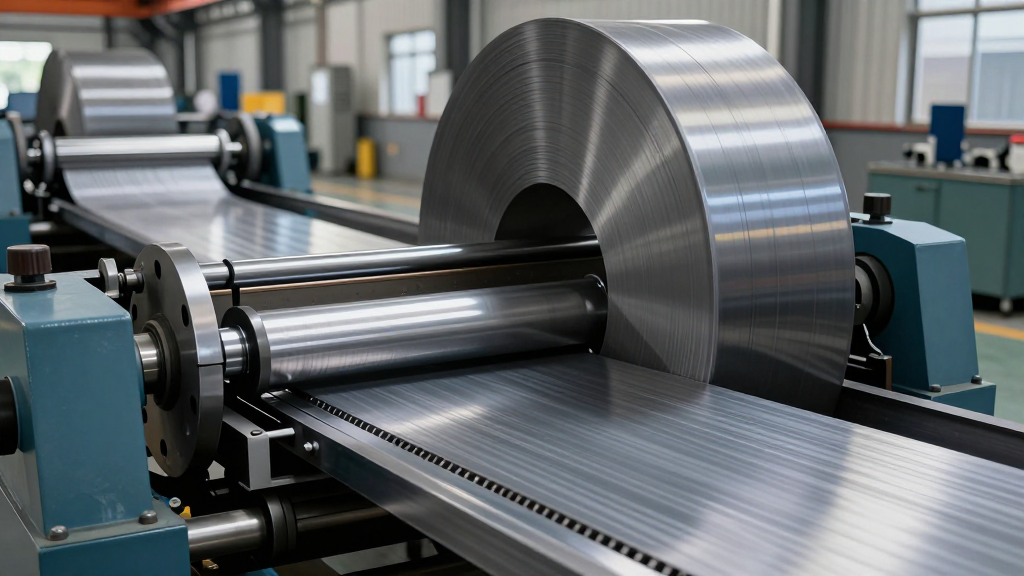
If you are sourcing processed steel from China and the quotation comes back with line items like “slit to 1250 mm” or “CUT TO LENGTH 2000 x 1000 mm” – and you are not sure what tolerance, edge condition, or flatness class those words commit the supplier to – then you are exposed on the three things that decide whether a coil or sheet feeds your downstream line. Steel coil slitting and cut to length are not commodity add-ons; they are precision metal-cutting operations with their own tolerance tables, defect modes, and specification language. A slit strip 2 mm narrow, a CTL sheet 3 mm out of square, or a leveled sheet still carrying coil set will jam a stamping press, misregister a laser nest, or fail a flatness hold – and none of it shows up on the mill test certificate.
This guide explains what coil slitting and CTL do to the steel, the tolerance numbers to hold the supplier to, the edge conditions (mill edge vs slit edge vs trimmed), the shape defects (camber, crossbow, coil set) that ruin a downstream line, which products need which process, and the MOQ / lead-time / pricing structure of a typical Chinese processing job. We run slitting and CTL at Yihang Metal for overseas buyers, so the recommendations come from real RFQs and real line-side feedback.
What Coil Slitting and Cut-to-Length (CTL) Are and Why They Matter
A hot-rolled or cold-rolled coil comes off the mill as a “master coil” – typically 1000-2080 mm wide, 10-30 tons, on a 508 mm (20 inch) or 610 mm (24 inch) ID mandrel. Almost no end-user consumes the master coil as-is. Two operations convert it into the dimensions a fabricator needs:
- Steel coil slitting cuts a wide master coil longitudinally into narrower mults (strips) that are re-coiled. Output is narrower coil – the input shape for roll-forming, stamping, tube welding, and service centers.
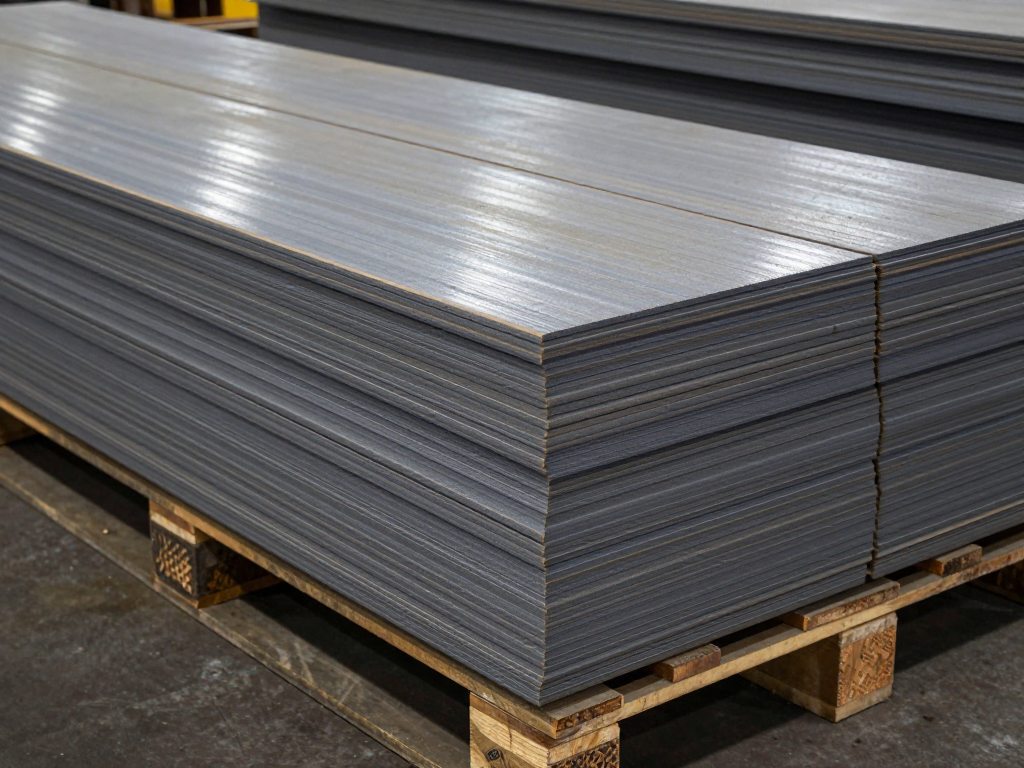
- Cut to length (CTL) unrolls a coil, levels it flat, and shears it transversely into discrete sheets of fixed length. Output is flat sheet, in stacks – the input shape for laser cutting, bending, and blanking lines.
These operations matter because both change the steel’s shape, not just its dimensions. Slitting introduces edge condition and residual stress; CTL introduces flatness and squareness. A buyer who specifies only “slit to 1200 mm” or “CTL 2000 x 1000” has left the tolerance, edge, and flatness clauses open, and the supplier will default to whatever is cheapest – which is rarely what the downstream line needs.
Key mental model: slitting and CTL are forming operations, not just cutting. They set the dimensional and shape tolerances your stamping, laser, or bending line must live with for the entire tonnage. Specifying them correctly is the difference between a coil that feeds and a coil that jams.
The Slitting Process: Rotary Knives, Strip Width Tolerances, and Edge Conditions
A slitting line feeds the master coil through a rotary knife arbor – a stacked set of circular disc knives spaced by precision shims, with mating rubber stripper rings. Each top-and-bottom knife pair makes one longitudinal cut, so a single pass can slit a 1500 mm master into three 500 mm mults or six 250 mm mults. After the knives, the mults pass a tensioner and are re-coiled onto separate mandrels.
Three process variables decide slit quality, and a buyer who understands them can read a supplier’s capability instead of trusting a generic “good edge” promise:
- Knife clearance (side gap). The horizontal gap between top and bottom knives is typically 8-12% of strip thickness for mild steel. Too tight and the edge work-hardens and burrs; too loose and the strip tears, leaving a ragged edge with metal drag. Clearance is set per thickness, so a slitter running a mixed-gauge campaign will be wrong for half the order.
- Knife overlap (vertical gap). Typically 1-3 mm for thin material, reducing to zero or negative for thicker plate. Wrong overlap produces a burr or a double-shear edge.
- Re-coil tension. Without enough tension the mults telescope (wander axially) on the mandrel; with too much the strip elongates and coil set is induced. Telescoping is the most common cause of a slit coil that won’t pay off cleanly on a downstream uncoiler.
The output of a correct setup is a set of narrow mults, each held to a coil slitting tolerance on width (see Section 4), with a clean slit edge and minimal coil set. A sloppy setup meets the nominal width but leaves a burr that scratches a die, a camber that walks out of a roll-former, or a work-hardened edge that cracks in a bend. The tolerance table alone does not catch these – the edge and shape clauses must be in the RFQ too.
The Cut-to-Length Process: Leveling, Shearing, and Flatness Control
A CTL line does two jobs in one pass: it removes the coil set (the longitudinal curl from coiling) and it cuts the strip to a fixed length. The line consists of an uncoiler, a leveler, a length-measuring system, a shear, and a stacker. The leveler is the heart of the line – it is what converts curled coil into a flat leveled steel sheet.
Leveler types and what each achieves
- Flattener (5-9 rolls). Removes gross coil set but not internal stress. Adequate for hot-rolled plate and heavy structural sheet. Residual flatness: 5-8 mm/m.
- Roller leveler (17-21 rolls, adjustable roll bend). The workhorse for cold-rolled and galvanized sheet. Alternating bend directions stress-relieve the strip. Residual flatness: 2-4 mm/m, tighter on a precision leveler.
- Tension leveler (strip under tension through bridle rolls). The premium process, for thin gauges and stretcher-level applications (electrical steel, automotive exposed panels). Residual flatness: ≤1-2 mm/m, and it also removes crossbow.
Shear type and length tolerance
- Flying shear. Cuts while the strip moves; line speed stays high (60-120 m/min). Length tolerance ±1.5 to ±3 mm, set by the encoder measuring system.
- Stop-cut shear. The line stops, shears, restarts. Slower (20-40 m/min) but more accurate; tolerance ±0.5 to ±1.5 mm. Used for thick plate and precision blanking.
The stacker then squares the sheets against a back gauge and side fence and stacks them – and this is where squareness is held or lost. A CTL line with a worn side fence produces sheets that meet length and width but are out of square by several millimetres on the diagonal.
Slitting Tolerances by Thickness and Width
Slitting width tolerance depends on strip thickness, nominal width, and the capability class of the line. The table below reflects what a competent Chinese slitting line holds on carbon steel to commercial tolerance (similar to ASTM A568 / EN 10131 practice). Precision-class slitting (automotive, electrical steel) runs roughly half these values.
| Strip thickness (mm) | Narrow mult < 250 mm | Medium mult 250-600 mm | Wide mult 600-1250 mm | Extra-wide mult > 1250 mm |
|---|---|---|---|---|
| 0.30-0.50 | ±0.10 mm | ±0.13 mm | ±0.15 mm | ±0.20 mm |
| 0.50-1.00 | ±0.13 mm | ±0.15 mm | ±0.18 mm | ±0.25 mm |
| 1.00-2.00 | ±0.15 mm | ±0.20 mm | ±0.25 mm | ±0.30 mm |
| 2.00-3.00 | ±0.20 mm | ±0.25 mm | ±0.30 mm | ±0.40 mm |
| 3.00-5.00 | ±0.25 mm | ±0.30 mm | ±0.40 mm | ±0.50 mm |
| 5.00-8.00 | ±0.30 mm | ±0.40 mm | ±0.50 mm | ±0.65 mm |
Two things to read from this table. First, tolerance widens with both thickness and width – a 2 mm thick, 1250 mm wide mult holds ±0.25 mm, while a 6 mm thick, 1500 mm mult holds ±0.65 mm. Second, narrow mults are held tighter per-millimetre because the knife set and shimming are more controllable at narrow widths. If your part needs a tighter tolerance than the table, specify “precision slit” or call out the exact band, because the default commercial tolerance will be the table above.
Practical tip: a slit-width tolerance is only as good as the slitter’s knife management. A line running the same knife set across a 0.5 mm and a 4 mm campaign will be wrong on one of them. For tolerance-critical orders, ask whether the knife clearance was re-shimmed for your specific thickness – and request a width check report from the first and last coil of the run.
CTL Tolerances: Length, Width, Flatness, and Squareness
A CTL sheet has four tolerances that decide whether it feeds a downstream line, and each is specified separately. Conflating them is the most common RFQ error.
Length tolerance
- Flying shear, 1000-3000 mm: ±1.5 to ±3.0 mm.
- Stop-cut shear, 1000-3000 mm: ±0.5 to ±1.5 mm.
- Long sheets 3000-6000 mm (plate CTL): ±3.0 to ±6.0 mm, dominated by line tracking error.
Width tolerance
CTL width is governed by how the master coil was prepared – either slit to width first and then run through CTL, or trimmed by the CTL line itself. Width tolerance on a CTL sheet is therefore the slitting tolerance from the table above, plus a small side-trim allowance. For sheets sheared directly from a mill-edge coil without side trim, width holds to the master coil’s mill-width tolerance, which is far looser (typically +5/-0 mm).
Flatness tolerance
Flatness is expressed as deviation per unit length (mm/m) or in I-units (a dimensionless strain measure). Commercial classes on a roller-leveled sheet:
- Standard commercial: ≤ 5 mm/m (≈ 30 I-units).
- Restricted (roller leveler): ≤ 3 mm/m (≈ 15 I-units).
- Precision (tension leveler): ≤ 1-2 mm/m (≈ 5-8 I-units).
Squareness tolerance
Squareness is the deviation of the cut edge from perpendicular to the side edge, measured across the diagonal. Commercial CTL lines hold ≤ 1 mm per 100 mm of width (≤ 0.5% of width); precision blanking lines hold ≤ 0.3 mm per 100 mm. Out-of-square sheets are the silent killer – they meet length and width but stack unevenly and misregister the first laser nest on every sheet.
Edge Conditions: Mill Edge vs Slit Edge vs Trimmed Edge
Edge condition is a separate specification from width tolerance, and it decides whether a part can be bent, welded, or left exposed. Three edge types appear on processed coil and sheet:
| Edge type | How it is produced | Typical application | Buyer note |
|---|---|---|---|
| Mill edge | Natural hot-rolled or cold-rolled edge as the coil leaves the mill; slightly rounded on HRC, sharper on CRC, with mill scale on HRC. | Structural plate, tube mill feed, parts where the edge is hidden or machined off. | Width tolerance loose (+5/-0 mm typical). Not for exposed or bend-critical edges. |
| Slit edge | Sheared by rotary slitting knives; clean sheared face with a small burr, possible light work-hardening at the cut. | Roll-forming, stamping, tube welding, general fabrication. | Default for processed coil. Burr ≤ 0.05 mm, toward the same side; deburr if it contacts a die. |
| Trimmed edge | Slit edge additionally trimmed (often by a rotary edge trimmer) to remove burr and work-hardened metal; closest to a machined edge. | Automotive exposed panels, furniture, exposed-edge parts, bend-critical flanges. | Premium process; specify explicitly. Required where the edge is visible or bends more than 90°. |
For most B2B fabrication, slit edge is the default and is adequate for welding, roll-forming, and stamping. Mill edge is acceptable for structural and tube-mill applications where the edge is consumed in the weld. Trimmed edge is the right call for automotive, appliance, and any part where the edge is exposed or bends sharply – and it must be specified explicitly, because a supplier’s default “slit” will not meet it.
Camber, Crossbow, and Coil Set: Defects to Watch For
Three shape defects survive the slitting and CTL process and reach the downstream line, and none of them appear on the MTC. They are measured on the coil or sheet itself, and a buyer who knows the names can reject a bad lot before it jams the press.
- Coil set (longitudinal curl). The strip retains the curvature of the coil – it curls up at the ends when laid flat. Caused by insufficient leveling or too-high re-coil tension. Eliminated by a roller or tension leveler. Spec: coil set ≤ 1 mm/m, or the sheet lies flat under its own weight on a flat surface.
- Crossbow (transverse curvature). The sheet is flat along its length but curves across its width – it rocks when placed face-down on a flat plate. Caused by roll-bending residual stress and by slitting knife pressure on narrow mults. Removed only by a tension leveler, not a roller leveler. Spec: crossbow ≤ 1.5 mm across width for standard, ≤ 0.5 mm for precision.
- Camber (edge curvature). The strip or sheet is not straight along its length – the edge deviates from a straight line over a 2 m gauge length. Caused by uneven slitting knife clearance, uneven tension across the mult, or a master coil that was already cambered. Camber is the defect that walks a strip out of a roll-former and misaligns a laser nest. Spec: camber ≤ 1 mm per 2 m for standard, ≤ 0.5 mm per 2 m for precision.
Of the three, camber causes the most downstream scrap, because it is invisible until the strip feeds into a die or roll-former and the part walks out of tolerance. If your downstream line is a stamping press, roll-former, or laser nest, specify camber explicitly and ask for a camber check on the first mult of every run.
Practical tip: camber on a slit mult is often caused not by the slitter but by the master coil. If the original HRC or CRC coil already had camber from uneven rolling reduction or cooling, slitting just propagates it into every mult. Buying a master coil from a mill with poor shape control and expecting the slitter to fix it is a false economy – the shape has to be controlled upstream.
Which Products Need Slitting vs CTL (HRC, CRC, GI, Stainless, Aluminum)
Whether a product goes through slitting, CTL, or both depends on the downstream form – coil or sheet – and on the product’s gauge and temper. The routing below is what buyers actually specify:
- Hot-rolled coil (HRC, 1.5-25 mm). Goes to CTL for plate and structural sheet (a heavy roller leveler or stretcher handles flatness). HRC is slit less often because the slit edge on hot-rolled scale is rough; when slit, usually for tube-mill feed.
- Cold-rolled coil (CRC, 0.3-3 mm). Goes both ways – slit for stamping and roll-forming mults, CTL for flat blanks and panels. CRC is the most tolerance-sensitive product because gauges are thin and downstream lines are high-speed.
- Galvanized coil (GI / Galvalume, 0.3-3 mm). Predominantly slit for roll-forming into roofing, decking, and purlins; CTL for flat cladding panels and appliance blanks. The zinc coating must not flake at the slit edge, so knife clearance is tighter than for bare steel.
- Stainless coil (304/316L, 0.3-6 mm). Slit for tube-mill and stamping feed; CTL for flat sheet in food, pharmaceutical, and architectural applications. Stainless work-hardens aggressively at the slit edge, so knife sharpness and clearance are critical – a dull knife creates a hardened edge that cracks in bending.
- Aluminum coil (1xxx-6xxx, 0.3-6 mm). Slit and CTL both common. Aluminum is soft and galls – knives must be ground to a sharper profile with smaller clearance than for steel. Burr is the main defect to control.
The general rule: if the downstream line feeds coil, specify slitting; if it feeds sheet, specify CTL. A buyer who orders slit coil for a laser-cutting line (which feeds sheet) pays to uncoil, level, and shear it again – and a buyer who orders CTL sheet for a roll-former (which feeds coil) has bought the wrong shape entirely.
Minimum Order Quantities, Lead Times, and Pricing Structure
Slitting and CTL are batch processes, and the cost structure reflects setup time, not tonnage. Understanding the MOQ and lead-time logic lets a buyer consolidate an order to the supplier’s economic batch and avoid minimum-charge penalties.
MOQ
- Slitting: typical MOQ is 25-50 tons per width spec (one master coil, 20-30 tons, is the practical floor). Below that, a slitter runs a “partial coil” but charges a minimum-setup fee that makes small orders uneconomic.
- CTL: typical MOQ is 20-40 tons per size (length x width). Multiple lengths from the same width share a setup, so a buyer needing several lengths from one coil can hit MOQ across the combined tonnage.
- Slit + CTL combined: MOQ is the larger of the two – typically 25-30 tons.
Lead times
- Slitting only: 5-10 working days from master coil availability.
- CTL only: 7-12 working days.
- Slit + CTL combined: 10-15 working days.
- With tension leveling or precision class: add 3-5 working days for line scheduling.
Pricing structure
Processing is quoted as a per-ton adder on top of the substrate coil price, plus a setup charge for small orders. Typical Chinese processing rates (indicative, USD/ton, FOB):
- Slitting: $25-50/ton (depends on thickness, number of mults, edge class).
- CTL (roller leveler): $35-60/ton.
- CTL (tension leveler / precision): $60-110/ton.
- Edge trimming (premium): +$10-20/ton on top of slit.
- Minimum setup charge: $150-400 for orders under one master coil.
The processing adder is small relative to the substrate, but the tolerance and flatness class it buys is large relative to downstream scrap. A $30/ton saving from specifying commercial flatness instead of restricted flatness is wiped out by one jammed shift on a stamping line.
RFQ Checklist for Slitting and CTL Services
The most common reason a processing RFQ comes back wrong is that the buyer specified the dimensions but not the tolerance, edge, or flatness. A complete slitting or CTL RFQ should lock all of the following:
- Substrate grade and standard: e.g., “DC01 per EN 10130”, “DX51D+Z275 per EN 10346”, “SUS304 per JIS G4305”. Don’t write “cold rolled steel” alone.
- Thickness and tolerance: nominal gauge with EN 10131 / ASTM A1008 tolerance class (commercial or restricted).
- Slit width and tolerance: nominal width with the band from Section 4 (or “precision slit” for half those values).
- CTL length and tolerance: nominal length with tolerance band; state shear type (flying or stop-cut) if length-critical.
- Edge condition: mill, slit, or trimmed – per mult or per sheet, not left to supplier default.
- Flatness class: commercial (≤5 mm/m), restricted (≤3 mm/m), or precision (≤1-2 mm/m), with leveling technology stated for the precision class.
- Shape tolerances: camber ≤ 1 mm/2 m, crossbow ≤ 1.5 mm across width, coil set ≤ 1 mm/m – or tighter if the downstream line demands.
- Coil ID and OD (for slit coil): 508 mm or 610 mm ID; max OD for downstream uncoiler clearance; eye-to-sky or eye-to-wall packing.
- Sheet stack spec (for CTL): sheets per bundle, bundle weight, skid or pallet, moisture-barrier wrapping.
- Inspection and MTC: EN 10204 3.1 MTC with chemistry and mechanicals per heat; first-and-last coil width and camber report for slit orders; flatness report for CTL orders.
- Incoterm and port: FOB Shanghai / Ningbo / Tianjin, or CIF destination port, with substrate and processing quoted line-by-line.
For the overall RFQ structure, the quote-request template gives the spec format (grade, gauge, size, tolerance, qty, Incoterm) that returns a clean, comparable quotation, and because slit coil and CTL sheet are both transit-rust sensitive, the export-packing checklist covers the moisture-barrier packing, desiccant, and steel-edge protection that prevents the processing investment from being ruined in the container.
How Yihang Metal Provides Processing Services
We provide steel processing service – slitting, CTL, and edge trimming – integrated with coil supply, so you buy the substrate and the processing in one RFQ and one shipment. A Yihang Metal processing quotation includes:
- Substrate range across HRC, CRC, GI/Galvalume, stainless (304/316L), and aluminum, per EN / ASTM / JIS / GB standards – so the grade is matched to the downstream line, not forced to whatever one mill produces.
- Slitting to width with commercial or precision tolerance, knife clearance re-shimmed per thickness, and a width check report from the first and last coil of the run. Burr controlled to ≤ 0.05 mm; telescoping controlled by re-coil tension.
- CTL on roller-leveler and tension-leveler lines, with commercial (≤5 mm/m), restricted (≤3 mm/m), or precision (≤1-2 mm/m) flatness class explicitly called out. Length tolerance stated by shear type.
- Edge condition specified per line item – mill, slit, or trimmed – with trimmed edge available for automotive, appliance, and bend-critical parts.
- Shape control with camber ≤ 1 mm/2 m and crossbow ≤ 1.5 mm across width on standard orders, tighter on request, and a shape check on the first mult of every slit campaign.
- EN 10204 3.1 MTC with chemistry and mechanicals per heat, 3.2 third-party witnessed for project-critical work, and the processing tolerance report attached as a separate inspection record.
- Sea-worthy, moisture-barrier export packing – slit coil on vertical eye-to-sky cores with edge protectors and desiccant; CTL sheet bundles on skids with VCI paper and steel edge protection – so the processing investment arrives as specified.
Because we run slitting, CTL, and edge trimming alongside the full substrate grade range, we can also give you a like-for-like cost comparison at the exact tolerance, edge, and flatness class each downstream line needs – so your processing specification is driven by the stamping press, roll-former, or laser nest that has to consume the output, not by which single capability a one-process service center wants to fill.
Specifying a slit or CTL order and not sure which tolerance, edge, or flatness class to call out? Tell us the substrate grade and gauge, the downstream line (stamping, roll-forming, laser, tube mill), the part feature that matters (bend, weld, exposed edge, flatness fixture), and the target dimensions. The team at Yihang Metal will recommend the slitting or CTL tolerance, edge condition, and leveling technology that gives you a coil or sheet that feeds cleanly at the lowest total cost – and back it with full EN 10204 documentation and a processing inspection report. Send us your specifications today for a quoted price within 24 hours.