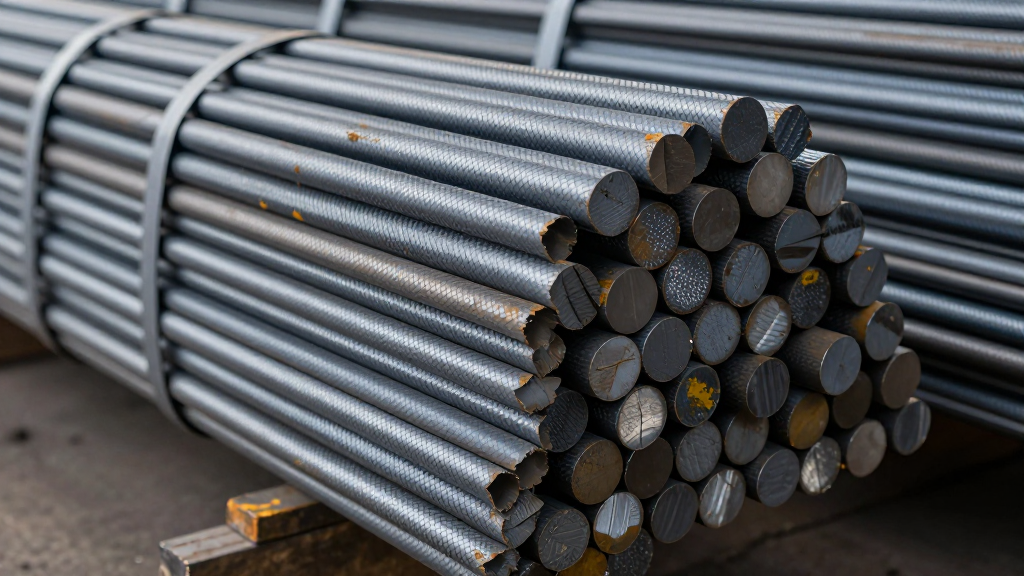
Carbon Steel Round Bar Buying Guide: 1045 vs C45 vs 4140 — How to Specify Round Bar for Machining, Shafts, and Fasteners
Carbon steel round bar is the feedstock of the machining world — shafts, pins, fasteners, and gears all start as bar. The grade decides machinability, hardenability, and weldability; the condition (hot-rolled, cold-drawn, peeled, ground) decides tolerance and surface. Order hot-rolled where cold-drawn was needed and the machinist burns hours on oversize stock; order alloy where carbon would do and you pay double for hardenability you never use.
This guide compares the common grades, bar conditions, tolerances, and a complete RFQ checklist.
Grade Comparison: 1045 vs C45 vs 4140
| Grade | Carbon | Key trait | Use |
|---|---|---|---|
| 1045 / C45 | ~0.45% | Hardenable, good strength | Shafts, gears, pins — the default medium-carbon bar |
| 1018 / C15 | ~0.18% | Weldable, formable, case-hardenable | Welded parts, cold-formed pins, low-stress shafts |
| 4140 / 42CrMo | ~0.40% + Cr-Mo | Deep hardening, fatigue strength | High-stress shafts, spindles, downhole tools |
| 12L14 / 1215 | Free-cutting | Fastest machining | High-volume screw-machine parts (not for welding) |
Bar Condition Guide
| Condition | Tolerance | Advice |
|---|---|---|
| Hot-rolled | Loose (e.g., ±0.4 mm) | Cheapest; for rough machining and forgings |
| Cold-drawn | Tight (h9–h11) | Shafts and pins with minimal machining |
| Peeled / turned | Tight, clean surface | Defect-free surface for fatigue parts |
| Ground / polished | Tightest (h6–h8) | Hydraulic shafts, precision pins — ready to use |
Standards Buyers Quote
- ASTM A29 / A576: carbon bar grades and conditions — quote grade + condition + tolerance class.
- EN 10083 (C45, 42CrMo4): European quenched-and-tempered grades — confirm delivery condition (+AR/+N/+QT).
- GB/T 699 / 3077: Chinese carbon and alloy bar references (45#, 42CrMo).
- UT testing: require ultrasonic inspection on bars above ~100 mm or for fatigue-critical shafts.
Heat Treatment Buyers Should Confirm
- As-rolled vs normalized vs quenched-and-tempered — QT adds strength but also cost and lead time.
- Hardness range on the PO (e.g., 22–28 HRC for 4140 QT) — vague “hardened” invites disputes.
- Straightness and chamfer requirements for automatic bar feeders.
Common Applications
- Motor and gearbox shafts, rollers, and pins.
- Fasteners, studs, and anchor bolts (cut from bar).
- Gears, sprockets, and couplings.
- Hydraulic and pneumatic piston rods (ground bar + chrome).
RFQ Checklist
- Grade: 1045/C45 / 1018 / 4140 / 12L14
- Condition: hot-rolled / cold-drawn / peeled / ground + tolerance
- Diameter x length, heat treatment + hardness if any
- UT required (yes/no), quantity, EN 10204 3.1 certs, destination / Incoterm
FAQ
1045 or 4140 for my shaft? 1045 for general shafts; 4140 only for high stress, fatigue, or impact loading.
Hot-rolled or cold-drawn? Hot-rolled for parts machined all over; cold-drawn where the bar surface stays in the finished part.
Why did my bar crack in welding? Medium-carbon and alloy bars need preheat and controlled cooling — or switch to a low-carbon grade for welded assemblies.
Why Source Round Bar from Yihang Metal
Yihang Metal supplies carbon and alloy round bar in 1018, 1045/C45, 4140/42CrMo, and free-cutting grades, in hot-rolled, cold-drawn, peeled, and ground conditions with UT inspection, QT heat treatment, and EN 10204 3.1 certs. Standard sizes typically ship in 25–35 days.
Ready to specify your round bar? Send us the grade, condition, diameter x length, heat treatment, and quantity, and we will confirm mill availability and lead time with a fixed-price quote and test certificate. Email [email protected] or use the quote form on this page — our team replies within one business day.