HRPO, Pickled, Oiled or Dry: How to Specify Hot-Rolled Steel Surface Condition Correctly
Hot-rolled steel leaves the mill with a surface that is not yet a product. It carries mill scale, it may be pickled to remove that scale, and it may or may not be oiled to protect it. These three variables — as-rolled vs pickled, oiled vs dry, and the edge and coil condition — define what the material can actually be used for, and they are routinely left off the purchase order.
The cost of leaving them off is asymmetric. As-rolled coil is cheaper than pickled, so an unspecified order tends to arrive as-rolled. If your process needs a pickled surface, you discover it at the laser cutter, the press brake, or the paint line — after the coil is on your floor.
This guide explains what each surface condition is, which processes require which, and how to write a surface clause that a mill can price and deliver.
The Three Surface Conditions
Hot-rolled steel surface is described by how the scale was handled and whether protection was applied.
| Condition | What it is | Surface appearance | Relative cost |
|---|---|---|---|
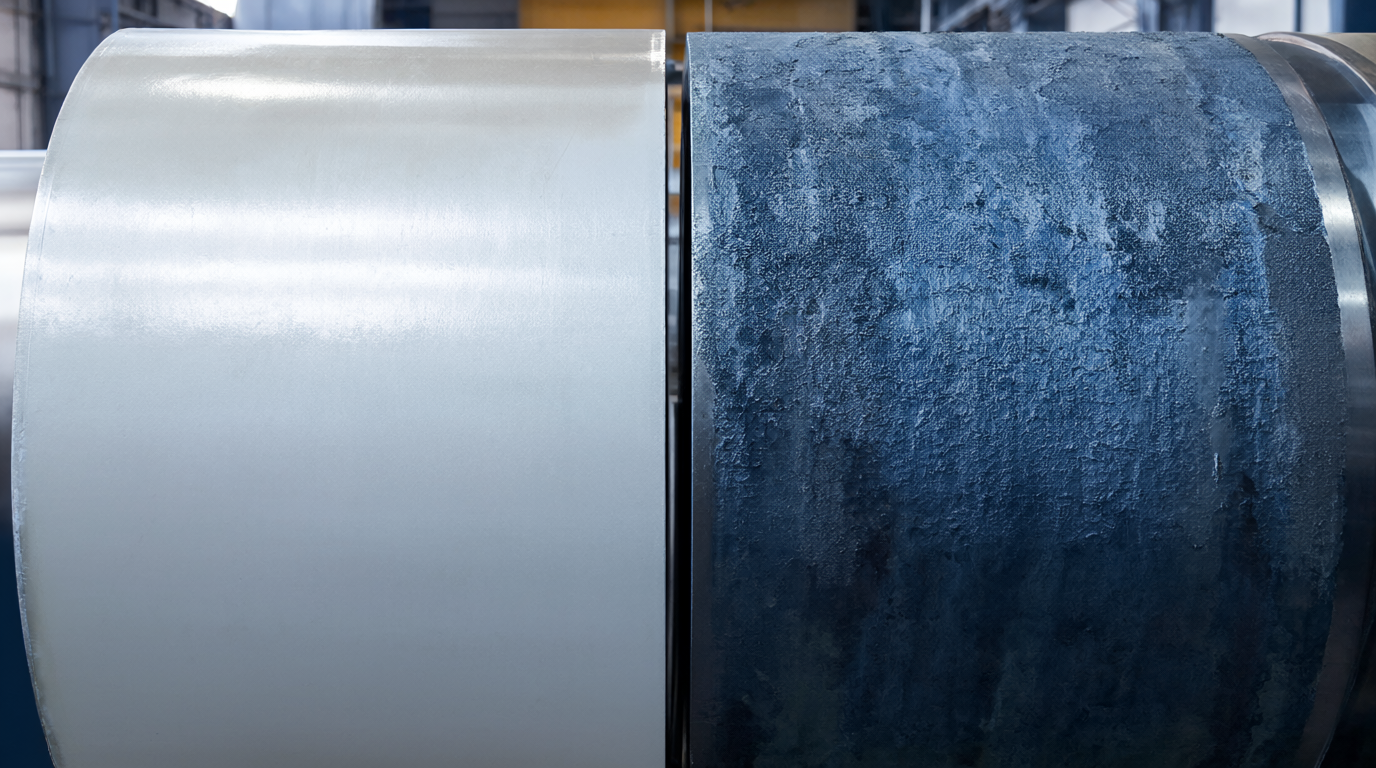
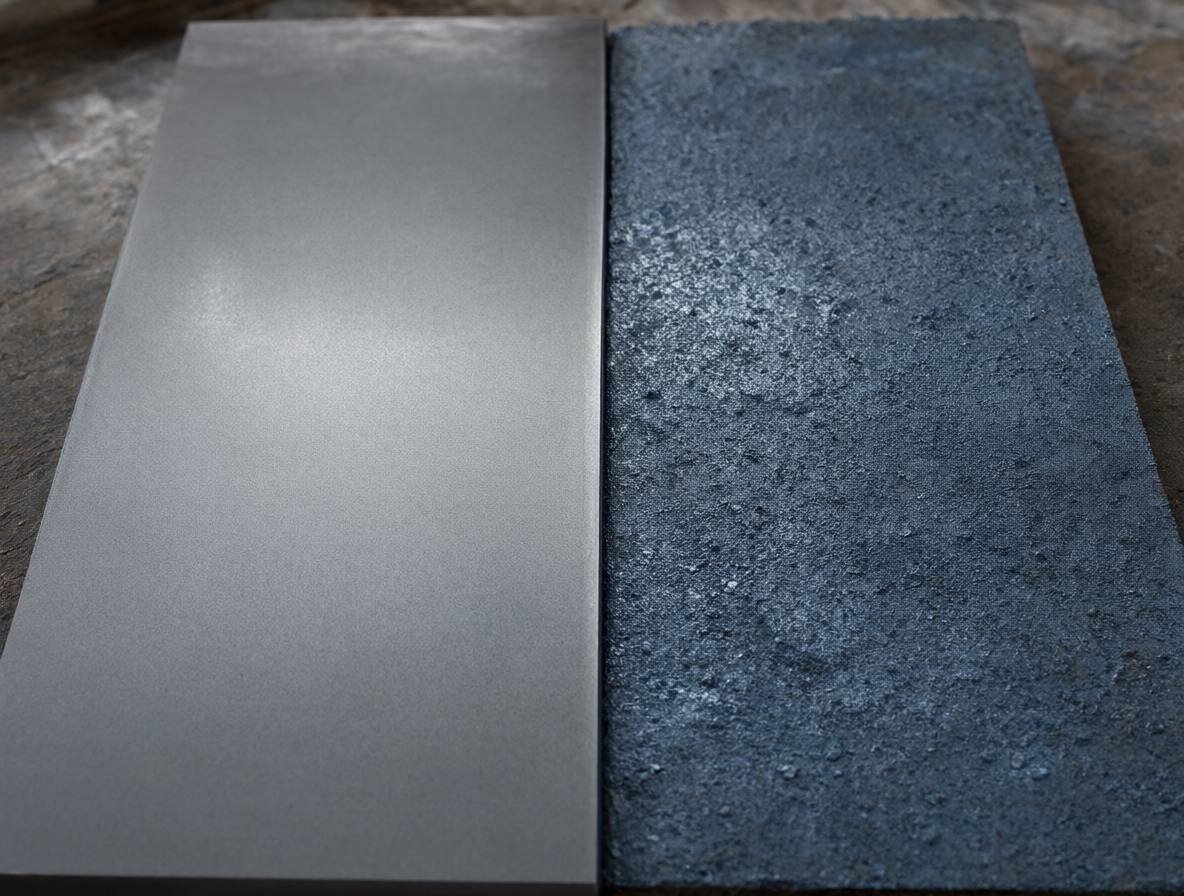
| As-rolled (HR, “black”) | Scale intact from hot rolling | Blue-grey to black oxide, rough | Baseline (lowest) |
| Pickled (P) | Acid pickling removes scale, leaving a clean grey surface | Uniform matte grey, smooth | Higher |
| Pickled and oiled (P&O) | Pickled, then a thin protective oil film applied | Grey with light oil sheen | Higher still |
| Pickled, oiled, and dry (P&O dry / “dry”) | Pickled and lightly oiled for transit, then dried | Grey, minimal surface oil | Similar to P&O |
“HRPO” (hot-rolled pickled and oiled) is the term you will see most in trade, and it is the standard commercial condition for hot-rolled sheet and coil that will be formed, cut, or coated. “Dry” is not a separate pickling process — it describes the oil state, and the distinction matters mostly for downstream handling.
Mill Scale: Why It Matters More Than It Looks
Mill scale is a layer of iron oxides (FeO, Fe₃O₄, Fe₂O₃) formed at rolling temperature. It is hard, brittle, and electrically non-conductive, and it causes problems in almost every downstream process:
| Process | Problem caused by mill scale |
|---|---|
| Laser cutting | Scale reflects and absorbs inconsistently; cut edge quality degrades, kerf widens, dross increases |
| Welding | Scale interferes with the arc and can be trapped as slag or oxide inclusions |
| Painting / coating | Scale flakes off later, taking the paint with it — the classic cause of premature coating failure |
| Galvanizing | Scale must be removed before fluxing; residual scale causes bare spots and poor zinc adhesion |
| Forming | Hard scale abrades tooling and can crack during severe deformation |
| Machining | Abrasive scale dulls tooling and creates inconsistent depth of cut |
This is why pickled material exists. Pickling in hydrochloric or sulphuric acid dissolves the oxide layer and leaves a clean, chemically active surface that welds, coats, and forms predictably. The trade-off is cost, an extra process step, and a surface that will rust quickly if unprotected — hence the oil.
A common misconception: buyers sometimes assume “pickled” means “smooth like cold-rolled.” It does not. Pickling removes scale; it does not roll the surface flat. A pickled hot-rolled sheet still has the roughness and thickness tolerance of a hot-rolled product. If you need cold-rolled surface quality, you need cold-rolled material, not pickled hot-rolled.
Matching Surface Condition to Process
| Your process | Recommended condition | Notes |
|---|---|---|
| Structural fabrication, site welding | As-rolled acceptable | Weld procedure must account for scale; grinding at the joint is normal |
| Laser or plasma cutting to tight tolerance | Pickled (P or P&O) | Scale variation is a direct cause of inconsistent cut quality |
| Press braking, roll forming | Pickled and oiled | Oil reduces tool wear and galling |
| Painting without blasting | Pickled and oiled | Scale must not be present if the coating is to adhere |
| Hot-dip galvanizing | Pickled or as-rolled | The galvanizer pickles anyway; buying pickled may be redundant — confirm |
| Powder coating | Pickled and oiled, then degreased | Oil must be removed before coating; confirm the oil is compatible with your pre-treatment |
| Deep drawing or severe forming | Cold-rolled, not hot-rolled | Hot-rolled pickled lacks the thickness control and surface for severe drawing |
| Structural, unpainted, exposed | As-rolled or weathering steel | Scale is acceptable; consider whether appearance matters |
The galvanizing row is worth a note. Many buyers pay a premium for pickled material and then send it to a galvanizer who pickles it again as the first step of the galvanizing line. That is not harmful, but it is often unnecessary cost. Ask your galvanizer whether incoming pickled material changes their process or price before specifying it.
Oiled vs Dry: The Storage Question
Pickled steel without oil will begin to rust within days in humid conditions — the pickled surface is chemically active and unprotected. Oil is applied as a temporary corrosion barrier for transit and storage.
| Oiled | Dry | |
|---|---|---|
| Corrosion protection | Good for months in covered storage | Poor; rust risk within weeks in humid air |
| Handling | Slippery; requires care in lifting and stacking | Better grip, less slippery |
| Before welding | Must be degreased at the joint | Less cleaning, but rust may need removal |
| Before painting | Must be degreased — oil causes coating defects | Must be rust-free; often needs light blasting |
| Best for | Export shipment, long storage, humid climate | Immediate use, in-plant processing, dry climate |
For export orders — which is most of what a Chinese mill ships — oiled is the practical default. A coil that spends six weeks in a container and another month in a port warehouse will rust if it is dry. If your process cannot tolerate oil, specify dry but plan to consume it quickly and store it under cover.
Oil type is a real specification, not a detail. Different oils are formulated for different downstream processes. A drawing oil is not the same as a temporary rust-preventive, and some oils interfere with painting or with galvanizing flux. If you have a coating line, tell the mill what the oil must be compatible with — or ask for a dry surface and control the storage yourself.
Edge Condition and Coil Parameters
Surface condition is only part of the coil specification. Three more parameters are routinely omitted and routinely cause problems.
| Parameter | Options | Why it matters |
|---|---|---|
| Edge type | Mill edge, slit edge | Mill edge has the natural rolled profile and may have edge cracks; slit edge is trimmed and dimensionally consistent |
| Coil inner diameter | 508 mm or 610 mm | Must match your decoiler mandrel; wrong ID means the coil cannot be mounted |
| Coil weight | Typically 3–25 t | Must suit your crane capacity and line; oversized coils cannot be handled |
| Max coil OD | Per mill and shipping constraints | Affects container loading and cradle design |
The inner diameter point catches buyers more often than expected. A 610 mm ID coil will not fit a 508 mm mandrel, and an adapter is not always available. If you are buying for an existing line, state the mandrel diameter explicitly.
Inspection at Goods-In
Surface condition is verifiable at receiving, and the checks are quick.
- Scale present? A pickled coil is uniformly grey. Patches of blue-black scale mean the pickling was incomplete or the material is as-rolled and mislabelled.
- Rust? Light surface rust on oiled material is common and usually acceptable; pitting is not. Check the coil edges and the outer wrap, which are most exposed.
- Oil uniformity? Patchy oil suggests uneven application; dry patches will rust first.
- Edge condition? Check for edge cracks, burrs, and whether the edge is mill or slit as specified.
- Coil ID and weight against the packing list — fast, and it prevents a handling problem at the line.
For critical coating or welding work, a small sample can be tested: solvent wipe to check for oil, or a light acid or mechanical check for residual scale. Both take minutes and settle the question before the coil is committed to production.
Writing the Clause
| Element | Weak | Enforceable |
|---|---|---|
| Surface | “good surface” | “Hot-rolled, pickled and oiled (HRPO)” |
| Standard | (unstated) | “Surface quality per EN 10051 / ASTM A1011 as applicable” |
| Oil | “oiled” | “Rust-preventive oil, compatible with [coating process]; dry on request” |
| Edge | (unstated) | “Slit edge, burr-free” |
| Coil | (unstated) | “ID 508 mm, weight 5–15 t, max OD 1,800 mm” |
| Inspection | (unstated) | “No residual scale; no pitting; oil uniform” |
The “no residual scale” line is the one that matters most. Without it, a coil with 80% clean surface and 20% residual scale passes, and the 20% is exactly where your paint will fail in two years.
FAQ
Is pickled steel the same as cold-rolled? No. Pickling removes scale from hot-rolled steel; cold rolling reduces thickness and improves surface and tolerance. Pickled hot-rolled is cheaper and has wider thickness tolerance than cold-rolled, and it is not a substitute where cold-rolled properties are needed.
Does as-rolled steel need to be pickled before welding? Not necessarily — many structural welds are made on as-rolled material with appropriate procedures and joint preparation. But for critical welds, or where scale could be trapped, grinding or pickled material is safer.
Can I paint directly over mill scale? You can apply paint, but it will not last. Scale flakes progressively and takes the coating with it. Pickled material, or blasting to remove scale, is the durable route.
How long will oiled pickled coil last outdoors? Not long. The oil film is a transit protection, not a weather barrier. Under cover and dry, months; exposed to rain, weeks. Plan storage accordingly.
Why does coil inner diameter matter? Because the decoiler mandrel is a fixed size. A 610 mm ID coil will not mount on a 508 mm mandrel. Confirm the ID your line accepts before ordering.
Is dry pickled steel available for export? Yes, but specify it deliberately and understand the rust risk. For sea freight, oiled is the safer default unless your process genuinely cannot tolerate oil.
Why Source Surface-Specified Steel from Yihang Metal
We supply hot-rolled, pickled, and pickled-and-oiled steel as coil, sheet, and plate, with the surface condition, oil state, edge type, and coil parameters stated on the order rather than assumed.
- As-rolled, pickled, or HRPO — stated explicitly, with pickling to a named standard so “pickled” means a clean, scale-free surface rather than a partial one.
- Oil matched to your process — rust-preventive for export and storage, or a formulation compatible with your coating line; dry available when your process requires it.
- Edge and coil parameters locked — mill or slit edge, 508 or 610 mm ID, coil weight and OD range confirmed against your handling equipment before shipment.
- Surface inspection reported — residual scale, pitting, and oil uniformity checked and reported, so a coating or welding problem does not surface after the coil is consumed.
- Full material range — carbon, galvanized, stainless, aluminium, and alloy steel in the surface conditions each product actually offers, without pushing a condition the mill cannot hold.
Tell us the downstream process — laser cutting, forming, coating, galvanizing, or welding — and we will confirm the surface condition that process needs, the oil compatibility, and the coil parameters your line can accept.
Request a quote or surface condition review: contact@yihangmetal.com — include the grade, thickness, width, quantity, downstream process, and required surface condition, and we will confirm availability and documentation.