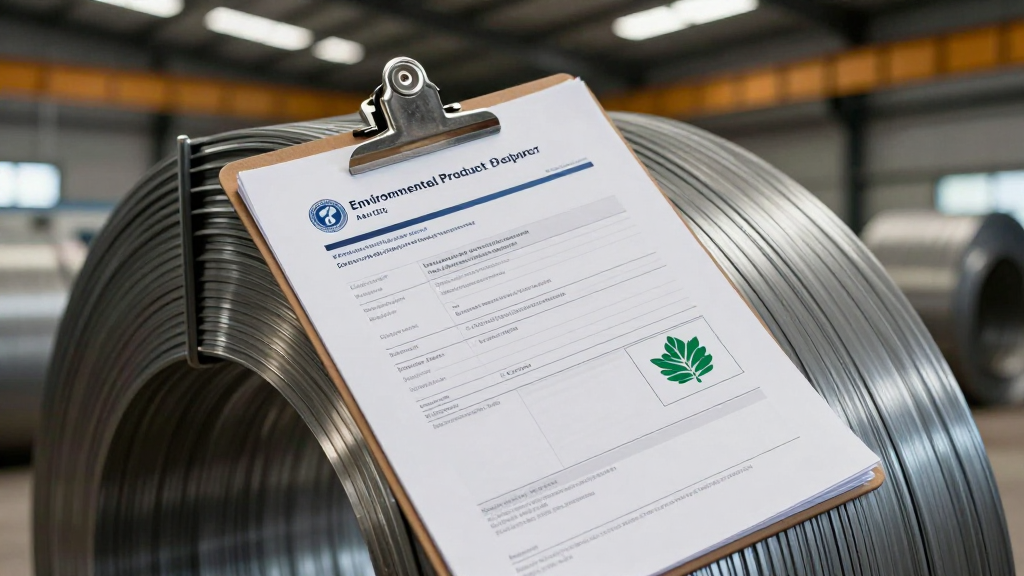
If you are a steel buyer in the European Union – or supplying into an EU project – you have probably been told two things that sound unrelated but are actually the same problem: “we need low-carbon steel” and “we need an EPD and CBAM data for this order.” They are the same problem because, since the EU Carbon Border Adjustment Mechanism (CBAM) moved into its definitive phase, every importer of steel into the EU has to report the embedded emissions of what they buy – and from the definitive period, surrender a CBAM certificate for those emissions. The steel you specify, and the route it was made by, now has a paperwork and a cost consequence that did not exist a few years ago.
In this guide we break down what low-carbon steel actually means for a buyer, how the electric arc furnace (EAF) route and recycled scrap content drive the embedded-emissions number, what CBAM and Scope 3 reporting require on paper, and – just as importantly – when a “green” premium is worth paying and when a standard BOF grade with a clean certificate is the smarter buy. We have supplied both routes from Yihang Metal to EU and OECD buyers, so the numbers below come from real RFQs and real EPD submissions, not a sustainability brochure.
What “Low-Carbon Steel” Actually Means for a Buyer
“Low-carbon steel” is an unfortunately ambiguous phrase – it can mean mild steel (low carbon content, the metallurgical sense) or low-carbon-emission steel (the climate sense). In this article, and in 2026 procurement, it means the second: steel with a lower embedded greenhouse-gas footprint per tonne. The embedded emissions of a tonne of steel are driven overwhelmingly by how it was made:
- BOF / BF-BOF (blast furnace – basic oxygen furnace): the traditional integrated route. Iron ore is reduced with coke in a blast furnace, then refined in a BOF. It is capital-intensive, runs at huge scale, and typically emits ~1.8-2.3 t CO₂e per tonne of crude steel, mostly from the coke/coal reduction of iron ore.
- EAF (electric arc furnace): steel is melted from scrap (or direct-reduced iron) using electricity in an electric arc furnace. Because it bypasses the blast furnace and coke, the direct process emissions are far lower – often ~0.3-0.7 t CO₂e per tonne depending on the scrap ratio and the grid electricity carbon intensity.
- Scrap content. Recycling scrap is, in emissions terms, almost free relative to reducing virgin ore. A high-scrap EAF charge is the single biggest lever on embedded emissions in conventional steelmaking today. The same nominal grade (e.g., S355) can carry very different footprints depending on whether it was made via EAF at 90% scrap or via BF-BOF.
- DRI / hydrogen routes. Direct-reduced iron using natural gas (and, increasingly, hydrogen pilots) lowers the ore-reduction emissions. These are real but still limited in commercial volume; most “low-carbon” steel a buyer can actually buy today is EAF + high scrap, not green-hydrogen DRI.
The practical upshot: when a buyer asks for “low-carbon steel,” what is actually being asked for is usually EAF-route material with a high recycled-scrap ratio and a documented embedded-emissions figure on an EPD. That is the product that satisfies CBAM reporting and Scope 3 accounting today.
Key mental model: in CBAM and Scope 3, what matters is not the brand of “green steel” – it is the verified embedded-emissions number (t CO₂e per tonne) and the route it was made by, on a recognized declaration. A standard EAF grade with a clean EPD often beats a “green” branded BOF product on the metric that actually gets reported.
CBAM and Scope 3: What the Paperwork Actually Requires
The EU CBAM covers steel (among other goods). For an importer, the operational requirements are concrete and they fall, in practice, on the data the supplier can provide:
- Embedded emissions reporting. Importers must report the direct embedded emissions of CBAM goods – in t CO₂e per tonne – on a quarterly basis during the transitional period, moving to certificate surrender in the definitive period. The default if you cannot get supplier data is a steep CBAM default value, which is deliberately punitive.
- Actual vs default values. If the supplier provides verified actual embedded emissions (via a CBAM-declaration or an EPD aligned to the relevant rules), the importer uses the lower actual figure. If not, the importer must use the much higher default. This is exactly where a supplier who can provide clean data saves the buyer money.
- Scope 3 (GHG Protocol). For corporate buyers reporting Scope 3 Category 1 (purchased goods), the steel’s embedded emissions per tonne is the input to the calculation. An Environmental Product Declaration (EPD) – per EN 15804, ideally with module A1-A3 (cradle-to-gate) – is the standard document a buyer uses to evidence the number.
- Documentation chain. What a buyer needs at order stage: mill name, production route (EAF vs BOF), scrap ratio if claimed, verified embedded emissions (t CO₂e/t), and either an EPD or a CBAM-specific declaration with the installation’s CBAM registration. For project work, third-party verification of the EPD is often required.
For a broader view of how the macro picture affects sourcing decisions – and how “green steel” is moving from pilot to procurement reality – our sustainable steel and green-steel trends guide is the companion read. And because CBAM compliance is ultimately a documentation exercise, the same discipline that makes EN 10204 3.1 vs 3.2 certification clean is what makes an EPD submission clean – get the certificate discipline right and the emissions paperwork follows naturally.
EAF, Scrap, and the Embedded-Emissions Number: How to Read a Declaration
When a supplier quotes “low-carbon steel,” the embedded-emissions number is the thing that matters. Here is how to read it:
- System boundary. Confirm the number covers A1-A3 (cradle-to-gate: raw materials + transport to mill + manufacturing). Some declarations quote only the mill gate (A3) and look artificially low. For CBAM and Scope 3, A1-A3 is the standard comparison basis.
- Route disclosure. The declaration should state EAF or BOF. If the route is not disclosed, treat the number with caution – route is the single largest determinant of footprint.
- Scrap ratio. A high-scrap EAF charge is the main driver of a low number. If a supplier claims a very low footprint without disclosing scrap content or route, ask for the basis.
- Grid electricity. For EAF, the carbon intensity of the grid (or a renewable PPA) at the producing mill matters. A mill on a low-carbon grid (or with a verified renewable contract) will report a lower number than the same process on a coal-heavy grid.
- Verification. An EPD should be third-party verified and registered with a program operator (e.g., EPD International, IBU, or an EU national program). A self-declared number is a starting point, not an endpoint, for CBAM.
- Actual vs default in CBAM. Even a modest actual embedded-emissions figure, properly documented, beats the CBAM default. The incentive is to get real data, even if the real number is not the lowest on the market.
The tariff and trade context matters here too: the steel tariffs and trade-wars guide covers how duties and trade policy affect landed cost; CBAM is now part of that same landed-cost calculation for EU-bound steel, on top of any conventional duty.
When the Low-Carbon Premium Is Worth It – and When It Is Not
Low-carbon / EAF-route steel with a clean EPD sometimes carries a premium over a standard BOF grade. Whether that premium is worth paying depends on where the steel is going:
- Steel destined for the EU. The CBAM certificate cost falls on the embedded emissions. A lower-emissions EAF grade with verified data can have a lower total landed cost (steel + CBAM certificate) than a cheaper-but-dirtier BOF grade once the default or actual emissions are priced in. In this case, the “premium” pays for itself at the border.
- Corporate Scope 3 targets. If the buying company has a public Scope 3 reduction commitment, EAF-route steel with an EPD is the documented lever to hit it. The premium is a sustainability-budget cost, not a steel-budget cost.
- Green-building and certified projects. LEED, BREEAM, and similar schemes reward documented low-embodied-carbon materials. An EPD-backed EAF grade earns points a standard grade cannot.
- Non-EU, non-certified destinations with no reporting obligation. If the steel is not going to the EU and the buyer has no Scope 3 or certification driver, paying a green premium for its own sake may not be justified – a standard grade with a clean EN 10204 MTC is the right call, and the emissions paperwork is not required.
Practical tip from the trade desk: do not treat “low-carbon” as a binary label. The decision is whether the verified embedded-emissions figure and the route documentation earn their premium in your specific destination and reporting context. For EU-bound or Scope-3-reporting buyers, they usually do; for a non-reporting destination, they usually do not.
What to Lock in Your RFQ: Route, Emissions, EPD, and Documentation
The most common reason a low-carbon-steel order disappoints is not the steel – it is a vague RFQ that leaves the emissions claim undocumented. To get what you actually need, specify all of the following:
- Route: “EAF-route, high-scrap” or “BOF with verified emissions” – state which. Do not accept “low-carbon steel” alone.
- Embedded emissions figure: request the verified t CO₂e per tonne on an A1-A3 basis, with the system boundary stated.
- EPD requirement: “Third-party-verified EPD per EN 15804, A1-A3, registered with a recognized program operator.” For CBAM, request the CBAM-specific declaration with the installation’s registration.
- Grade and standard: the metallurgical spec does not change – S355, A36, 304, etc. per EN / ASTM / JIS as usual. The route and emissions are additional spec dimensions, not a substitute for the grade.
- Standard and MTC: EN 10204 3.1 as standard, with chemistry and mechanicals confirmed; 3.2 witnessed certification for project-critical work. The EPD sits alongside the MTC, not in place of it.
- Traceability: heat/lot traceability linking the coil or plate to the declared emissions batch – CBAM reporting is per-shipment, so the data has to trace to the cargo.
- Destination and reporting context: tell the supplier whether the steel is EU-bound (CBAM applies) or for a Scope-3-reporting buyer, so the documentation is matched to what the importer actually needs to file.
If you are new to the broader import mechanics – documents, Incoterms, inspection – the how to import steel from China guide covers the baseline, and the how to choose a reliable steel supplier guide covers the supplier-vetting that matters even more when emissions claims and EPDs are on the line.
How Yihang Metal Supplies Low-Carbon / EAF-Route Steel With EPD Documentation
We source both EAF-route and BOF-route material so you can choose on the basis of destination and reporting context, not on which product a single-route mill wants to push. Here is what a Yihang Metal low-carbon-steel quotation includes as standard:
- EAF-route steel with high recycled-scrap content in the grades you already specify – carbon plate (S355, A36, A572), HRC, stainless (304/316L), galvanized and PPGI coil – with the production route confirmed on the quote.
- Verified embedded-emissions figure (t CO₂e per tonne, A1-A3) and, for EU-bound and Scope-3-reporting buyers, a third-party-verified EPD per EN 15804 plus a CBAM-aligned declaration with the installation’s registration.
- EN 10204 3.1 MTC with chemistry and mechanicals, and 3.2 third-party witnessed certificates for project-critical work – the EPD sits alongside the metallurgical certificate, not in place of it.
- Heat/lot traceability linking each coil, plate, or shipment to the declared emissions batch, so CBAM reporting maps cleanly to the cargo.
- Both routes available so EU-bound / Scope-3-reporting buyers can step up to EAF + EPD, while non-reporting destinations can take a standard BOF grade with a clean MTC and no unneeded premium.
- Export packing and documentation matched to the destination’s reporting regime – sea-worthy packing, certificate set, and emissions paperwork packaged for the importer’s filing.
Because we ship both routes side by side, we can also give you an honest cost-and-emissions comparison at the exact grade and destination your project needs – so the low-carbon decision is driven by where the steel is going and what you have to report, not by a marketing label.
Not sure whether EAF-route low-carbon steel with an EPD is right for your order? Tell us the grade, the destination (EU-bound or not), and whether you have a CBAM or Scope 3 reporting obligation. The team at Yihang Metal will recommend the route and documentation package that gives you the lowest total landed cost – including the CBAM consequence – and back it with a verified EPD and full EN 10204 certification. Send us your specifications today for a quoted price within 24 hours.