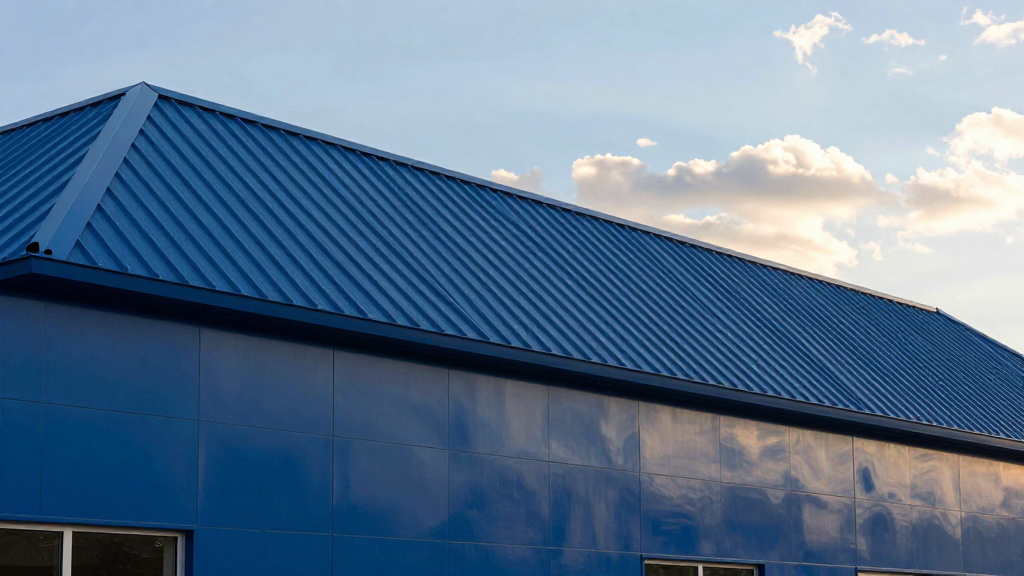
If you are sourcing pre-painted steel coil for a roofing, facade, or architectural project that is supposed to look good in 20 years, not 5, you will be offered a menu of paint systems that all carry the same “premium” label – and one of them, PVDF (polyvinylidene fluoride), often sold under the Kynar 500 / Hylar 5000 brand umbrella, is the one that actually justifies its price. The catch is that “PVDF” on a quotation can mean very different things: a true 70% PVDF fluoropolymer topcoat that lasts 30+ years, or a thin 30% PVDF blend that is barely better than a polyester. Buying the wrong one is the most common reason architectural coil-coating projects fail their warranty or fade prematurely.
In this guide we break down what PVDF actually is, how a true Kynar 500 / 70% PVDF coil coating compares to SMP and PE polyester systems on weathering, color retention, and cost, and – just as importantly – when the cheaper paint system is still the right call. We have supplied PVDF-coated coil from Yihang Metal to roofing distributors and facade contractors across the Middle East, Africa, and Southeast Asia, so the numbers below come from real project RFQs and real exposure feedback.
What PVDF / Kynar 500 Coil Coating Actually Is
PVDF is a fluoropolymer resin – the same polymer family that gives non-stick and high-purity pipework their performance. In coil coating, it is formulated into a topcoat paint with exceptional resistance to UV, chalking, and chemical attack. The key things to know:
- Kynar 500 and Hylar 5000 are licensed resin trademarks. A coating only carries the “Kynar 500” license seal when the coating manufacturer has formulated the topcoat with a minimum 70% PVDF resin in the binder. This 70% threshold is the line that separates true architectural PVDF from lower-tier blends.
- “70% PVDF” vs “30% PVDF”. A 70% PVDF topcoat (the architectural grade) uses PVDF as the majority binder. A 30% PVDF blend cuts the fluoropolymer with acrylic and behaves closer to a high-end polyester – better than PE, but nowhere near true PVDF weathering. Some quotations list “PVDF” without the percentage; that is the warning sign.
- Structure. A PVDF coil-coated panel is typically a three-coat system on a metallic substrate: primer (epoxy or polyester), a PVDF topcoat (15-25 µm), and sometimes a clear PVDF clearcoat for metallic finishes. The substrate is usually hot-dip galvanized (GI) or Galvalume (AZ) per EN 10346 / ASTM A653 / A792.
- Standards. Architectural PVDF coil coating is specified against AAMA 2605 (the top-tier architectural specification for high-performance organic coatings on architectural extrusions and panels), EN 10169 (continuously organic-coated steel), and the license terms of the Kynar 500 / Hylar 5000 program. AAMA 2605 requires a Florida 10-year and 20-year weathering performance, among other tests.
For most architectural roofing and facade work buyers encounter, “PVDF” should mean a 70% PVDF / Kynar 500-class topcoat meeting AAMA 2605. We use “PVDF” in that sense through the rest of this article, and we will call out explicitly when a 30% blend is the topic.
Key mental model: the resin chemistry is the ceiling on coating life. A polyester, no matter how well applied, chalks and fades because the resin itself breaks down under UV. PVDF’s carbon-fluorine bonds are so stable that UV, heat, and humidity barely touch them – which is why a 70% PVDF coating can hold color and gloss for decades where a polyester is gone in five to ten years.
PVDF vs SMP vs PE: Weathering, Color, and Cost Compared
Here is the side-by-side at the properties an architectural or roofing buyer actually specifies against. PE (polyester) and SMP (silicone-modified polyester) are the two coatings below PVDF in the coil-coating hierarchy.
| Property | PE (Polyester) | SMP (Silicone-Modified Polyester) | PVDF (70% / Kynar 500) |
|---|---|---|---|
| Resin type | Polyester | Polyester modified with silicone (~30-50%) | 70% PVDF fluoropolymer + acrylic |
| Typical architectural spec | AAMA 2604 (lower) | Between AAMA 2604 and 2605 | AAMA 2605 (top tier) |
| Florida weathering (color & gloss retention) | ~5-7 years to visible fade/chalk | ~10-15 years | 20-30+ years |
| UV / chalk resistance | Fair – chalks in sun | Good | Excellent – fluoropolymer resists UV |
| Chemical / stain resistance | Low | Medium | High – resists acids, alkalis, salt |
| Formability / bend | Excellent (flexible resin) | Good | Fair – harder, can micro-crack on tight bends; needs care at roll-former |
| Gloss range | Wide (low to high gloss) | Wide | Typically lower gloss; metallic finishes need clearcoat |
| Typical cost (relative) | Lowest | Medium | Highest |
| Best-fit application | Indoor, appliances, short-life panels | Mid-tier roofing, industrial buildings | Premium roofing, facades, airports, stadiums, coastal |
Weathering and Color Retention: Why PVDF Earns Its Premium in the Sun
The reason PVDF costs more is that it actually lasts longer outdoors – and the gap widens precisely in the harsh environments where roofing and facade failures happen. South-facing, high-UV, coastal, or desert climates are where a polyester coating chalks and fades within a few years and a 70% PVDF coating still looks new.
- UV and chalking. Polyester resins photodegrade under UV; the surface chalks (a powdery oxide layer) and the color drifts. PVDF’s C-F bonds are essentially UV-stable, so chalking is minimal even after 20+ years of Florida-equivalent exposure. This is the single biggest reason PVDF is specified for prestige and long-life architecture.
- Color retention (ΔE). AAMA 2605 limits color change (ΔE) after a defined Florida exposure. A dark blue or deep red polyester roof will visibly fade in 5-8 years; the same color in 70% PVDF holds its depth for decades. For brand-critical corporate facades and signature buildings, this is the whole point.
- Gloss retention. Same story – PVDF holds gloss where polyester goes chalky and flat.
- Coastal and chemical resistance. PVDF resists salt spray, acid rain, and airborne chemicals better than polyester. For coastal roofing, urban facades, or industrial zones, that translates directly to longer repaint-free service life.
- The warranty tells the story. PE coil typically carries a 5-10 year coating warranty; SMP 10-15 years; a true 70% PVDF / AAMA 2605 system carries 20-30 year warranties from the coating manufacturer. Read the warranty for what it actually covers – film integrity, color change limits, chalk limits – not just the year count. Our PPGI warranty claims buyer checklist walks through what to confirm before accepting a long warranty promise.
When PVDF Is the Right Call – and When PE or SMP Is Smarter
PVDF is the premium choice, but over-specifying it wastes money. Choose 70% PVDF / Kynar 500 (AAMA 2605) when:
- The building is long-life and the appearance is brand-critical – airports, stadiums, corporate HQs, signature facades.
- The site is high-UV, coastal, or polluted – desert, tropical, marine, or industrial zones where a polyester would fade or chalk quickly.
- The coating warranty target is 20+ years and the end-client or spec demands AAMA 2605.
- Darker, saturated colors (deep blues, reds, greens) that show fade most aggressively.
- Metallic finishes (mica, metallic flake) that require a PVDF clearcoat to hold their effect.
Choose SMP when the project is mid-tier – industrial roofing, warehouses, agricultural buildings – where 10-15 year performance is acceptable and the color is forgiving. Choose PE for indoor panels, appliance backs, temporary structures, or short-life applications where the lowest cost matters most.
For the broader question of which paint system fits which job – and how PE, SMP, HDP, and PVDF stack up across the full PPGI range – our PE / SMP / HDP / PVDF paint-system guide is the companion read. And if the project is coastal, the PPGI vs PPGL for coastal projects guide covers how the substrate (GI vs Galvalume/Aluzinc) interacts with the coating choice in salt environments – PVDF over a Galvalume substrate is a common premium coastal combination.
Color, Gloss, and the “PVDF” Trap: Reading the Spec Without Getting Burned
The most expensive misunderstanding in PVDF buying is assuming the word “PVDF” on a quote means 70% PVDF. It does not always. To buy correctly:
- Demand the percentage. “PVDF” alone is meaningless. Specify “70% PVDF topcoat, Kynar 500 / Hylar 5000 licensed, AAMA 2605.” If the supplier cannot confirm the resin percentage or the license, you are likely being quoted a 30% blend or a generic fluoropolymer.
- Demand the coating manufacturer and license number. Kynar 500 and Hylar 5000 are licensed programs – the coil coater is audited and the coating carries a license. A true architectural PVDF coating is traceable to a licensed coater, not just “PVDF paint.”
- Specify the standard. AAMA 2605 (architectural, top tier) vs AAMA 2604 (high-performance, mid tier). PVDF meets 2605; many polyesters meet 2604. The standard is a cleaner discriminator than the marketing term.
- Confirm the system, not just the topcoat. Primer type and thickness, topcoat thickness (typically 15-25 µm for architectural PVDF), backer coat, and substrate (GI vs AZ, coating weight). A great topcoat on a thin-galvanizing substrate will still rust at the edges. The RAL white selection guide shows how the same logic applies to color choice – the coating system matters as much as the shade.
- Color matching and batch consistency. PVDF metallic and custom colors need a color-match approval and a batch-acceptance tolerance (ΔE). For large facades, request a master color chip and approve production samples before the full coil runs.
Practical tip from the project desk: for a facade or roof that has to hold color for 20+ years, the cost difference between a 30% PVDF blend and a true 70% Kynar 500 system is small compared to the cost of re-coating or re-paneling a faded building. The saving from downgrading is not worth the risk on a prestige project – but it is genuinely worth taking on a short-life warehouse. Match the coating to the building’s real service life.
What to Lock in Your RFQ: Resin, Standard, System, and Substrate
The most common reason a PVDF coil order disappoints is not the resin – it is a vague RFQ. To get what you actually need, specify all of the following:
- Resin and license: “70% PVDF topcoat, Kynar 500 / Hylar 5000 licensed, AAMA 2605.” Not “PVDF coil” alone.
- Coating system and thickness: primer (type + µm), topcoat (µm), backer; e.g., 5 µm epoxy primer + 20 µm PVDF topcoat + 8 µm backer per EN 10169.
- Substrate and coating weight: GI (Z275) or Galvalume (AZ150) per EN 10346 / ASTM A653 / A792. For coastal, AZ150 minimum; for premium facades, AZ150 + PVDF is the standard combination.
- Color and finish: RAL / custom color, gloss level, solid vs metallic (metallic needs clearcoat and a ΔE approval).
- Standard and MTC: EN 10204 3.1 as standard, with coating-thickness and adhesion test results on the certificate. For project work, 3.2 witnessed certification is available.
- Coil dimensions: thickness (with tolerance), width, coil ID (508 mm export standard), max coil weight, and flatness class for roll-forming.
- Warranty: state the warranty class and term you need (e.g., 20-year film integrity + color ΔE limit), and require the licensed coater’s warranty document, not just the mill’s.
How Yihang Metal Supplies PVDF / Kynar 500 Coil-Coated Steel
We stock and source the full coil-coating hierarchy – PE, SMP, and 70% PVDF / Kynar 500 – so you can compare them like-for-like in one RFQ rather than chasing three coaters. Here is what a Yihang Metal PVDF coil quotation includes as standard:
- 70% PVDF / Kynar 500-licensed topcoat meeting AAMA 2605 / EN 10169, on GI or Galvalume substrate, with the coating manufacturer and license confirmed on the quote.
- Full coating system – primer + PVDF topcoat (15-25 µm) + backer – with thickness confirmed on the EN 10204 3.1 MTC, plus adhesion (T-bend, cross-hatch) and reverse-impact test results.
- Substrate options – GI Z80-Z275, Galvalume AZ100-AZ185 – per EN 10346 / ASTM A653 / A792, matched to the environment (AZ150 minimum for coastal).
- Color matching – RAL standards, custom colors, and metallic finishes with clearcoat, with master-chip approval and batch ΔE control.
- Coil and cut-to-length in custom widths, 508/610 mm coil IDs, with flatness controlled for standing-seam and roll-form lines.
- Licensed-coater warranty documentation alongside the MTC, and 3.2 third-party witnessed certificates for project-critical work.
- Export packing – sea-worthy, color-protective, edge-protected – suitable for long ocean transit and outdoor yard storage.
Because we ship PE, SMP, and PVDF side by side, we can also give you an honest cost-and-performance comparison at the exact color, substrate, and coating weight your project needs – so the decision is driven by the building’s real service life and environment, not by which paint system a single-line coater wants to push.
Not sure whether 70% PVDF / Kynar 500, SMP, or PE is right for your roofing or facade project? Tell us the building type, the site (UV level, distance from coast, pollution), the design life, the color, and the substrate you have in mind. The team at Yihang Metal will recommend the coating system and warranty class that gives you the lowest cost per year of appearance – and back it with full EN 10204 documentation and a licensed-coater warranty. Send us your specifications today for a quoted price within 24 hours.