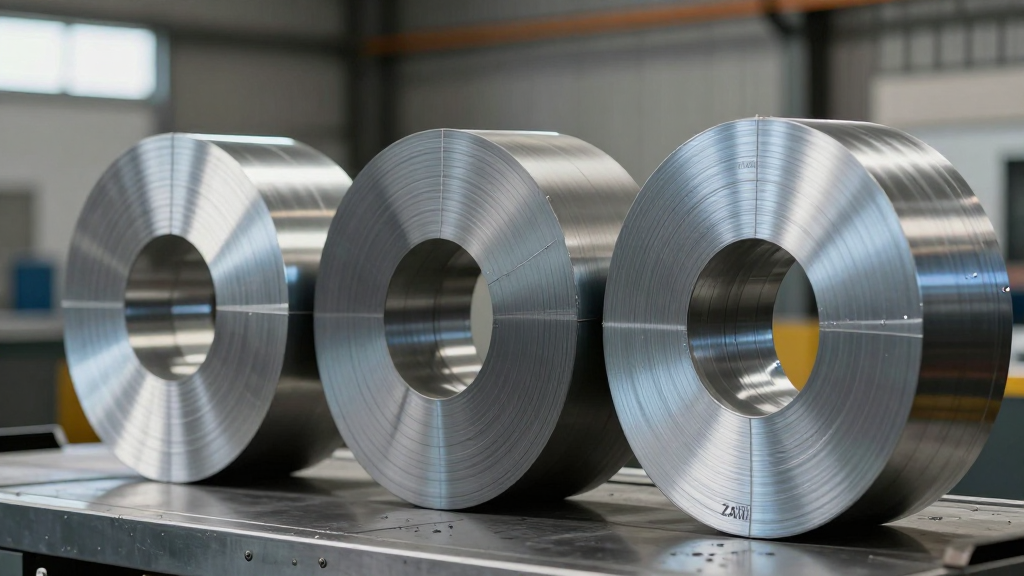
If you are specifying coated steel for an outdoor, coastal, or agricultural project in 2026, you have probably been offered three options that sound almost identical: hot-dip galvanized (GI), Galvalume (AZ), and the newer zinc aluminum magnesium steel — often branded as ZAM, Magnelis, or PosMAC. They all look silver, they all protect carbon steel from rust, and they all carry a coating-weight number. But they do not perform the same, and choosing the wrong one is the single most common reason coated-steel projects fail early.
In this guide we break down what each coating actually is, how they compare on corrosion, formability, and cost, and — just as importantly — when the cheaper option is still the right call. We have supplied all three from Yihang Metal to buyers across the Middle East, Southeast Asia, and Latin America, so the numbers below come from real RFQs and real feedback, not a brochure.
What Zinc-Aluminum-Magnesium (ZAM) Coating Actually Is
Zinc-aluminum-magnesium (ZAM) is a hot-dip metallic coating applied to carbon steel strip in a continuous line, the same way GI and Galvalume are made. The difference is the bath chemistry. Instead of pure zinc, the molten bath contains three alloying elements that work together:
- Zinc (balance) — provides the sacrificial (galvanic) protection that keeps bare steel from rusting.
- Aluminum (either ~11% or ~55%) — forms a dense, stable oxide barrier that slows the reaction between the zinc and the atmosphere.
- Magnesium (1–3%) — the key addition. Magnesium changes the corrosion-product chemistry so that the layer forming on the surface (and on cut edges) is denser, more adherent, and self-repairing.
There are two main ZAM families on the market, and it helps to know which one a mill is offering:
- Low-Al Zn-Al-Mg (≈1–11% Al, 1–3% Mg, balance Zn) — e.g., Magnelis (3.5% Al / 3% Mg), PosMAC (3% Mg / 6% Al), Nisshin ZAM (6% Al / 3% Mg). Covered in Europe under EN 10346 (ZM designation) and in the US under ASTM A1046.
- High-Al Zn-Al-Mg (≈55% Al, with 1–2% Mg, balance Zn) — essentially a Magnesium-modified Galvalume. Often sold against ASTM A792 (AZM). Higher heat reflectivity, excellent atmospheric corrosion resistance.
For most structural and outdoor applications buyers encounter, the low-Al family (EN 10346 ZM, ASTM A1046) is what is being quoted when someone says “ZAM.” We will use “ZAM” in that sense through the rest of this article.
The reason ZAM outperforms plain zinc is not that it is thicker — it is that the magnesium makes the corrosion product seal the surface instead of flaking off. More on this in the cut-edge section.
ZAM vs GI (Hot-Dip Galvanized) vs Galvalume (AZ): Composition, Structure, and Self-Healing
Here is the side-by-side. All three are applied by the same continuous hot-dip process; only the bath differs.
| Property | GI (Hot-Dip Galvanized) | Galvalume (AZ) | ZAM (Zn-Al-Mg) |
|---|---|---|---|
| Bath composition | ≥99% Zn | 55% Al / 43.5% Zn / 1.5% Si | 1–11% Al, 1–3% Mg, balance Zn (low-Al family) |
| Typical standard | EN 10346 (Z), ASTM A653 | EN 10346 (AZ), ASTM A792 | EN 10346 (ZM), ASTM A1046 / A792 AZM |
| Coating structure | Layered Zn-Fe intermetallic + pure Zn | Dendritic Al-rich + Zn-rich phases on Si barrier | Fine eutectic Zn-Al-Mg phases, very compact |
| Self-healing of cut edges | Limited — zinc sacrifices but does not re-cover | Weak — aluminum is less sacrificial, edges can stay bare | Strong — Mg-rich corrosion products flow over cut edges |
| Hardness of coating | Soft (~60–80 HV) | Medium | Hard (~100–140 HV), resists abrasion in transit |
The structural difference matters at the fabrication stage. GI’s soft zinc layer smears and flakes under forming pressure. Galvalume is harder but its aluminum-rich phases are less galvanically active, so a scratch or a cut edge exposes bare steel that the coating will not aggressively protect. ZAM sits in a sweet spot: hard enough to survive roll-forming and transit, active enough to keep protecting where the steel has been cut.
Corrosion Resistance Compared: Salt Spray, Coastal Exposure, and Soil Contact
Lab numbers first. Neutral salt-spray testing (ASTM B117) is not a perfect predictor of real life, but it is the most widely published benchmark and it does rank the three coatings in the correct order. Typical ranges for comparable coating weights:
| Coating | Designation | Approx. coating weight (g/m², both sides) | Salt spray to first red rust (ASTM B117) |
|---|---|---|---|
| GI (pure zinc) | Z275 | 275 | 300–500 hours |
| Galvalume (55% Al-Zn) | AZ150 | 150 | 1,000–1,500 hours |
| ZAM (Zn-Al-Mg) | ZM275 | 275 | 2,000–3,000+ hours |
Note the coating weights are not identical — that is deliberate. Because Galvalume’s alloy has a lower density (~3.0 g/cm³ versus zinc’s 7.1 g/cm³), an AZ150 coating delivers roughly the same physical film thickness per side as a Z275 zinc coating. So the table above is a fair performance comparison at comparable film thickness, not comparable mass.
In real-world atmospheric exposure the gap narrows but the ranking holds. Long-term marine test sites (C5-M atmosphere, 50–200 m from the coastline) consistently show ZAM coatings reaching 3–10× the service life of equivalent-mass pure zinc. In rural and urban atmospheres (C2–C3) the multiplier is smaller — often 2–4× — because GI already performs adequately there.
Where ZAM pulls clearly ahead of both GI and Galvalume is in three environments that are brutal on coated steel:
- Coastal / salt-laden air (C5-M) — chloride attack. GI consumes zinc rapidly; ZAM’s Mg-stabilized layer resists chloride penetration.
- Soil contact and concrete embedment — GI is vulnerable to sulfate-reducing bacteria and alkaline attack in concrete; ZAM shows markedly better performance in buried and embedded conditions, which is why it has displaced GI in many ground-screw and cable-tray installations.
- Livestock and poultry housing — ammonia + humidity + manure gases create an aggressively corrosive micro-climate. This is one of the strongest use cases for ZAM.
Cut-Edge Protection: Why ZAM Heals Where GI and AZ Leave Bare Steel
This is the single most important mechanical difference, and it is the one most buyers overlook until they see rust creeping in from a cut edge three years into a 20-year project.
When you cut galvanized or Galvalume coil — by shearing, slitting, or punching — you expose bare carbon steel at the cut. With GI, the adjacent zinc continues to sacrifice itself galvanically to protect that edge, which is good, but the zinc does not migrate across the cut to re-cover it; the edge stays metallurgically bare and slowly consumes the nearby coating. With Galvalume, the aluminum-rich coating is less sacrificial, so cut edges are protected more weakly and can show red rust earlier than the flat surface would suggest.
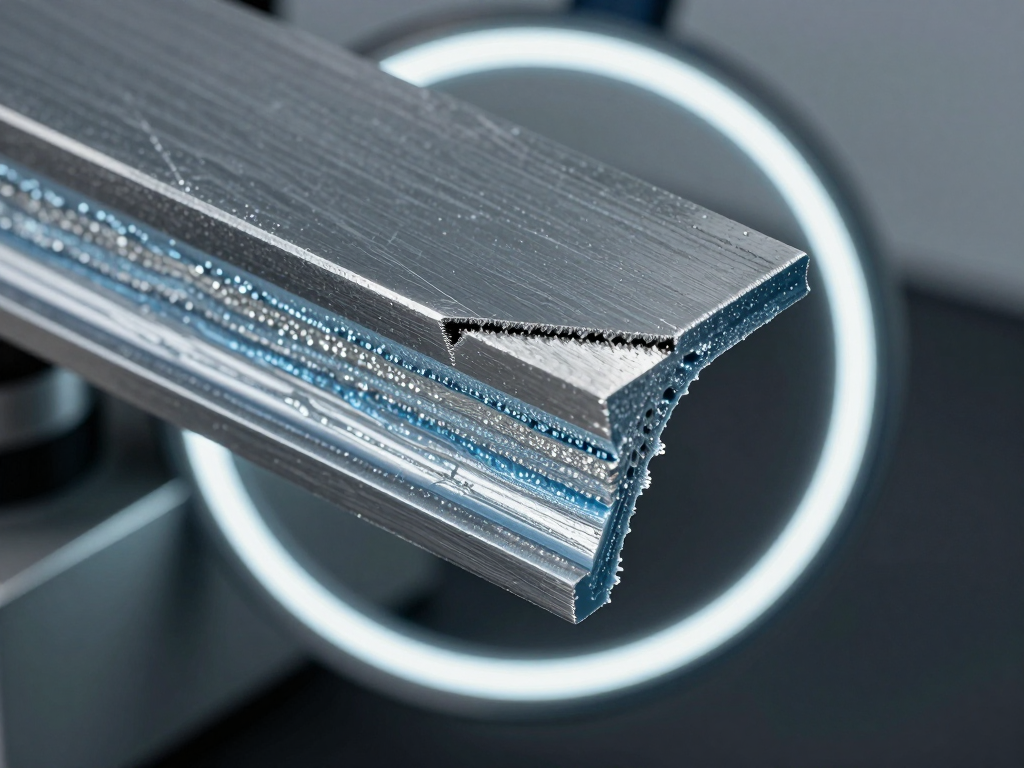
ZAM behaves differently. The magnesium promotes the formation of layered double-hydroxide corrosion products (such as simonkolleite) that are dense, adherent, and — critically — mobile enough to spread a few millimeters over a freshly cut edge. Under humidity, that white deposit seals the cut, isolating the bare steel. This is why ZAM parts can be shipped, cut, drilled, and roll-formed without a post-galvanizing or zinc-rich paint touch-up step on the cut edges.
Rule of thumb we give buyers: if your design has more than ~5% of the surface area as cut edges, holes, or punched slots — and most roll-formed profiles do — zinc aluminum magnesium steel’s edge-protection advantage becomes the dominant factor in service life, not the flat-surface salt-spray number.
Formability, Welding, and Paintability — What Changes at the Press Brake and Roll-Former
A coating that protects well but cracks on the press brake is useless. Here is what actually changes in fabrication:
Forming
ZAM’s coating is harder and more compact than GI’s soft zinc, so it does not smear, flake, or build up on forming rolls the way GI can. This means cleaner roll-formed profiles (solar C-rails, Z-purlins) and less die maintenance. Minimum bend radii are similar to GI for the same substrate; the coating does not impose a tighter limit. Galvalume is also formable but can show micro-cracking of the aluminum-rich phase on tight bends, after which edge corrosion becomes a concern.
Welding
- Spot welding: All three are spot-weldable. ZAM’s harder coating tends to give more consistent contact resistance than GI, which can actually improve tip life. Expect to adjust weld current slightly upward versus GI.
- MIG/MAG and seam welding: Remove the coating in the weld zone for structural welds, same as with GI. ZAM produces a more stable arc and less spatter than GI thanks to the lower zinc vapor pressure at the weld pool.
- Avoid over-specifying a heavy coating if you will weld a lot — ZM120 welds more cleanly than ZM275.
Paintability
ZAM takes paint and powder coating well without a primer, though we still recommend a primer for premium pre-painted systems. If your end product is pre-painted (PPGI / PPGL), the coating under the paint matters less for corrosion and more for adhesion — Galvalume (AZ) remains the industry-standard substrate for pre-painted building panels, and that is a case where ZAM is often unnecessary.
Coating Weight Notation: ZM120 / ZM180 / ZM275 vs Z275 vs AZ150 — Apples-to-Apples
The notation is the source of endless RFQ confusion because the three coatings use the same “g/m² both sides” convention but perform differently per gram. Here is how to read them:
| Notation | Coating | Mass (g/m², total both sides) | ~Film thickness per side | Typical use |
|---|---|---|---|---|
| Z80 / Z120 / Z180 / Z275 / Z350 | Pure zinc (GI) | 80 / 120 / 180 / 275 / 350 | 5.5 / 8.5 / 13 / 19 / 24 µm | General indoor and mild outdoor |
| AZ100 / AZ150 / AZ185 | 55% Al-Zn (Galvalume) | 100 / 150 / 185 | ~17 / 25 / 31 µm (lower density) | Roofing, pre-painted panels, C3–C4 |
| ZM90 / ZM120 / ZM180 / ZM275 / ZM350 | Zn-Al-Mg (ZAM) | 90 / 120 / 180 / 275 / 350 | 6 / 8.5 / 13 / 19 / 24 µm | C4–C5, marine, agricultural, soil contact |
The key insight: because ZAM performs better per gram, you can often down-gauge the coating weight. A common substitution that works in practice is ZM180 replacing Z275 GI, or ZM275 replacing AZ185 Galvalume, in corrosive environments — at lower or equal coating mass. That is the basis of the cost argument in the next section.
Cost-per-Square-Meter vs Cost-per-Year-of-Service — the Right Way to Compare
On a per-ton basis, ZAM coil carries a premium. As of recent quotations, expect roughly:
- GI Z275 — base price (the reference)
- Galvalume AZ150 — +3% to +8% over GI
- ZAM ZM275 — +8% to +18% over GI
But comparing per-ton price is the wrong frame. The correct question is cost per year of service in your actual environment. Two adjustments change the math dramatically:
- Down-gauging. If ZM180 lasts as long as Z275 in your environment, the coating cost difference largely disappears because you are buying less coating metal.
- Service-life multiplier. In a C4–C5 environment where GI gives ~10–15 years and ZAM gives ~30–40 years, the cost-per-year of ZAM is roughly half of GI even at a 15% per-ton premium — before you count the avoided cost of replacement labor and downtime.
| Scenario (C4 marine-industrial, 25-yr design life) | GI Z275 | Galvalume AZ150 | ZAM ZM275 |
|---|---|---|---|
| Relative material cost (per m²) | 100 (baseline) | 105 | 113 |
| Expected service life (yrs, this environment) | 10–15 | 20–25 | 30–40 |
| Replacements needed in 25 yrs | 1–2 | 0–1 | 0 |
| Cost per year of service (indexed) | 7–10 | 4–5 | ~3 |
The numbers above are indicative — actual lives depend on geometry, orientation, and micro-climate — but the direction is consistent across every test program we have seen.
Best-Fit Applications: Where Zinc Aluminum Magnesium Steel Earns Its Premium
Based on the projects we ship, zinc aluminum magnesium steel is the clear choice for:
- Solar mounting structures — C-profiles and rails driven into ground screws, exposed for 25+ years. ZAM is now the de-facto standard for utility-scale solar frames in corrosive soils.
- Livestock and poultry barns — ammonia, humidity, and manure gases destroy GI within a decade. ZAM’s edge protection and chloride resistance extend structure life substantially.
- Cable trays — especially in coastal substations and tunnels where cut edges and punched holes are everywhere.
- Highway guardrails and noise barriers — long service life, hard to repaint, exposed to de-icing salt.
- Marine hardware and port furniture — bollards, ladder stiles, grating supports in the splash zone.
- Greenhouse and tunnel structures — humid, chemically active environments with frequent condensation.
Where GI or Galvalume Is Still the Smarter Buy (Don’t Over-Spec)
ZAM is not always the answer, and over-specifying wastes money. GI or Galvalume is the better call when:
- The environment is dry or indoor (C1–C2). Indoor cable trays, ductwork, appliance internals — GI Z120 or Z180 is plenty, and ZAM adds cost for no service-life gain.
- The steel will be pre-painted. If the coating is fully sealed under paint, Galvalume (AZ) is the proven substrate for pre-painted building panels and PPGI/PPGL coil. The under-paint corrosion environment is mild.
- Service life is short or the part is disposable. Temporary shoring, formwork, short-life packaging — buy the cheapest adequate coating.
- Your fabricator is not set up for ZAM. Some shops have older tooling tuned for GI’s softer coating. Test before switching an entire production line.
- Budget is the overriding constraint and the structure is genuinely protected from the weather.
A quick filter we use with buyers: if the answer to “will this see salt, soil, ammonia, or 20+ years outdoors?” is yes, go ZAM. If the answer is no, GI or Galvalume will serve you just as well for less.
What to Lock in Your RFQ: Coating Weight, Surface Treatment, Flatness, Coil ID
The most common reason a ZAM shipment disappoints is not the alloy — it is a vague RFQ. To get what you actually need, specify all of the following:
- Coating designation and mass: e.g., ZM180 per EN 10346, or ASTM A1046 ZM180. State both sides total. Do not accept “ZAM coil” alone — the weight matters.
- Surface treatment: AFP (anti-fingerprint) passivation is standard for ZAM and recommended for any part that will be handled or visible. Specify passivation type (Cr-free is now the default for ROHS/REACH compliance) and whether oiling is required.
- Base metal grade: e.g., DX51D (commercial quality), S350GD / S390GD / S430GD (structural) per EN 10346. The substrate yield strength, not the coating, determines load capacity.
- Flatness tolerance: critical for roll-forming and laser cutting. Quote EN 10131 (cold-reduced) or the flatness class in EN 10346. Specify special flatness (e.g., 3 mm/m) if you are running high-speed roll-form lines.
- Coil dimensions: thickness (with tolerance), width, coil ID (508 mm is the export standard; 610 mm for some lines), and max coil weight.
- Standard and MTC requirement: EN 10204 3.1 or 3.2. For ZAM, confirm the coating-mass test method (ASTM A90 / ISO 7148) is on the certificate.
- Spangle / surface appearance: ZAM has a fine, uniform surface (no spangle). If appearance matters, request a surface-class designation.
How Yihang Metal Supplies ZAM, GI, and Galvalume Coils With Full EN 10204 Documentation
We stock and source all three coating families so you can compare apples-to-apples in one RFQ rather than chasing three suppliers. Here is what a Yihang Metal coated-steel quotation includes as standard:
- Coil or sheet in your specified designation — ZM90–ZM350 (ZAM), Z80–Z350 (GI), AZ100–AZ185 (Galvalume) — per EN 10346, ASTM A653 / A792 / A1046.
- EN 10204 3.1 MTC with substrate chemistry, mechanical properties, and coating-mass test results. 3.2 third-party witnessed certificates available on request for project-critical work.
- Surface treatment options — AFP anti-fingerprint, Cr-free passivation, light oiling, or dry — matched to your downstream process.
- Custom widths and coil IDs, slit-to-width and cut-to-length, with flatness controlled for roll-forming and laser-cutting lines.
- Export packing — sea-worthy, VCI-paper-lined, steel-strap and edge-protected — suitable for long ocean transit and outdoor yard storage.
Because we ship GI, Galvalume, and ZAM side by side, we can also give you a like-for-like cost comparison at the coating weight your application actually needs — so the decision is driven by performance and total cost of ownership, not by which product a single-product mill wants to push.
Not sure whether ZAM, GI, or Galvalume is right for your project? Tell us the application, the environment (atmosphere class, distance from coast, soil contact), the design life, and the forming process. The team at Yihang Metal will recommend the coating family and weight that gives you the lowest cost per year of service — and back it with full EN 10204 documentation. Send us your specifications today for a quoted price within 24 hours.