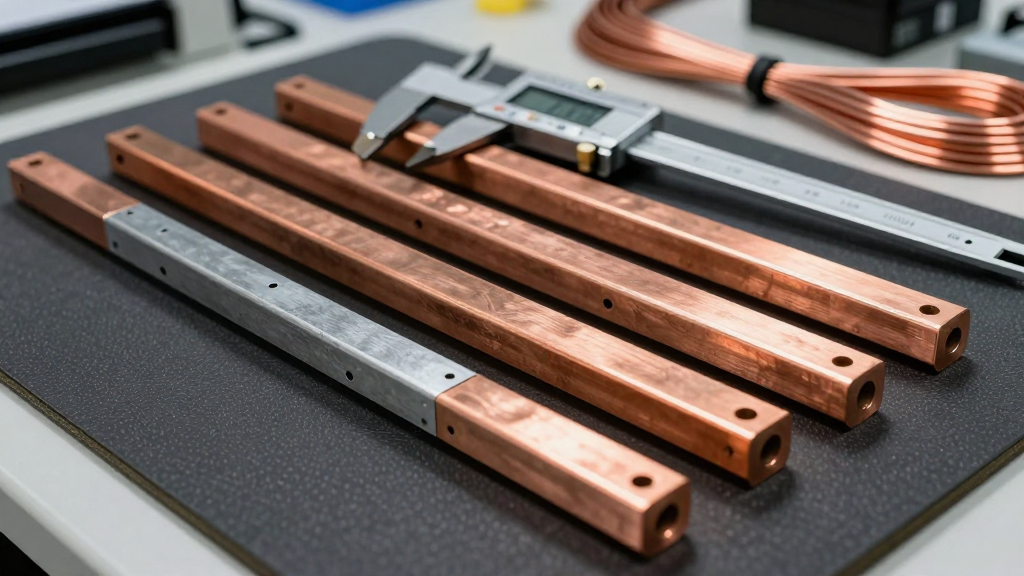
If you are sourcing copper busbar for a switchgear, distribution board, transformer, or battery energy-storage system (BESS), you are choosing between three copper grades that look almost identical on the shelf but behave differently the moment current, heat, and time are applied: C11000 electrolytic tough pitch (ETP), C10200 oxygen-free (OFC/OFHC), and C12200 phosphorus-deoxidized (DHP). Pick the wrong one and you get either a busbar that embrittles in a hydrogen-rich transformer environment, one that costs 30-40% more than the job needs, or one that cannot be brazed without leaking. The grade choice is the single biggest cost and reliability lever in a busbar RFQ, and it is the one buyers most often leave blank.
This guide breaks down C11000 vs C10200 vs C12200 for electrical busbar: composition, conductivity (IACS%), temper, formability, brazing/welding behavior, price tier, and the applications each is actually specified for. We supply copper busbar and flat strip from Yihang Metal to panel builders, switchgear OEMs, and renewable-energy EPC contractors, so the recommendations below come from real BOMs and real delivery feedback – not a datasheet copy.
What a Busbar Asks of the Copper
A busbar is a solid conductor that carries high current between points in an assembly. The copper has to satisfy four requirements that pull against each other:
- Electrical conductivity. Busbar is sized by ampacity – the cross-section needed to carry the rated current without overheating. Higher conductivity (IACS%) means a smaller, lighter, cheaper bar for the same current. C11000 at ~101% IACS is the benchmark; dropping to a lower-conductivity grade means upsizing the cross-section, which can wipe out any material-cost saving.
- Thermal stability. The bar runs hot under load and is brazed or soldered during fabrication. The copper must hold its temper and not oxidize or embrittle at joint temperatures. Oxygen content and deoxidant chemistry decide this.
- Formability and joining. Busbar is bent, punched, drilled, brazed, and sometimes TIG-welded. A grade that cracks on a 90-degree bend or that cannot be brazed without porosity is unusable regardless of conductivity.
- Cost discipline. Oxygen-free copper (C10200) carries a 30-40% premium over C11000. Specifying OFC where ETP would do is the most common busbar overspend – and the one buyers never catch because the bar “looks the same.”
The three grades that balance these requirements are C11000, C10200, and C12200, supplied as flat bar, strip, or coil to ASTM B187 (busbar rod, bar, shapes), ASTM B152 (flat copper strip/sheet), or the busbar-specific ASTM B187 / EN 13601 profiles.
Key mental model: busbar grade selection is driven by the environment and joining process, not by chasing the highest conductivity. A vacuum interrupter or hydrogen-rich transformer demands oxygen-free copper; a standard distribution board is perfectly served by ETP. Specifying OFC everywhere “for safety” is a tax, not an upgrade.
C11000 vs C10200 vs C12200 Busbar – Side by Side
Here is the comparison at the properties a panel builder or procurement engineer actually specifies against:
| Property | C11000 ETP | C10200 OFC / OFHC | C12200 DHP |
|---|---|---|---|
| Nominal composition | 99.90% Cu, 0.02-0.05% O (oxygen) | 99.95% Cu, <0.001% O (oxygen-free) | 99.90% Cu, 0.015-0.040% P (phosphorus-deoxidized) |
| Electrical conductivity | ~100-101% IACS (the benchmark) | ~101% IACS | ~85-90% IACS (phosphorus lowers it) |
| Thermal conductivity | ~391 W/m-K (high) | ~391 W/m-K (high) | ~340 W/m-K (lower) |
| Hydrogen embrittlement | Susceptible – oxygen reacts with H2 at braze temps | Immune – no oxygen to react | Immune – deoxidized |
| Braze / solder / weld | Solders well; brazing in reducing (H2) atmosphere risks steam embrittlement | Brazes and welds excellently, including in hydrogen | Brazes and welds excellently; preferred for plumbing/welded joints |
| Typical temper supplied | H04 (hard), H02 (half-hard), H00 (1/4 hard), OS025 (soft) | Same temper range as C11000 | Same temper range; often soft/half-hard |
| Relative material cost | Baseline (lowest) | +30-40% premium | Slightly above C11000 |
| Best-fit busbar use | Standard switchgear, panel boards, BESS, motor controls – the default | Vacuum interrupters, hydrogen-rich transformers, sealed electronic assemblies, high-reliability weldments | Brazed/welded busbar assemblies, plumbing, heat-exchanger tubes; less common for high-ampacity busbar due to lower IACS |
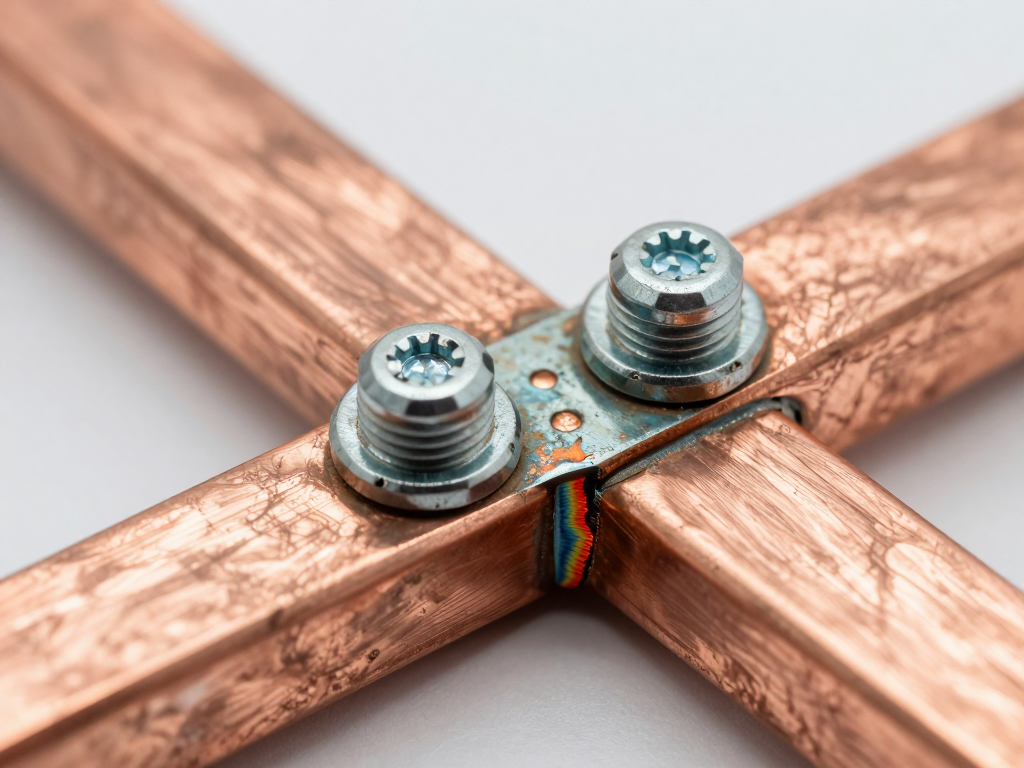
C11000 ETP – the Default Busbar Grade (and Why It Covers 80% of RFQs)
C11000 electrolytic tough pitch is the workhorse busbar copper. It is electrolytically refined, then cast with a small, controlled oxygen content (0.02-0.05%) that scavenges residual impurities and locks the conductivity at the ~100-101% IACS ceiling. For almost every standard electrical assembly – low- and medium-voltage switchgear, distribution panels, motor control centers, busway, BESS interconnects, neutral and ground bars – C11000 is the correct, lowest-cost choice and the grade most national busbar standards (ASTM B187, EN 13601, GB/T 5585) default to.
The one thing C11000 cannot tolerate is a hydrogen-containing reducing atmosphere at brazing temperature. The dissolved oxygen reacts with hydrogen to form steam, which cracks the copper from the inside (“hydrogen embrittlement” or “gassing”). In open-air brazing with flux, or in standard resistance-bolted joints, this never happens – it is only a problem in hydrogen-atmosphere furnace brazing or in sealed hydrogen/oil-filled transformer environments run hot. If your process or service environment is one of those, step up to C10200.
C10200 OFC / OFHC – When Oxygen-Free Copper Actually Pays
C10200 oxygen-free copper (also sold as OFC, OFHC, or “oxygen-free high-conductivity”) is produced without the oxygen-scavenging step, to <0.001% oxygen. It matches C11000 on conductivity (~101% IACS) and thermal conductivity, but is immune to hydrogen embrittlement – so it brazes and welds flawlessly even in hydrogen atmospheres, and it does not degrade in sealed, hot, hydrogen-bearing environments.
The legitimate cases for C10200 busbar are narrower than buyers think. Specify it when:
- Vacuum interrupter and vacuum-switchgear components where the copper is part of a sealed vacuum envelope and outgassing must be negligible.
- Hydrogen- or oil-filled transformer internals and other sealed assemblies run hot in a reducing environment.
- Furnace-brazed or hydrogen-atmosphere brazed busbar assemblies where C11000 would gas and leak.
- High-reliability weldments (laser or TIG) where porosity from oxygen is unacceptable.
- Microwave, particle-physics, and ultra-high-vacuum feedthroughs where trace oxygen matters.
Outside these cases, C10200 is an unnecessary premium. A distribution board built from OFC busbar performs identically to one built from ETP – it just costs a third more. For high-purity reference, our C10100 OFHC copper plate covers the even-higher-purity (99.99%) tier used in electronics and vacuum work.
C12200 DHP – the Deoxidized Grade for Joined and Plumbing Assemblies
C12200 phosphorus-deoxidized copper (DHP) is deoxidized with phosphorus, leaving no free oxygen. It is immune to hydrogen embrittlement like C10200, but the residual phosphorus drops electrical conductivity to ~85-90% IACS. That makes C12200 a poor choice for high-ampacity primary busbar (you would have to upsize the cross-section ~12-15% to carry the same current, eating the cost saving), but an excellent choice where joining dominates and current density is modest:
- Brazed and welded busbar sub-assemblies, flexible braids, and terminations where weld soundness matters more than peak conductivity.
- Plumbing, water-cooled busbar, and heat-exchanger tubes – C12200 is the standard deoxidized tube grade.
- Grounding and neutral bars in non-critical ampacity roles.
The decision between C11000 and C12200 for a joined assembly often comes down to whether the joint is bolted (use C11000, keep the IACS%) or furnace-brazed in hydrogen (use C12200 or C10200). For straight, bolted high-current busbar, stay on C11000.
Temper, Plating, and the Details That Decide Yield
Beyond grade, three specification choices decide whether a busbar order forms cleanly and survives in service:
- Temper. Busbar is supplied in temper: H04 (hard, full-hard – springy, holds shape, harder to bend cold), H02 (half-hard – the most common busbar temper, bendable yet stiff), H00 (1/4 hard), and OS025 (soft/annealed – dead soft, easy to form, lower strength). Most switchgear busbar is specified H02 or H04; deep-formed or tightly-bent parts use softer tempers. Mismatched temper is a top cause of bend cracking and springback problems.
- Tin plating (most common). Busbar is frequently tin-plated (2-10 microns) to prevent oxidation at contact faces, improve bolted-joint conductivity over time, and ease soldering. Tin plating is standard for switchgear busbar in humid or corrosive environments. Specify plating thickness and whether it is hot-dip tinned or electroplated.
- Silver plating (high-end). Silver-plated busbar is used in high-temperature or high-reliability joints (e.g., generator busbar, high-cycle switchgear) for lower contact resistance and stability at elevated temperature. It carries a meaningful cost adder.
- Edge and surface finish. Busbar edges should be de-burred and radius-ed for flashover performance at medium voltage; surface finish affects contact resistance at bolted joints. Specify edge condition for anything above 1 kV.
Practical tip from the engineering desk: if a formed busbar cracks on a 90-degree bend, the cause is almost always temper, not grade. A hard-temper (H04) C11000 bar bent to a tight inside radius will crack where a half-hard (H02) or soft (OS025) bar of the same grade will form cleanly. The fix is to step the temper down, not to switch grades – and it is far cheaper than changing to OFC.
What to Lock in Your RFQ: Grade, Temper, Plating, Tolerance
The most common reason a busbar order disappoints is a vague RFQ that leaves grade, temper, or plating open. Specify all of the following:
- Grade with standard: e.g., “C11000 ETP per ASTM B187,” “C10200 OFC per ASTM B187,” “C12200 DHP per ASTM B152.” Do not write “copper busbar” alone – the grade decides hydrogen-embrittlement behavior and cost.
- Temper: H04 / H02 / H00 / OS025 – the temper decides bendability and springback.
- Cross-section and tolerance: width x thickness with tolerance (e.g., 40 x 5 mm, +/-0.05 mm). Busbar is sized by ampacity; tolerance on thickness affects joint pressure and current rating. Our weight-and-cross-section calculation guide covers the per-meter weight and area math that applies to copper bar as well as steel.
- Plating: tin-plated (thickness, hot-dip or electroplated), silver-plated, or bare. State whether plating is on the full bar or only on contact zones.
- Length, straightness, and edge condition: cut length with tolerance, straightness per ASTM B187, de-burred/radiused edges for MV busbar.
- Certificate: EN 10204 3.1 MTC with chemistry (Cu, O, P) and conductivity (IACS%) confirmed per heat. For the 3.1-vs-3.2 distinction and when third-party certification is mandatory, see our mill test certificate guide.
- Standards cross-reference: if your drawing calls up a national standard (ASTM, EN, GB, JIS), confirm equivalent grade – our standards cross-reference guide walks through the ASTM/DIN/JIS/GB mapping that prevents a wrong-grade shipment.
For the RFQ itself, the quote-request template guide gives the spec structure (grade, size, temper, qty, Incoterm) that returns a clean, comparable quotation – the same structure we use on copper busbar inquiries. And because busbar is often a custom-cut, high-value product, the quality inspection checklist covers the receipt-inspection points (dimensional, surface, plating continuity, certificate match) that catch a wrong-grade or wrong-temper shipment before it reaches assembly.
How Yihang Metal Supplies Copper Busbar and Flat Strip
We supply all three busbar grades – C11000 ETP, C10200 OFC, and C12200 DHP – so you can buy the correct grade per assembly in one RFQ rather than over-specifying OFC everywhere. Here is what a Yihang Metal copper busbar quotation includes as standard:
- Grade range per ASTM B187 / B152 / EN 13601: C11000 ETP (default switchgear), C10200 OFC (vacuum, hydrogen, brazed), C12200 DHP (joined/plumbing). Our C11000 electrical busbar strip and C10200 oxygen-free strip cover the common strip forms.
- Full temper range – H04, H02, H00, OS025 – matched to your forming and springback requirement, with bend-test confirmation.
- Tin- and silver-plating to specified thickness, full-bar or contact-zone, hot-dip or electroplated.
- EN 10204 3.1 MTC with chemistry (Cu, O, P) and measured IACS% conductivity per heat; 3.2 third-party witnessed certification for project-critical work.
- Custom widths, thicknesses, cut lengths, and edge conditions (de-burred, radiused for MV), with tight thickness tolerance for consistent bolted-joint pressure.
- Sea-worthy, moisture-barrier export packing suited to long transit – copper oxidizes and tarnishes in transit if unprotected, so packing matters as much as it does for steel. See our export-packing checklist for the standard we apply to high-value metal shipments.
Because we ship all three grades side by side, we can also give you a like-for-like cost-and-conductivity comparison at the exact cross-section each assembly needs – so your busbar BOM is driven by the actual environment and joining process, not by which single grade a one-product mill wants to push.
Not sure which copper grade to specify for your busbar or flat strip? Tell us the assembly (switchgear, BESS, transformer, vacuum interrupter), the rated current and voltage, the joining process (bolted, brazed, welded), and the service environment. The team at Yihang Metal will recommend the grade (C11000 / C10200 / C12200), temper, plating, and tolerance that gives you reliable conductivity at the lowest cost – and back it with full EN 10204 documentation and IACS% certification. Send us your specifications today for a quoted price within 24 hours.