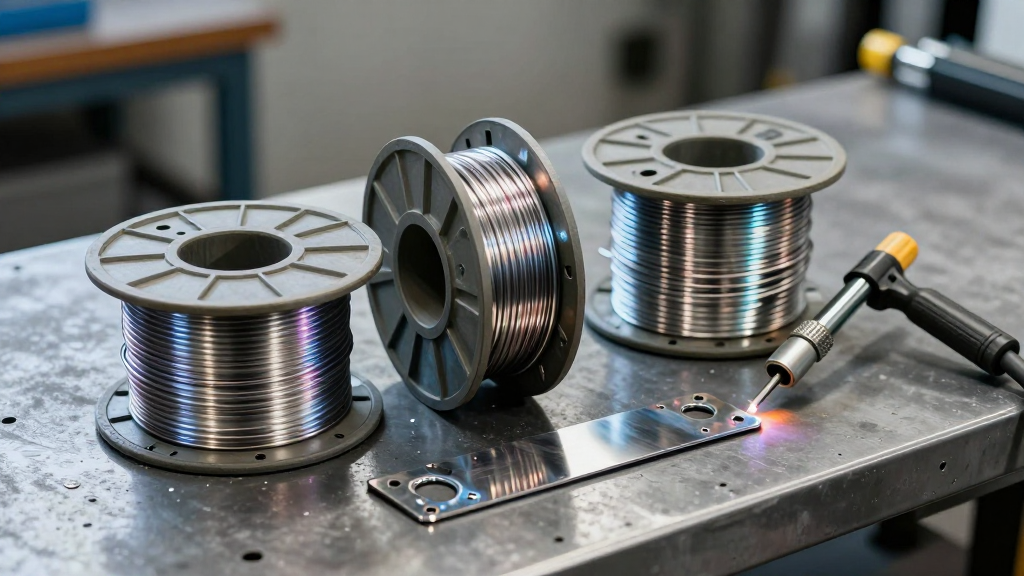
If you are buying stainless steel welding wire for a fabrication shop, a pressure-parts job, or an export project, you will be quoted three filler metals that sound almost interchangeable: ER308, ER309, and ER316. They are all austenitic stainless bare wire for TIG (GTAW) and MIG (GMAW), they all come on the same spool or rod sizes, and they all look like bright silver wire. But they are not interchangeable – and specifying the wrong one is the single most common reason stainless welds fail inspection, corrode early, or get rejected at review.
In this guide we break down what each filler is, how ER308, ER309, and ER316 compare on chemistry, corrosion resistance, dissimilar-metal use, and cost, and – just as importantly – when the cheaper ER308 is the right call and when stepping up to ER316 (or a low-carbon / low-silicon variant) genuinely matters. We have supplied all three from Yihang Metal to fabricators and EPC contractors across Southeast Asia, the Middle East, and Latin America, so the numbers below come from real weld procedures and real project feedback.
What ER308, ER309, and ER316 Actually Are
All three are bare solid wire (or rod) classified under AWS A5.9 (and the ISO equivalents). The “ER” prefix means it can be used as both electrode (MIG) and rod (TIG). The numbers refer to the nominal weld-metal chemistry, which is matched – or deliberately mismatched – to the base metal:
- ER308 / ER308L / ER308LSi – the general-purpose 19Cr-9Ni austenitic filler, matched to 304 and 304L base metal. The “L” is low carbon (≤0.03%), which minimizes carbide precipitation in the heat-affected zone and preserves intergranular corrosion resistance. “Si” adds ~0.8% silicon for better wetting and a flatter bead in MIG. This is the default stainless filler – the one most shops reach for first.
- ER309 / ER309L / ER309LSi – a higher-alloy 23Cr-13Ni filler. The extra nickel and chromium give it enough alloy content to bridge dissimilar joints – stainless to carbon steel, stainless to low-alloy steel, or clad-steel overlay – without forming brittle martensite at the dilution boundary. It is also used to weld 304 to itself when the joint will see mixed dilution.
- ER316 / ER316L / ER316LSi – an 18Cr-12Ni-2.5Mo filler matched to 316/316L base metal. The molybdenum is the entire point: it raises resistance to pitting and crevice corrosion in chloride environments (marine, food, chemical, coastal). Using ER308 on a 316 base dilutes the molybdenum below the threshold and throws away the reason you bought 316.
The low-carbon “L” variants (ER308L, ER309L, ER316L) have largely replaced the standard grades for everything except high-temperature service. For most buyers, “ER308L”, “ER309L”, and “ER316L” are what is actually being quoted; we use the “L” sense through the rest of this article unless a high-temperature job specifically calls for the standard grade.
Key mental model: match the filler to the base metal for corrosion-critical welds (308→304, 316→316). Step up to 309 only when you are joining two different metals and need to absorb dilution. The filler is not “stronger” as the number goes up – it is alloyed for a different job.
ER308 vs ER309 vs ER316: Chemistry, Corrosion, and Use Compared
Here is the side-by-side at the properties a fabrication buyer or welding engineer actually specifies against.
| Property | ER308(L) | ER309(L) | ER316(L) |
|---|---|---|---|
| Nominal chemistry | 19Cr-9Ni | 23Cr-13Ni | 18Cr-12Ni-2.5Mo |
| AWS classification | A5.9 ER308 / ER308L / ER308LSi | A5.9 ER309 / ER309L / ER309LSi | A5.9 ER316 / ER316L / ER316LSi |
| Matched base metal | 304 / 304L / 301 / 302 | Dissimilar: stainless ↔ carbon/low-alloy; clad overlay | 316 / 316L; also 317, some 321/347 service |
| Chloride pitting resistance | Baseline (no Mo) | Baseline (no Mo, but higher Cr/Ni helps high-temp) | Best – Mo gives CPT typically 15–25 °C higher than 308 |
| Dilution tolerance (dissimilar joints) | Poor – forms martensite on carbon-steel dilution | Excellent – designed to absorb up to ~40% dilution | Fair – not the right choice for stainless-to-carbon |
| Typical service | General 304 fabrication, food, architectural, tanks | Transition joints, clad plate overlay, carbon-to-stainless | Marine, chemical, food/dairy, pharma, coastal |
| Relative cost | Lowest | Medium (higher Ni/Cr) | Highest (molybdenum content) |
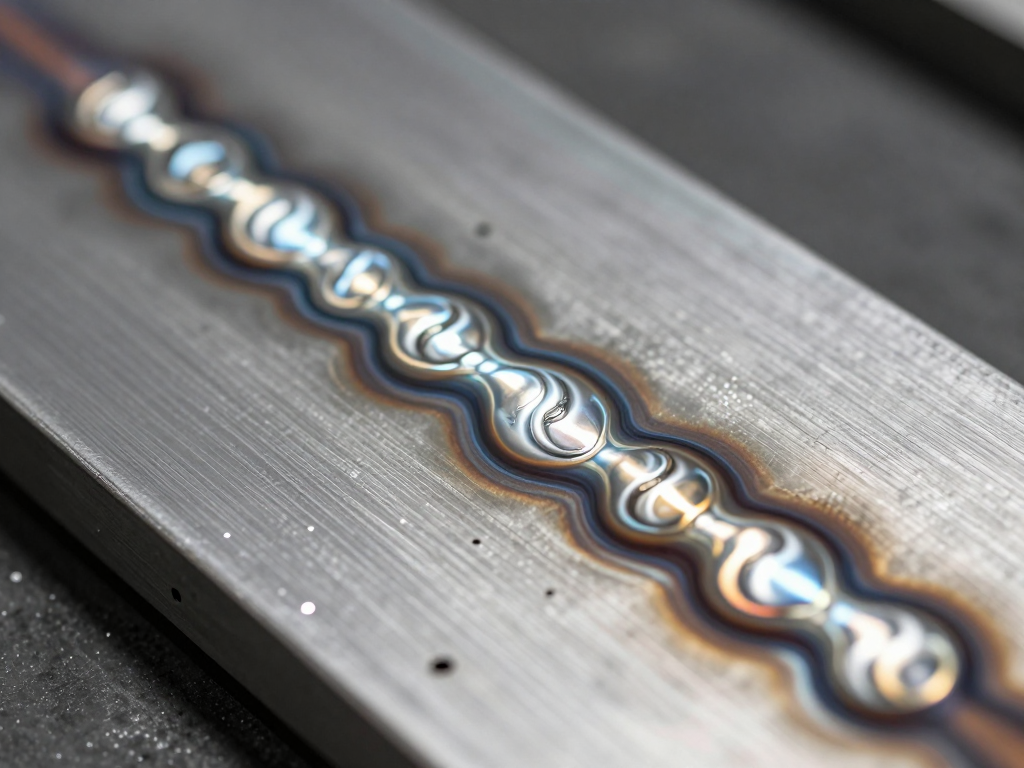
Corrosion Resistance: Why ER308 on a 316 Job Wastes the Money You Spent on 316
This is the most expensive mistake in stainless filler selection. A buyer specifies 316L plate for a chloride environment – coastal handrail, food-processing tank, chemical vessel – and the shop runs ER308L filler “because it’s stainless and we had it on the rack.” The weld metal ends up with roughly 1% molybdenum after dilution instead of the 2.5% the design called for. The plate is 316L; the weld is effectively 304L. The first pit shows up at the weld in service.
- Match for chloride service. If the base metal is 316/316L and the environment contains chlorides (marine, food brines, chemical, swimming pool, coastal), the filler must be ER316L. There is no cheaper substitute that preserves the pitting resistance.
- 308 is fine for non-chloride 304 service. General 304 fabrication – tanks, ducting, architectural, indoor food equipment without brine – runs perfectly on ER308L. Stepping up to ER316L here adds cost for no service-life gain.
- 309 is a bridge, not a corrosion upgrade. ER309L has no molybdenum, so it is not a substitute for ER316L in chloride service. Its job is to handle dilution at dissimilar joints. Do not let a “higher number is better” instinct lead you to 309 where 316 is required.
- Low carbon matters. The “L” grades (≤0.03% C) resist sensitization in the weld HAZ. For anything that will see corrosive service after welding, specify the L variant. Standard (non-L) grades are reserved for elevated-temperature service where carbides are less of a concern and creep strength matters.
For a deeper look at how 304 and 316L themselves compare – including the chloride environments that drive the filler choice – our 304 vs 316L weldability guide covers the base-metal side of this decision, and the duplex 2205 vs 316L guide covers when even 316L is not enough.
Dissimilar Welds: Where ER309 Earns Its Premium
ER309L is the one filler in this group that exists primarily to be wrong for the base metal on purpose. When you join stainless to carbon steel, or stainless to a low-alloy structural steel, the weld pool is a mixture of two very different chemistries. If you use ER308L, the carbon-steel dilution drops the nickel and chromium below the level needed to keep the weld austenitic, and a hard, brittle martensite phase forms – the weld cracks or fails in service.
- Stainless-to-carbon steel: ER309L. The 23Cr-13Ni chemistry is high enough that, even after ~30-40% dilution from the carbon side, the weld metal stays austenitic with a small retained ferrite content (4-10 FN) that resists hot cracking.
- Clad plate overlay: ER309L as the first (buffer) layer over the carbon-steel backer, then ER308L or ER316L for the matching surface layer. This is the standard procedure for pressure-vessel clad plate.
- Stainless-to-low-alloy (e.g., P11/P22): ER309L works for many non-critical transitions; for creep-critical or code-bound joints, a nickel-base filler (ERNiCr-3) is often specified instead. Confirm with your WPS and code.
- Stainless-to-stainless, different grades: usually use the filler matched to the more alloyed side (e.g., 304-to-316 joint welded with ER316L) unless dilution from a carbon-steel member is involved.
Practical tip from the shop floor: if a drawing calls out “stainless weld” on a joint that ties into carbon steel structure, do not default to ER308L. The moment there is carbon-steel dilution, ER309L is the correct call – and ordering the wrong wire is a lot more expensive than the price difference between the two spools.
Form, Size, Surface, and Silicon: The Specs That Actually Affect Your Run
Beyond the grade, the practical variables on a filler-metal RFQ are the ones that change how the wire feeds and how the bead lays down:
- Form: TIG cut lengths (36″ / 1000 mm rods, 1.0-3.2 mm), MIG continuous spool wire (D200/D300 spools, 0.8-1.2 mm), or submerged-arc wire (coils/drums, 2.4-4.0 mm). Match the form to your process – do not buy rods for a MIG line.
- “Si” variant for MIG: ER308LSi / ER316LSi add ~0.7-0.9% silicon, which improves wetting and gives a flatter, smoother bead with less spatter in short-circuit and spray transfer. For MIG/GMAW, the Si variant is usually worth it; for TIG, plain L is fine.
- Surface finish: bare bright (standard for TIG), copper-coated (improves MIG feed and contact-tip life, but copper contamination can matter for some food/nuclear specs), or chemically cleaned. For food and pharma, specify bare or cleaned, not copper-coated.
- Shielding gas match: TIG/rod – pure Ar; MIG solid wire – Ar + 2% O₂ or Ar + 2-3% CO₂. Confirm the gas is compatible with the wire chemistry; the wrong gas can shift the deoxidizer balance and cause porosity.
- Traceability: each spool/lot should carry a heat number traceable to the MTC, and the chemistry should be confirmed to AWS A5.9 tolerances. For code work (ASME, PED), this traceability is mandatory, not optional.
Where ER308 Is Still the Smarter Buy (Don’t Over-Specify)
ER316L costs more because molybdenum is a priced alloy. Don’t specify it where ER308L does the job:
- General 304 fabrication in non-chloride service – indoor tanks, ducting, architectural trim, general sheet-metal work. ER308L is correct.
- Food equipment without brine or chloride exposure. Many food-contact applications run perfectly on ER308L; reach for ER316L only where salt, brine, or chloride cleaners are present. Our food-grade stainless selection guide breaks down which food applications actually need 316.
- Dissimilar stainless-to-carbon joints – ER309L, not ER316L, is the correct filler here.
- Budget-driven non-critical work where the base metal is 304 and the environment is mild.
Step up to ER316L when the base metal is 316/316L, when chloride pitting is a design risk, or when the WPS and code require a Mo-bearing deposit. And if your project also involves cutting the stainless before welding, the choice of process on our laser vs plasma vs waterjet cutting guide affects cut-edge quality and the weld prep you will need.
What to Lock in Your RFQ: Grade, Form, Heat, and Documentation
The most common reason a filler-metal order disappoints is not the grade – it is a vague RFQ. Specify all of the following:
- Full grade and variant: “ER316LSi per AWS A5.9” – not “316 wire.” The L, the Si, and the standard all matter.
- Form and size: TIG rod (1.6 mm x 1000 mm) or MIG spool (1.2 mm, D300). State the diameter and packaging.
- Surface: bare bright, copper-coated, or cleaned – matched to your process and any food/pharma constraint.
- Heat number and lot traceability on every spool and on the MTC.
- Standard and MTC: EN 10204 3.1 as standard, with chemistry confirmed to AWS A5.9 tolerances; 3.2 witnessed certification available for code-bound work.
- Quantity and packaging: spools per carton, pallet packing, sea-worthy for export. Wire is deceptively heavy – confirm carton weights and palletization.
How Yihang Metal Supplies ER308, ER309, and ER316 Welding Wire
We stock and source all three grades so you can buy the right filler for each job in one RFQ rather than chasing multiple suppliers. Here is what a Yihang Metal welding-wire quotation includes as standard:
- ER308L / ER308LSi, ER309L / ER309LSi, ER316L / ER316LSi per AWS A5.9 (and EN ISO equivalents), in TIG rod, MIG spool, and SAW coil forms.
- EN 10204 3.1 MTC with full chemistry (including Mo for 316) confirmed to AWS tolerances, and heat/lot traceability on every spool. 3.2 third-party witnessed certificates available on request for ASME / PED code work.
- Surface options – bare bright for TIG and food/pharma, copper-coated for high-speed MIG – matched to your process.
- Standard diameters and spool sizes (D200/D300, 5-15 kg) plus cut-length TIG rods and SAW drums, with custom packaging for export.
- Sea-worthy export packing – moisture-barrier, palletized, with lot labels preserved for traceability after long transit.
Because we ship 308, 309, and 316 side by side, we can also give you a like-for-like cost comparison at the diameter and packaging your shop actually runs – so the filler decision is driven by the base metal and the service environment, not by which wire a single-grade supplier wants to move.
Not sure whether ER308L, ER309L, or ER316L is right for your weld? Tell us the base metal (grade and whether it ties into carbon steel), the service environment (chlorides, temperature, code), and the process (TIG rod, MIG spool, SAW). The team at Yihang Metal will recommend the grade, variant, form, and surface that gives you a sound, corrosion-resistant weld – and back it with full EN 10204 documentation and heat traceability. Send us your specifications today for a quoted price within 24 hours.