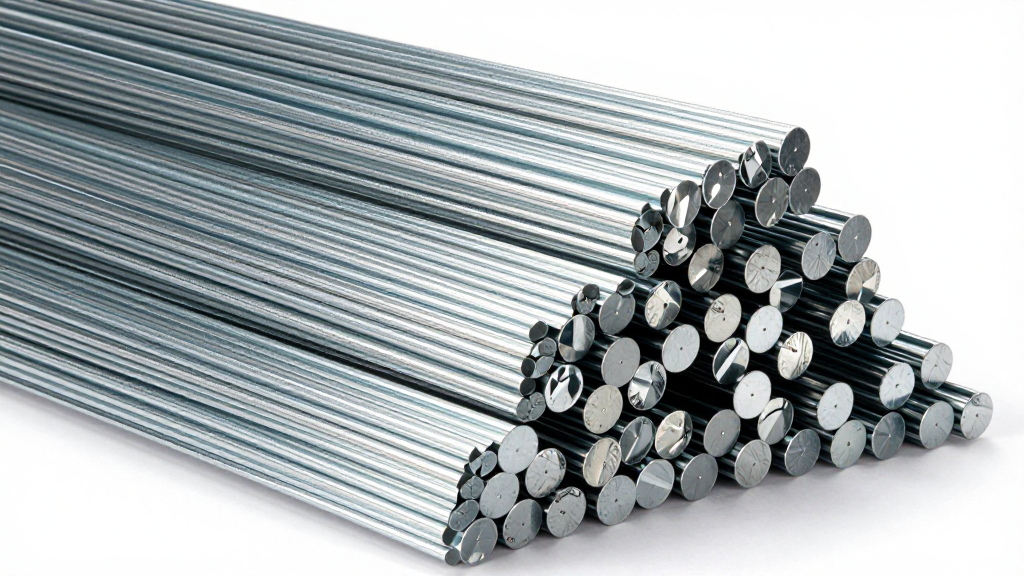
Galvanized Iron Wire (GI Wire) Buying Guide: Hot-Dip vs Electro-Galvanized, Wire Gauges, Coating Weights, and Common Applications
Few steel products look simpler than a coil of galvanized iron wire, and few cause more specification disputes. “GI wire” is not one product: it is a family defined by five variables – coating method (hot-dip or electro), coating weight in g/m², wire gauge (BWG or SWG), steel grade, and temper (hard or annealed). Change any one and you get a different wire, priced differently and lasting a different number of years outdoors. If you source wire from China, this guide covers each variable with the numbers you need on an RFQ: coating weights, gauge conversions in mm and kg/km, tensile strengths in MPa, and the tests that prove the coating is really there.
China is the world’s largest exporter of galvanized wire, shipping hundreds of thousands of tonnes a year. Buyers who order by vague description get coils that rust too early, snap when tied, or arrive underweight. The specifics below are the ones that appear on real Chinese mill test certificates and export quotations for GI wire.
1. What Galvanized Iron Wire Is and Where It’s Used
Galvanized iron wire is low-carbon steel wire – normally Q195 or Q235 rod drawn down to diameter – with a zinc coating applied during or after drawing. The zinc seals the steel from moisture and corrodes preferentially as a sacrificial anode, protecting bare steel even where the wire is scratched. That self-healing behavior is why galvanized wire beats painted or oiled wire outdoors and dominates open-air products:
- Binding and tie wire – tying rebar, bundling goods, baling.
- Fencing – barbed wire, chain link fabric, field fence, poultry netting.
- Wire products – nails, staples, wire mesh, gabion baskets.
- Cables and ropes – galvanized armoring wire and wire rope strands.
- Industrial use – hanging and bundling, packaging, food processing.
Because the uses differ, the buying job is matching wire to application: a chain link fence needs a heavier, stiffer wire than a baling line, and a rebar tie needs soft, break-resistant annealed wire a worker can twist by hand. The sections below give the numbers to make that match.
2. Hot-Dip Galvanized vs Electro-Galvanized Wire: The Coating Difference
The first buying decision is the coating method, because it fixes the coating weight range, the surface, and the corrosion life before anything else is negotiated.
Hot-dip galvanized wire (HDG)
Hot dipped galvanized wire is passed through a molten zinc bath at roughly 450–460 °C. The zinc forms a metallurgical bond – iron-zinc alloy layers under a pure zinc surface – so the coating is tenacious and does not peel when the wire is bent or wound tightly. Commercial coatings run from about 40 g/m² to 120 g/m², with heavier product (150–300 g/m²) for harsh service; the surface is matte gray to bright.
Electro-galvanized wire (EG)
Electro galvanized wire is coated by electrolytic deposition in a zinc sulfate bath, giving a thin, smooth, bright layer – typically 10–35 g/m². The bond is mechanical rather than metallurgical, so it can flake under severe deformation, and the thin layer gives far shorter outdoor life. EG suits indoor, decorative, or bright-finished wire.
| Property | Hot-Dip Galvanized (HDG) | Electro-Galvanized (EG) |
|---|---|---|
| Typical coating weight | 40–120 g/m² (up to 300 special) | 10–35 g/m² |
| Coating bond | Metallurgical alloy layers; resists flaking | Mechanical; may flake in severe bending |
| Surface finish | Matte gray to bright | Bright, smooth, uniform |
| Corrosion life (rural outdoor) | Roughly 5–15+ years by coating weight | Roughly 1–4 years |
| Uniformity on fine wire | Uneven below ~0.9 mm | Excellent down to 0.5 mm |
| Relative price | Higher | Lower |
| Typical applications | Fencing, chain link, barbed wire, armoring | Indoor binding, craft wire, staples |
Rule of thumb: if the wire will see rain, salt, or years outdoors, buy hot-dip and specify the g/m². If it is indoor or decorative, electro-galvanized is economical – just do not expect it to survive the weather.
3. Wire Gauges: BWG, SWG, and Metric mm Conversions
Wire diameter is quoted in three systems, and mixing them up is the most common wire RFQ error. Wire gauge BWG (Birmingham Wire Gauge) is what Chinese mills use by default; SWG (British Standard Wire Gauge) has different values at the same number; millimetres are the only unambiguous system. A “12 gauge” request means 2.77 mm in BWG but 2.64 mm in SWG – a difference that changes weight and strength. Weight per kilometre follows W (kg/km) = 0.00617 × d², which is how coils are priced:
| BWG | Inch | Millimetre | Weight (kg/km) | Common uses |
|---|---|---|---|---|
| 8 | 0.165 | 4.19 | 108.3 | Heavy mesh, gabion, armoring |
| 9 | 0.148 | 3.76 | 87.2 | Heavy fence, mesh |
| 10 | 0.134 | 3.40 | 71.3 | Chain link, field fence |
| 11 | 0.120 | 3.05 | 57.4 | Chain link, barbed wire core |
| 12 | 0.109 | 2.77 | 47.3 | Barbed wire, poultry netting |
| 13 | 0.095 | 2.41 | 35.8 | Barbed wire, light fencing |
| 14 | 0.083 | 2.11 | 27.5 | Baling wire, fencing, hose spiral |
| 15 | 0.072 | 1.83 | 20.7 | Baling wire, light fence |
| 16 | 0.065 | 1.65 | 16.8 | Baling wire, staples |
| 17 | 0.058 | 1.47 | 13.3 | Tie wire, light baling |
| 18 | 0.049 | 1.25 | 9.6 | Standard construction tie wire |
| 19 | 0.042 | 1.07 | 7.1 | Binding wire, craft |
| 20 | 0.035 | 0.89 | 4.9 | Binding wire, rebar tie |
| 21 | 0.032 | 0.81 | 4.0 | Light binding wire |
| 22 | 0.028 | 0.71 | 3.1 | Light binding wire, small coils |
Three practical points. Always state the millimetre diameter and treat gauge as a reference – “BWG 18 / 1.25 mm” removes every ambiguity. Weight follows diameter squared: dropping from BWG 18 (1.25 mm) to BWG 20 (0.89 mm) nearly halves the weight per kilometre, so a gauge error silently changes your tonnage. And if your market quotes SWG, give the supplier both the SWG number and the target millimetre.
4. Coating Weights and Specifications: ASTM A641, GB/T 343, and Common Coating Classes
Coating weight decides how long the wire survives outdoors and is stated in grams per square metre (g/m²) of zinc; 1 oz/ft² ≈ 305 g/m², so a “0.30 oz coating” is roughly 92 g/m². Two standards dominate: ASTM A641, which defines Classes 1, 2, and 3, and GB/T 343, the Chinese standard for galvanized low-carbon steel wire. Both define minimum coating weights – the certificate states the lowest value measured on any sample, not an average.
ASTM A641 coating classes
Minima are diameter-dependent; for wire sizes common in binding and fencing (about 1.0–3.0 mm), they sit approximately at Class 1 ≈ 0.30 oz/ft² (≈92 g/m²), Class 2 ≈ 0.60 oz/ft² (≈183 g/m²), and Class 3 ≈ 0.80 oz/ft² (≈245 g/m²) – confirm against the current edition’s tables.
GB/T 343 coating weight groups
Under GB/T 343 (and YB/T 5294 for annealed wire), Chinese mills group minimum coating weights by diameter as follows:
| Wire diameter (mm) | Typical min. coating (g/m²) | Common commercial product |
|---|---|---|
| < 1.0 | 20–30 | Light binding wire (EG common) |
| 1.0–1.8 | 40–50 | Standard hot-dip binding/tie wire |
| 1.8–2.5 | 50–65 | Fencing, baling wire |
| 2.5–4.0 | 60–80 | Chain link, barbed wire core |
| 4.0–6.0 | 70–100 | Armoring, heavy mesh wire |
Two traps are common. A supplier quoting “hot-dip galvanized” without a coating weight may ship 40 g/m² where your fence needs 80 g/m² – specify the g/m² number in writing, never the word “heavy”. And on fine wire below 0.9 mm, Chinese mills routinely supply electro-galvanized at 10–25 g/m² even when the buyer says “galvanized”, because thin hot-dip coating is costly; if the wire must survive outdoors, write “hot-dip, min 40 g/m²” on the RFQ and confirm it on the certificate.
5. Core Grades: Low Carbon (Q195/Q235), Medium Carbon, and High Carbon Wire
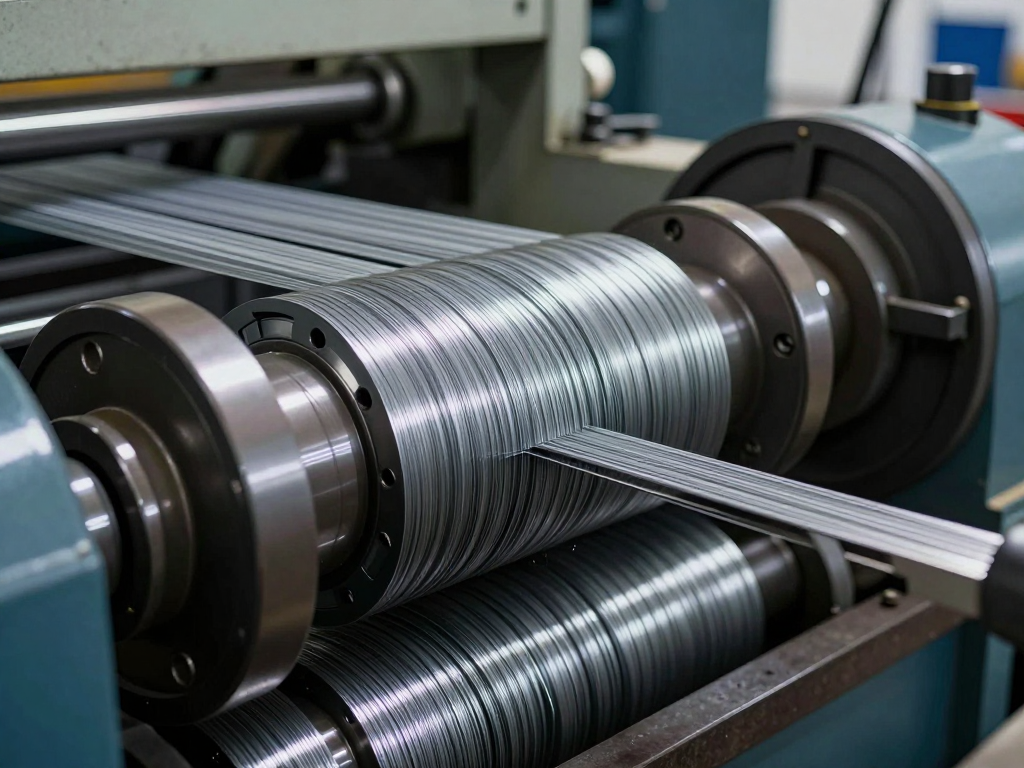
Under the zinc, the grade fixes tensile strength, from soft low-carbon rod to hard high-carbon wire; most commodity GI wire sits on the bottom two rungs:
- Q195 – max carbon about 0.12%, rod tensile roughly 335–410 MPa. The workhorse for binding wire and soft annealed products; draws and anneals easily.
- Q235 – carbon 0.12–0.20%, tensile roughly 375–460 MPa. Stronger and stiffer; for fencing, barbed wire, and mesh needing spring and snap resistance.
- Medium carbon (45#, SWRH52A/62A) – 600–900 MPa drawn; nails, staples, cable armoring, wire rope.
- High carbon (SWRH72A/82B) – 1400–2000 MPa after patenting; prestressed wire, rope strands, springs – engineered products, not commodity GI wire.
State the grade and tensile range on the RFQ (“Q195 annealed, 300–400 MPa” or “Q235 hard drawn, 450–600 MPa”), because the same diameter can double in strength with grade and drawing reduction. The certificate should report both grade and measured tensile.
6. Hard vs Soft (Annealed) Wire: Tensile Strength and Bendability
Galvanized wire is sold in two tempers, and choosing wrong is a field failure. Hard drawn wire (as-drawn, work-hardened by the dies) is springy and holds its shape; annealed wire is furnace-softened (often bright-annealed) so it bends, twists, and knots without snapping:
| Property | Hard (As-Drawn) Wire | Soft (Annealed) Wire |
|---|---|---|
| Tensile strength (Q195/Q235) | 350–700 MPa by diameter and reduction | 300–450 MPa |
| Elongation | 1–5% (breaks with little warning) | 10–25% (stretches before breaking) |
| Bendability | Springy; hard to tie by hand; holds formed shape | Bends and twists easily; knots without cracking |
| Coating behavior | Zinc can stress-crack on sharp bends | Follows severe deformation; ideal for tying |
| Typical uses | Fencing, barbed wire, mesh, armoring, nails | Binding wire, tie wire, rebar tying, baling |
| Production cost | Lower (drawn only) | Slightly higher (extra annealing step) |
State “annealed” or “hard” in one word on the RFQ – the second most common dispute after coating weight. Hand tying needs soft annealed wire; fence fabric that holds shape under tension needs hard drawn.
7. Tie Wire, Binding Wire, and Construction Wire: The Common Commodity Grades
The largest export volume is commodity grades – tie wire, binding wire, and construction wire – and the differences between them are mostly diameter, temper, and coil size:
- Binding wire – BWG 20–22 (0.89–0.71 mm), soft annealed, in 0.5–1 kg mini rolls for hand tying of rebar, bundles, and packaging; often EG or light hot-dip (20–40 g/m²).
- Tie wire / construction tie wire – most commonly BWG 18 (1.25 mm), soft annealed, hot-dip 40–60 g/m², in 1–25 kg coils for rebar mats and formwork; must bend at the twist point without cracking the zinc.
- Baling wire – BWG 14–16 (2.11–1.65 mm), hard or semi-hard, for scrap and hay balers where the wire must hold tension after the bale is ejected.
- Barbed and fencing wire – BWG 12–14, hot-dip, hard drawn, as single-strand fence wire or twisted with crimped barbs.
This is where underweight coils and light coatings do the most damage – volumes are huge and margins thin. Weight-check coils on arrival (a 1 kg binding roll should net at least 0.98 kg) and confirm the coating weight on the certificate; both are cheap and separate good sources from bad.
8. Coil Weights, Packing, and Shipping Formats
GI wire leaves Chinese mills in formats from 0.5 kg mini rolls to 1000 kg process spools, and the format you choose affects both handling cost and freight:
- 0.5–1 kg mini rolls – binding wire for hand tying; 50–100 rolls per carton.
- 3.5–25 kg coils – construction tie wire, baling wire; plastic film inner, woven bag outer.
- 50–100 kg coils – fencing and general wire; eye-traced and compressed into packs.
- 200–500 kg coils – mesh and process wire; strapped and palletized.
- 500–1000 kg spools/reels – machine payoff lines for chain link and mesh.
Standard ocean packing is plastic film (inner), woven polypropylene bag or kraft (outer), strapping, and pallets with corner protection, often with a light rust inhibitor for transit humidity. Weight tolerance is typically ±1%. A 20-foot container loads roughly 20–25 tonnes net depending on format – useful for comparing per-tonne freight. State the coil weight on the RFQ, since mini rolls and spools cost more than plain 100 kg coils. Standard lead time is 7–15 days to loading.
9. Corrosion Testing: How to Verify Coating Quality
Zinc coatings are easy to fake on paper and easy to verify with three tests on a handful of samples:
- Coating weight test (gravimetric) – per GB/T 1839 or ASTM A90: weigh a measured wire length, strip the zinc in inhibited hydrochloric acid, weigh again; the loss converted to g/m² is the coating weight, and it should match your minimum.
- Copper sulfate test (Preece test) – per GB/T 2972 or ASTM A239: dip the wire in 60-second intervals into copper sulfate solution; each pass that exposes no steel counts, and required passes climb with coating class – the fastest field check of continuity.
- Bend / adhesion test – bend 180° around a mandrel of matching diameter; flaking, peeling, or bare steel means the coating bond failed.
- Salt spray (optional) – ASTM B117 hours to white/red rust, for coastal or de-icing environments.
Verification protocol per shipment: micrometer-check diameter on every coil, run copper sulfate dips on one sample per heat, and measure gravimetric coating weight on one sample per batch. All three are cheap and give you a solid claim if the coating is short.
10. Common Applications: Binding, Fencing, Cables, Nails, Chain Link, Wiring
Matching the wire to the end product is the last step; these are typical commercial ranges (confirm against your drawing or fence spec):
- Binding and rebar tying – BWG 20–22, soft annealed, EG or light HDG; ductility outranks strength.
- Chain link fabric – 1.6–3.5 mm hot-dip, hard drawn, 60–80 g/m²; must retain spring in the weave.
- Barbed wire – 2.11–2.77 mm (BWG 14–12), hot-dip, hard drawn; barbs crimped on without cracking the zinc.
- Field fence and poultry netting – 1.4–2.5 mm, hard drawn, heavier coating for ground contact.
- Nails and staples – 1.0–4.5 mm, usually medium carbon, bright or electro-galvanized.
- Cable armoring and wire rope – 2.0–4.5 mm hot-dip, medium-to-high carbon, 400–800 MPa tensile; specification work, not commodity buying.
- Hanging and packaging wire – 0.5–1.5 mm EG bright, soft; garment hangers, food bags, floral wire.
The pattern: outdoor products want hot-dip with a stated g/m² and hard temper; manual tying and packaging want soft annealed; engineered products want grade and tensile control. State the end use on the RFQ and the mill can flag a mismatch before it becomes a container of unusable wire.
11. RFQ Checklist for GI Wire
Send this list with every inquiry and the quotations you get back will be comparable. Anything missing from the response is a red flag:
- Diameter – millimetre plus gauge system: “1.25 mm / BWG 18” – never gauge alone.
- Diameter tolerance – typical commercial ±0.03–0.05 mm.
- Coating type – hot-dip or electro-galvanized, stated explicitly.
- Coating weight – minimum g/m² (e.g., “min 50 g/m²” or “ASTM A641 Class 1”); must appear on the certificate.
- Standard – ASTM A641, GB/T 343, or your national equivalent.
- Grade and temper – Q195/Q235, hard or annealed, tensile range in MPa.
- Coil weight and packing – kg per coil, spool or coil.
- Quantity and unit – tonnes; net weight per coil and total net.
- Price basis and port – FOB (Qingdao/Tianjin), CFR, or CIF.
- Documentation – mill test certificate with coating weight, tensile, and grade; optional third-party inspection (SGS/BV/Intertek).
- Delivery and samples – lead time to loading; 50–100 m cut samples with the specified coating weight.
Two warnings. Put the coating weight in writing even when the salesperson says “heavy zinc” – the g/m² number is what survives a claim. And compare quotes on a common basis: per tonne of net wire at stated coil weight and packing, freight excluded from the wire price.
12. How Yihang Metal Supplies Galvanized Iron Wire
Yihang Metal (www.yihangmetal.com) supplies galvanized iron wire from integrated Chinese wire mills as mill-direct export material: hot-dip galvanized wire and electro-galvanized wire from 0.5 mm to 6.0 mm; Q195, Q235, and medium-carbon grades; hard and annealed tempers; coating weights from 20 g/m² to 120 g/m² (heavier on request); and coil formats from 0.5 kg binding rolls to 1000 kg spools, packed for ocean transit and loaded at northern Chinese ports.
Every Yihang Metal quotation is built to the RFQ checklist above: millimetre diameter with the BWG reference, coating weight in g/m², grade and tensile range, coil weight, packing, and mill test certificates reporting measured coating weight and tensile, with third-party inspection available before shipment. Sourced directly from the mill, buyers get the producer’s price and test data instead of a trader’s repackaged description.
Request a Quote for Your Galvanized Iron Wire Order
Galvanized iron wire is a commodity only when the specification is complete – coating method, coating weight in g/m², gauge in mm and BWG, grade, temper, coil weight, and packing. Get those seven numbers right and wire is one of the easiest steel products to buy from China; get one wrong and you own a container that rusts, snaps, or underweighs. Send Yihang Metal your requirement with the checklist above – diameter, coating, grade, temper, coil weight, quantity, and port – and receive a detailed quotation with the coating weight on the certificate, packing details, and a delivery schedule. Request a quote today at www.yihangmetal.com, and get GI wire quoted the way the mill measures it: in grams per square metre, millimetres, and megapascals.