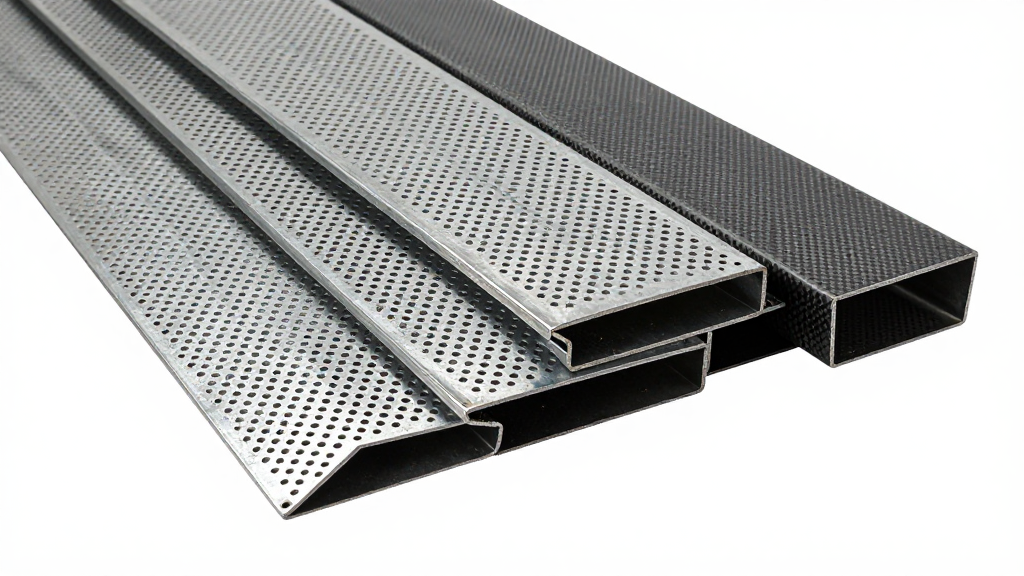
Perforated Metal and Expanded Metal Buying Guide: Hole Patterns, Open Areas, Materials, and Applications (ASTM A666, EN 10051)
Perforated metal sheet and expanded metal sheet look similar in a photograph and behave very differently in a machine guard, a filter, or a building facade. One is punched — material removed, holes in straight or staggered rows. The other is slit and stretched — no material lost, diamond openings formed by strands and bonds. They are made on different machines, quoted in different units, and priced on different factors, yet buyers routinely conflate them. This guide covers how both are made, how to read and compare hole patterns and open area, materials by environment, thickness-versus-hole-size rules, and an RFQ checklist that closes the gap between drawing and delivered sheet.
The fastest way to disqualify a supplier is to ask for “expanded metal” and receive a quotation in hole diameter and pitch. Those are perforated-metal terms. Ask for SWD x LWD — or send a drawing.
1. Perforated vs Expanded Metal: Two Different Products with Different Manufacturing
Perforated metal starts from a flat sheet and removes material: a punch pushes through into a die, shearing out a slug, so the product has discrete holes — round, square, slotted, or hex — in a defined hole pattern. The slugs are scrap, a real cost — which is why open area and price move together.
Expanded metal sheet removes nothing. A machine with staggered knives slits the sheet in offset rows, then stretches it in one pass, opening the slits into diamond-shaped openings framed by strands (the metal between openings) and bonds (where strands meet). No material is lost: a square meter weighs nearly what the starting sheet weighed — it simply grew in area at the expense of strand thickness. Open area in expanded metal comes free of scrap.
The practical differences a buyer cares about:
- Perforated gives a flat, dimensionally stable surface with precise, uniform holes, any hole shape, open area up to roughly 60–75% in practice — but scrap adds cost.
- Expanded gives diamond openings only, strong per unit weight (strands act as stiffeners), cheap at high open areas; standard (raised) mesh is not flat — flattened is a secondary roll operation.
- Both are sold as raw sheet, coil, or fabricated panels, at about 20–70% open area, in carbon steel, galvanized, stainless, and aluminum.
Choose perforated for filtration accuracy, a flat surface, or a specific aperture shape. Choose expanded for maximum strength and open area per kilogram — guards, walkways, racks — at lowest material cost.
2. How Perforated Metal Is Made: Rotary Punching and Hole Pattern Nomenclature
Commercial perforated metal runs on two line types. High-volume coil stock goes through rotary punching (roll-type) machines, where synchronized punch and die rolls index the strip forward by the pitch between strokes; short runs and thick plates use CNC turret or single-station presses with changeable patterns. Rotary lines handle 0.3–3.0 mm; hydraulic presses up to 10 mm or more.
Reading a hole pattern specification
Every perforation spec is five numbers: hole diameter (d), pitch (p) — center-to-center distance — the stagger, sheet dimensions, and the margin (unperforated border) if any. A typical write-up: “round-hole perforated metal, d = 3 mm, p = 6 mm, 60° staggered, 1220 × 2440 mm, 50 mm margin.” The standard arrangements:
- 60° staggered — round holes in a hexagonal arrangement. Highest open area for a given pitch; the default for filtration and screens.
- Straight (inline) pattern — holes in perpendicular rows; standard for square apertures.
- 45° staggered — holes offset on the diagonal; common for square-hole screens.
Hole shapes
Round holes (0.5–50 mm) are the workhorse: strong ligaments in every direction, best open area per hole. Square holes (0.8–50 mm) give precise sizing for sifting and grading. Slotted holes (width 0.3–10 mm, length up to 100 mm) deliver high open area with narrow apertures for screening and ventilation. Hex holes are decorative or structural. Catalog names read “round hole 3×6”, “square hole 8×12” — always write the full set: shape, size, pitch, stagger.
3. How Expanded Metal Is Made: Slitting and Stretching – SWD/LWD/AWD Terminology
Expanded metal is made in a single pass: a sheet or coil feeds between staggered knives that slit it in offset rows while a cam action simultaneously stretches it, opening each slit into a diamond. The result is a network of strands (the inclined bars) joined at bonds, with diamond openings between.
The diamonds are elongated, so the product is defined by two dimensions — and mills are not always consistent about which is which. Specify both:
- SWD — short way of diamond: the narrow opening dimension, which controls screening and guardability.
- LWD — long way of diamond: the long diagonal, in the direction the sheet stretched during expansion.
- AWD — actual way of diamond: some mills’ term for the actual measured opening dimension along an axis, as opposed to the nominal figure. If a quotation uses AWD, ask for a drawing — short and long way must be unambiguous.
A complete spec reads: “expanded metal, standard (raised), SWD 10 × LWD 20 mm, strand 3 mm, thickness 1.5 mm, Q235 galvanized.” The strand width governs weight and strength as much as the opening. LWD is the direction of greatest strength — orient it vertically in facades, horizontally where flexing is the load case, and state the orientation in the order.
4. Perforated Patterns Compared: Round Hole, Square Hole, Slotted – Open Area Calculation
Open area is the single most important performance number in perforated metal sheet, and it is arithmetic:
- Round holes, 60° staggered: OA% = 90.69 × (d/p)². Example: d = 3 mm, p = 6 mm gives 90.69 × 0.25 = 22.7%; d = 4 mm gives 40.3%. The theoretical ceiling is 90.7% — the hexagonal close-packing limit when holes touch.
- Round holes, straight pattern: OA% = 78.54 × (d/p)². At the same d/p ratio, about 13% less open area than the 60° stagger.
- Square holes, inline: OA% = 100 × (a/p)², where a is the side length. Example: 8 mm square at 12 mm pitch = 44.4%.
- Slotted holes: OA% ≈ 100 × (w × l)/(pₙ × p), slot width/length over the two pitches. Example: 2 × 30 mm slot at 5 × 36 mm pitch ≈ 33%.
In practice, ligament (metal between holes) rules limit production: typical d/p is 0.4–0.7 for rounds, landing most standard perforated metal between roughly 15% and 45% open area; 50–75% is special, expensive tooling. Punched metal suppliers add scrap cost, and scrap rises steeply above about 40% open area.
| Pattern | Typical size range | Arrangement | Open area formula | Practical max OA | Best use |
|---|---|---|---|---|---|
| Round | d = 0.5–50 mm | 60° staggered | 90.69 × (d/p)² | ≈60–70% | Filtration, ventilation, acoustic, guards |
| Round | d = 0.5–30 mm | Straight (inline) | 78.54 × (d/p)² | ≈50–55% | Decorative panels, low-cost screening |
| Square | a = 0.8–50 mm | Inline or 45° staggered | 100 × (a/p)² | ≈55–60% | Sizing screens, grain and aggregate grading |
| Slot | w = 0.3–10 mm, l up to 100 mm | Rows, staggered or inline | 100 × (w×l)/(pₙ×p) | ≈60–70% | High-flow screening, ventilation grilles, drying |
| Hex | Across-flats 3–40 mm | Nested honeycomb | Per drawing | ≈65% | Architectural cladding, reinforcement cores |
Before comparing quotes, calculate open area yourself: two suppliers quoting “30% open” can differ by five points because one used a straight pattern and the other staggered.
5. Expanded Metal Types: Standard (Raised) vs Flattened, and SWD x LWD Ranges
Expanded metal leaves the machine as standard — also called raised — with strands inclined out of the plane, so the surface is ribbed and sheets do not stack flat. Flattened expanded metal is standard mesh passed through a cold rolling mill that presses the strands level. Flattening extends the sheet roughly 2–5% in each direction and slightly compresses the strand cross-section, so weight drops a few percent. For walkways and guards needing a flat surface, flattening is worth it; for screening and fencing, standard is cheaper and stiffer.
| Property | Standard (raised) | Flattened |
|---|---|---|
| Surface | Ribbed, strands inclined out of plane | Flat and level after cold rolling |
| Overall size after processing | As expanded | +2–5% in length and width |
| Stiffness per weight | Higher (strands act as ribs) | Slightly lower |
| Stacking / packing | Does not stack flat; bundles | Stacks flat, packs denser |
| Best for | Guards, fencing, grating, screening | Flat panels, walkway treads, facades, racking |
SWD×LWD is the language of every expanded metal price list. Commonly quoted Chinese mill meshes:
| SWD × LWD (mm) | Typical strand (mm) | Typical sheet thickness (mm) | Typical open area | Typical use |
|---|---|---|---|---|
| 3 × 6 | 0.8–1.2 | 0.3–0.8 | ≈30–35% | Fine filter mesh, speaker grilles |
| 5 × 10 | 1.0–1.5 | 0.4–1.0 | ≈35–45% | Ventilation louver core, guard mesh |
| 10 × 20 | 1.5–2.5 | 0.6–2.0 | ≈40–50% | Machine guard mesh, walkway infill |
| 15 × 30 | 2.0–3.0 | 1.0–3.0 | ≈45–55% | Fencing, storage rack mesh |
| 20 × 40 | 2.5–4.0 | 1.2–4.0 | ≈50–60% | Heavy guards, grating infill, cages |
| 32 × 64 / 40 × 80 | 3.0–5.0 | 2.0–6.0 | ≈60–70% | Coarse screening, security fencing |
When comparing suppliers on SWD LWD expanded metal, make strand width part of the inquiry: a 10×20 mesh with a 2.5 mm strand weighs about twice one with a 1.5 mm strand at the same nominal openings.
6. Materials: Carbon Steel, Stainless 304/316, Aluminum – by Environment
The substrate is chosen by environment, not fashion. The standards buyers cite alongside perforation and expansion specs: ASTM A666 for stainless sheet and strip (304/316), EN 10051 for hot-rolled carbon steel (S235JR/S275JR), and JIS G4304 in Asian markets. Hole-making does not change the base grade — the certificate reflects the substrate standard, with the perforation spec added as a pattern code or drawing.
| Material | Grade examples | Environment fit | Typical finishes | Cost level |
|---|---|---|---|---|
| Carbon steel | S235JR (EN 10051), Q235 | Indoor guards, racks, screening where rust is acceptable or coated | Plain oiled, hot-dip galvanized, powder coated | $ |
| Stainless 304 | 1.4301 (ASTM A666) | Food, pharma, general outdoor, hygiene areas | 2B mill, dull polish, PVC-film protected | $$ |
| Stainless 316 | 1.4401 / 1.4404 | Coastal, chemical, marine, chlorides | 2B, pickled, brushed | $$$ |
| Aluminum | 5052, 6061 | Facades, sunshades, signage, lightweight panels | Anodized, PVDF-coated, mill | $$$ |
Two notes. First, galvanize after hole-making: pre-galvanized sheet punched afterward leaves bare steel on every hole wall — expanded metal is all edge. Second, in coastal or chlorine atmospheres, 316 rather than 304 is the difference between a 10-year facade and a 2-year one, because punching exposes fresh material everywhere.
7. Sheet Thickness vs Hole Size: The Rule of Thumb
The relationship of thickness to hole size is the first thing a tooling engineer checks, because it decides whether your pattern is stock or special tooling. The rule of thumb for perforated metal sheet: minimum hole diameter ≈ sheet thickness — practically 1.0–1.2× thickness for holes up to about 10 mm in low-carbon steel. Below that, punches flex and break and the sheet tears rather than shears cleanly, producing heavy exit-side burrs.
Material hardness moves the ratio: in stainless 304/316 the practical minimum rises to roughly 1.2–1.5× thickness — up to 2.0× in work-hardening grades. Slots are the tightest case: minimum slot width about 1.5–2.0× thickness. Examples: 1.0 mm sheet with 1.5–2.0 mm rounds is normal; 3 mm plate with 2 mm holes is a tooling claim waiting to happen. Small holes in thick sheet mean long tooling lead times — or consider expanded metal, where openings are set by the expanding dies, not punching limits.
A buyer who writes only “perforated sheet, 3 mm holes” leaves the tooling engineer to guess the rest — and the guess sets your price.
8. Common Applications: Filtration, Screening, Ventilation, Building Facades, Machine Guards, Racks
- Filtration and separation — round-hole, 60°-staggered perforated metal at 15–50% open area as filter support and pre-screens; hole slightly larger than the media it protects; stainless 304/316 where process is corrosive.
- Screening and sizing — square holes on 45° stagger give the sharpest sizing for grain, seed, and aggregate; slots for dewatering, where slot width sizes but length keeps open area high.
- Ventilation and HVAC — slotted or round patterns at 40–60% open area as louver cores; open area drives pressure drop directly, so never substitute patterns without recalculating.
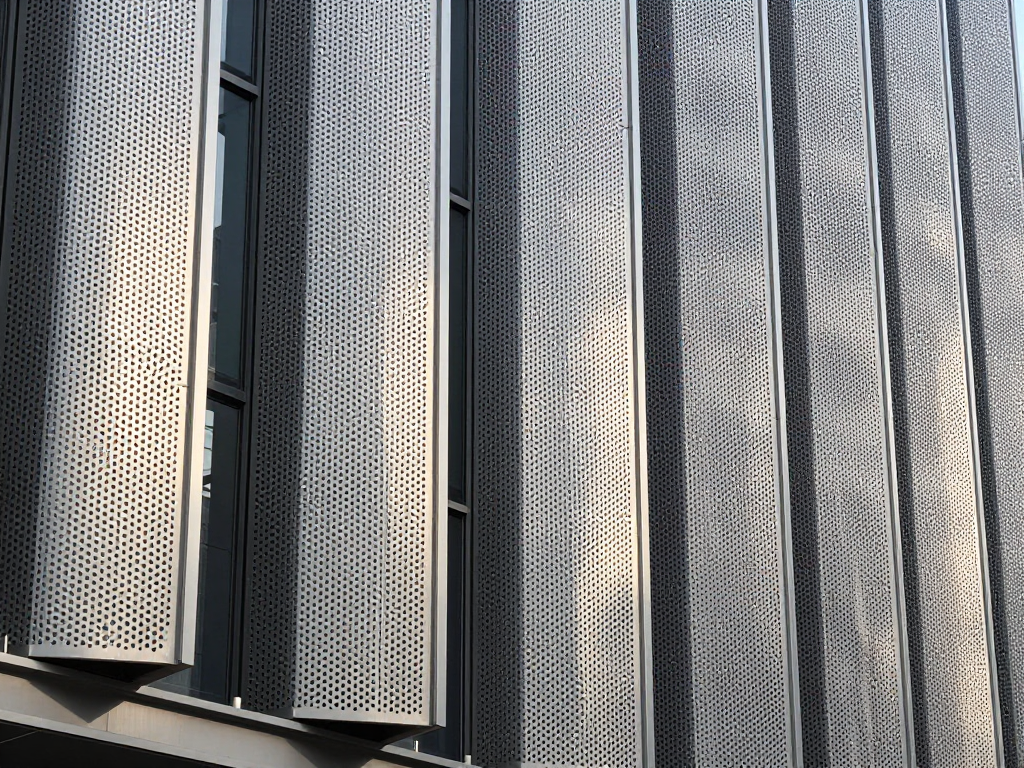
- Building facades and sunshades — aluminum expanded or large-hole perforated panels; LWD horizontal for sunshade blades; name hole size, open area, and ligament width in the spec — all three affect solar gain and opacity.
- Machine guards — machine guard mesh is expanded metal in 10×20 or 20×40 (SWD×LWD), 1.0–2.5 mm thick, standard or flattened. Openings follow safety-distance rules such as ISO 13857: fingertip protection demands small openings, recessed body parts allow larger ones. Certify the opening against your machinery directive rather than guessing.
- Racks, baskets, cages — expanded metal 15×30 to 32×64 in galvanized carbon steel; LWD orientation decides sag direction on long spans.
Write the application and loading; a good supplier confirms pattern, orientation, and material against the duty before tooling a single punch.
9. Burr, Deburring, and Edge Finishing Requirements
Every punched hole has a burr side: the punch enters one face (flat side) and exits the other, rolling the edge so a burr — typically 5–15% of sheet thickness — stands on the exit face. A buyer controls the exposed face with one line in the order: “burr side down” or “burr side up”. That line costs nothing and fixes most burr complaints: in guards, face the burr side toward the machine; in facades, the flat side faces the street.
Where burrs are unacceptable — food equipment, conveyor contact, filter media seating — specify deburring: vibratory or tumbling for small parts, roll-type brushing for flat sheet, chemical or electrolytic for stainless where abrasives are forbidden. It is a per-square-meter cost and a scratch risk (vibratory media can mar a 2B finish), so make it a deliberate line item, not a discovery at inbound inspection. Edges are separate: sheared edges carry their own burr; laser-cut edges are burr-free but show a heat-affected zone — specify “edge deburred” or “edge rounded” if panels are finished in place.
10. Tolerances and Cut-to-Size Services
Tolerances in perforated and expanded metal are looser than buyers expect, and they are the top source of post-arrival disputes. Typical figures: hole diameter ±0.1 mm, pitch ±0.2–0.5 mm, sheet dimensions ±1–2 mm, and expanded SWD/LWD ±10% of nominal. Substrate thickness follows the base standard — EN 10051 for hot-rolled, ASTM A666 for stainless. If your application is dimension-critical — filter tube peripheries, interlocking panels — say so: tighter tolerance classes are available but priced differently.
Most China suppliers, Yihang included, sell more than raw sheet:
- Cut-to-size sheets and panels — sheared or laser-cut to drawing, edges deburred.
- Fabricated blanks — mounting holes drilled, flanges folded, panels rolled to cylinder.
- Full processing — flattening, galvanizing after hole-making, powder coating, anodizing.
A filter-tube claim needs the pattern indexed to the seam, ±1–2 mm rolled-diameter tolerance, and a seam decision: welded, welded and ground, or riveted overlap. None of that appears in a plain “perforated sheet” price — each is a process step with cost and lead time.
11. RFQ Checklist for Perforated and Expanded Metal
A complete inquiry prevents weeks of email ping-pong. Send this to every supplier — the complete ones can price it, the incomplete ones reveal themselves:
| RFQ item | What to state | Example |
|---|---|---|
| Product type | Perforated or expanded — never “mesh” | “Perforated metal sheet” |
| Substrate | Grade + material standard | SS304 per ASTM A666; S235JR per EN 10051 |
| Sheet thickness | Nominal thickness and tolerance class | 1.5 mm ±0.1 mm |
| Pattern | Hole shape, size, pitch, stagger, margin | Round d3 × p6, 60° staggered, 40 mm margin |
| Open area | Calculated % (or ask supplier to confirm yours) | 22.7% |
| Expanded mesh (if expanded) | SWD × LWD, strand width, standard or flattened | 10 × 20 mm, strand 2 mm, standard |
| Sheet / panel size | Dimensions, quantity in sheets, m², or pieces | 1220 × 2440 mm, 200 sheets |
| Burr and edges | Burr side direction; deburring; edge treatment | Burr side down; edge deburred |
| Finish | Coating sequence relative to hole-making | Expand first, then hot-dip galvanize, 85 µm |
| End use | One-line application + load/duty | Machine guard, ISO 13857, opening ≤ 12 mm |
| Logistics | Destination port, packing, inspection | CIF Rotterdam; steel crates; SGS at loading |
12. How Yihang Metal Supplies Perforated and Expanded Metal
Yihang Metal (www.yihangmetal.com) supplies perforated and expanded metal as raw sheet, coil, or finished panels, from Chinese mills and its own processing lines. Round, square, slotted, and hex perforation from 0.5 mm holes upward; expanded metal from fine 3×6 mesh to heavy 40×80, in standard and flattened forms; carbon steel, hot-dip and electro-galvanized, stainless 304/316 per ASTM A666, and aluminum 5052/6061 — with mill test certificates and, on request, third-party inspection at loading (SGS, Bureau Veritas, Intertek).
Beyond the sheet, we cut to size, deburr, flatten, galvanize after hole-making, powder coat, and fabricate panels to drawing — filter blanks, guard panels, facade cassettes, rack infill. Every inquiry is reviewed by an engineer before pricing: we confirm open area from your hole size and pitch, verify thickness-to-hole ratio against tooling limits, and flag pattern, orientation, or material risks. We export regularly to Southeast Asia, Africa, the Middle East, Europe, and the Americas with ocean-grade packing — PVC film, steel-edge protection, palletized or crated bundles — so the mesh arrives square and burr-side where you asked for it.
Request a Quote for Perforated or Expanded Metal
Whether you need 500 sheets of 60°-staggered round-hole perforated metal for filter screens, a container of 10×20 SWD/LWD expanded metal for machine guards, or a facade quantity in stainless with full certificates, send Yihang Metal your drawing, target open area, and end use — we confirm pattern, tooling, and tolerance class and return a complete quotation with lead time and freight. On order, we confirm the open area you calculated, lock the burr side you specified, and verify strand width against your guard spec before the coil runs. Request a quote today at www.yihangmetal.com — perforated and expanded metal priced by engineers who check the pattern before they check the price.