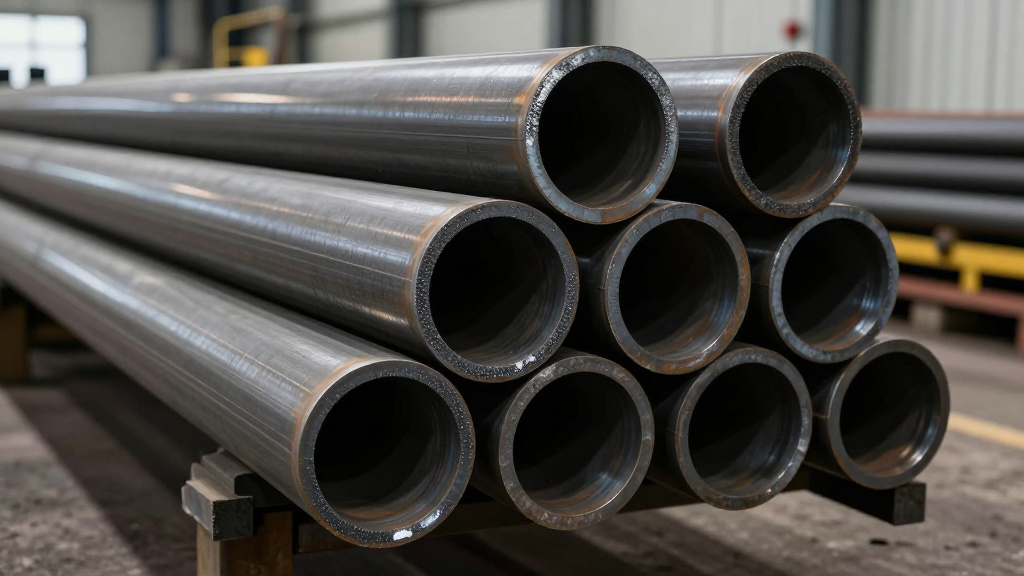
What Boiler and Heat Exchanger Tubes Are – and Why Seamless Is Mandatory
When you’re sourcing pressure tubing for a boiler, superheater, or shell-and-tube heat exchanger, the word “seamless” isn’t a marketing claim – it’s a safety requirement. A seamless boiler tube is produced by piercing a solid steel billet and drawing or rolling it into a hollow tube without any longitudinal weld. That means there’s no weld seam to fail under combined pressure and temperature, no heat-affected zone to act as a corrosion initiator, and no weak link in the hoop stress path.
Boiler and heat exchanger tubes operate in some of the most demanding conditions in any plant: water-wall tubes in a pulverized-coal boiler see internal pressures of 15-30 MPa and metal temperatures approaching 500°C; superheater tubes run even hotter, with steam temperatures up to 605°C in modern ultra-supercritical units; heat exchanger tubes in refining service can face thermal cycling, sour process fluids, and hydrogen partial pressure. In every one of these services, a weld seam is a potential failure point – and pressure codes (ASME Boiler and Pressure Vessel Code Section I, Section VIII; EN 12952 for water-tube boilers) require seamless tubing for high-pressure and high-temperature duty unless a welded tube is explicitly qualified.
If you’re a procurement manager or engineer responsible for boiler fabrication, power plant maintenance, or heat exchanger manufacturing, this guide walks you through the four key ASTM grades – A179, A192, A210, and A213 – and gives you a practical spec and RFQ framework so the tubes you buy actually meet the service they’re going into.
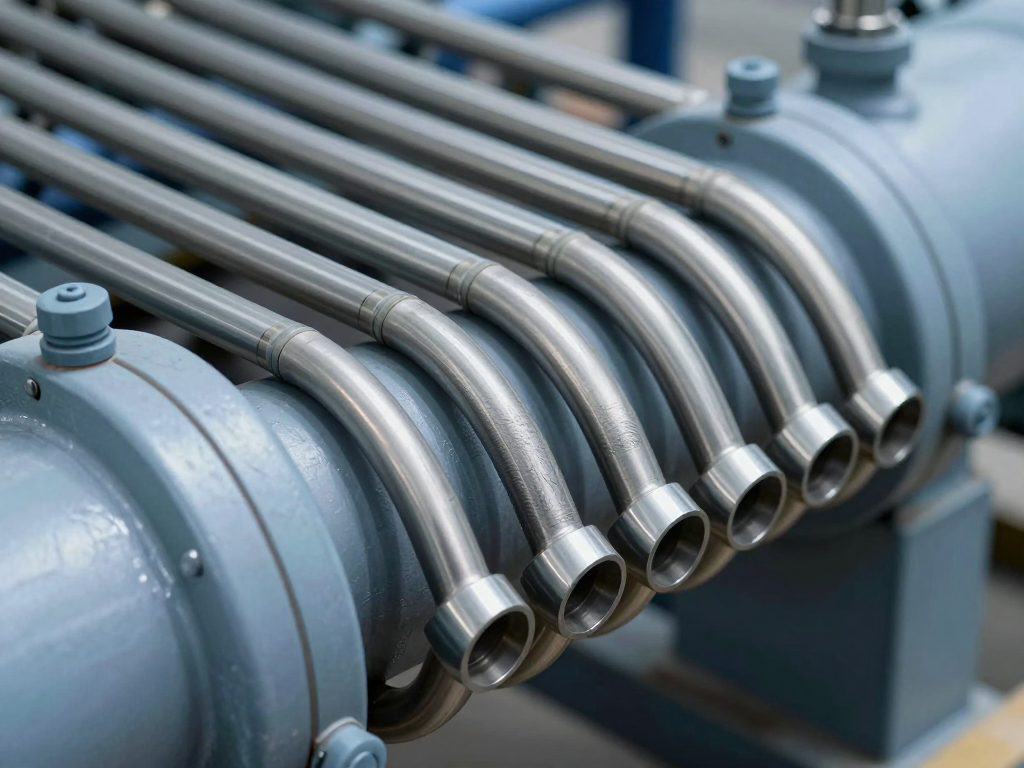
The Key Standards Explained: A179, A192, A210, A213
The four ASTM specifications cover the bulk of seamless pressure tubing used in boilers and heat exchangers. They differ by chemistry, by intended service temperature and pressure, and by which section of a plant they’re designed for. Confusing them is the most common – and most expensive – spec error in this product family.
ASTM A179 – Seamless Cold-Drawn Low-Carbon Steel Heat Exchanger Tubes
A179 is the entry-level grade for heat exchanger and condenser service. It’s a low-carbon steel (0.06-0.18% C) supplied in cold-drawn condition, designed for relatively modest temperatures – up to around 400°C. You’ll find A179 tubes in shell-and-tube heat exchangers, condensers, feedwater heaters, and similar services where the pressure is moderate and the temperature stays below the creep range. It’s the most economical grade in this group and the most widely specified for general heat-transfer duty.
ASTM A192 – Seamless Carbon Steel Boiler Tubes for High-Pressure Service
A192 is specified for high-pressure boiler service – water-wall tubes, economizers, and superheaters in boilers operating at pressures typically above 6 MPa. The carbon range is slightly higher than A179 (0.06-0.18% C with tighter control on phosphorus and sulfur), and the tubes are supplied in hot-rolled or cold-drawn condition. A192 is the workhorse grade for boiler fabricators building to ASME Section I, and it’s the default spec for water-wall and evaporator tubing in subcritical and supercritical boilers.
ASTM A210 – Seamless Medium-Carbon Steel Boiler and Superheater Tubes
A210 comes in two grades: A210-A-1 (medium carbon, 0.27% max) and A210-C (0.35% max carbon with added manganese). The higher carbon gives higher tensile strength, which is why A210 is the spec for superheater and reheater tubing where metal temperatures push into the 450-500°C range. A210-C in particular is favored for sections that see both elevated temperature and higher stress. If you’re sourcing tubes for the hottest sections of a boiler, A210 is almost always the right call.
ASTM A213 – Seamless Ferritic and Austenitic Alloy-Steel Boiler, Superheater, and Heat-Exchanger Tubes
A213 is the alloy family – and it’s the grade you reach for when carbon steel won’t survive the temperature. A213 covers dozens of grades designated T2, T5, T9, T11, T22, T91 (ferritic/martensitic) and TP304, TP316, TP321, TP347 (austenitic stainless). The ferritic grades T11, T22, and T91 are the backbone of modern supercritical boiler superheaters; T91 alone, with its 9% Cr-1% Mo chemistry, allows steam temperatures up to 620°C. The austenitic TP grades handle the hottest sections and the most aggressive process fluids. A213 is significantly more expensive than the carbon grades – but if your service temperature is above ~575°C, you have no alternative.
Chemistry and Mechanical Comparison Across the Four Grades
The table below summarizes the chemistry and mechanical properties of the most common grades in each specification. Use it as a quick reference, but always confirm against the current published ASTM standard when issuing a purchase order.
| Spec / Grade | C (% max) | Key Alloying | Tensile (MPa min) | Yield (MPa min) | Elong. (% min) | Service Cap |
|---|---|---|---|---|---|---|
| A179 (low-C) | 0.18 | Carbon steel | 325 | 195 | 35 | ~400°C, moderate pressure |
| A192 (low-C) | 0.18 | Carbon steel, tighter P/S | 325 | 205 | 35 | ~480°C, high pressure |
| A210 A-1 (med-C) | 0.27 | Carbon steel | 415 | 255 | 30 | ~500°C, superheater |
| A210 C (med-C) | 0.35 | C + 1.6% Mn | 485 | 275 | 30 | ~510°C, high stress |
| A213 T11 | 0.15 | 1.25Cr-0.5Mo | 415 | 205 | 30 | ~550°C |
| A213 T22 | 0.15 | 2.25Cr-1Mo | 415 | 205 | 30 | ~580°C |
| A213 T91 | 0.12 | 9Cr-1Mo-V-Nb | 585 | 415 | 20 | ~620°C |
| A213 TP304 | 0.08 | 18Cr-8Ni | 515 | 205 | 35 | ~700°C, corrosive |
| A213 TP316 | 0.08 | 16Cr-12Ni-2Mo | 515 | 205 | 35 | ~700°C, chloride service |
Temperature and Pressure Service Ranges
The chemistry table tells you what each grade is made of; the service ranges below tell you where each grade belongs. These are practical limits based on the onset of creep and oxidation in carbon steel and the qualified service envelopes in ASME Section I and EN 12952.
- A179 – up to ~400°C: Heat exchangers, condensers, feedwater heaters, low-pressure boiler economizers.
- A192 – up to ~480°C: Water-wall tubes, evaporators, economizers in subcritical and supercritical boilers.
- A210 A-1 and C – up to ~500-510°C: Superheater and reheater sections in subcritical boilers; steam piping in some applications.
- A213 T11/T22 – 500-580°C: Superheater and reheater in supercritical boilers; refinery heater tubes.
- A213 T91 – up to ~620°C: Ultra-supercritical superheater and reheater; high-temperature steam lines.
- A213 TP304/TP316 – up to ~700°C and corrosive service: Fired heaters in refining, ethylene cracker tubes, high-temperature heat exchangers in petrochemical service.
If your design temperature sits within 30°C of a grade’s service cap, move up to the next grade. Margins disappear fast once creep becomes the dominant failure mode, and the cost difference between grades is small compared to the cost of an in-service tube failure.
Size Ranges and the Importance of Wall Tolerance
Seamless boiler and heat exchanger tubes are produced across a wide size range, but the practical envelope for most projects is:
- Outside diameter (OD): 6mm to 152mm (1/4″ to 6″). The most common range for heat exchanger tubes is 16-32mm OD; boiler water-wall and superheater tubes typically run 38-76mm OD.
- Wall thickness (WT): 0.5mm to 12mm. Heat exchanger tubes commonly use 1.5-3mm wall; boiler tubes run 3-8mm depending on pressure.
- Length: Random lengths of 6-12m for boiler tubes; cut-to-length or U-bend for heat exchanger tubes, typically 3-9m.
Wall thickness tolerance is the spec detail that bites buyers most often. ASTM A450 (the general requirement spec that governs A179, A192, A210) and ASTM A999 (which governs A213) both permit wall tolerance of +22%/-12.5% for hot-rolled tubes and +/-10% for cold-drawn tubes. That -12.5% on a hot-rolled tube is not a rounding error – it’s a real reduction in pressure-retaining capacity. For a heat exchanger tube with a calculated minimum wall of 2.0mm, a hot-rolled tube could arrive at 1.75mm and still be “in tolerance.” If your design assumed the nominal wall, you’ve lost 12.5% of your pressure margin.
For heat exchanger service, specify cold-drawn tubes with +/-10% wall tolerance (or tighter, +/-7.5%, if your fabricator can accept the price premium), and confirm the minimum wall meets your code calculation. For boiler tubes, hot-rolled with -12.5% tolerance is standard practice because the design already accounts for it – but state the tolerance in the PO so there’s no ambiguity.
Manufacturing Route: Hot-Rolled vs Cold-Drawn
Seamless tube production starts with a heated billet that’s pierced on a rotary piercing mill to form a hollow shell. From there, the route diverges:
Hot-rolled tubes are finished by rolling the pierced shell on a plug mill or mandrel mill at high temperature, then sizing and reheating as needed. The resulting tube has a characteristic scaled surface, looser dimensional tolerance (+/-22%/-12.5% wall), and a coarse grain structure. Hot-rolled tubes are specified for boiler service where tolerance is less critical and cost matters – they’re roughly 10-20% cheaper than cold-drawn of the same size.
Cold-drawn tubes take the hot-rolled hollow and pull it through a die at room temperature (often after pickling to remove scale), reducing OD and wall and improving surface finish, tolerance, and dimensional accuracy. Cold-drawn tubes have +/-10% wall tolerance, a smooth pickled or bright-annealed surface, and finer grain – all critical for heat exchanger tubes that need to fit snugly into tube sheets and resist fouling. Cold-drawn is the standard for A179 heat exchanger tubes and for any service where surface cleanliness matters.
Why cold-drawn is preferred for heat exchanger tubes specifically: the tube-to-tubesheet joint depends on a clean, accurately-sized tube OD to achieve a proper expanded or welded joint. A scaled, out-of-tolerance hot-rolled tube will leak at the tubesheet, and the cost of pulling and re-rolling a tube bundle in service dwarfs any savings on the tube purchase.
Testing Requirements: Hydrostatic, Flattening, Flaring, NDT
Pressure tubing has to be tested – both the mill and the buyer need evidence that the tube will hold pressure without failing. The standard test package for boiler and heat exchanger tubes includes:
- Hydrostatic test: Each tube is pressurized with water to a calculated test pressure (typically 1.5x design pressure, or per the formula in ASTM A450/A999) and held for a minimum of 5 seconds. ASTM also permits a nondestructive test (UT or ET) in lieu of hydrostatic for certain sizes – confirm which your code requires.
- Flattening test: A specimen is flattened between parallel plates to a specified height (typically until the distance between plates is a percentage of the OD). This tests ductility and the absence of defects – the tube should flatten without cracking.
- Flaring test: The tube end is flared outward over a cone of specified angle (typically 30° or 60°) to a defined expansion percentage, again without cracking. This confirms formability for tube-to-tubesheet expansion.
- Nondestructive testing (NDT): Ultrasonic testing (UT) per ASTM E213 or eddy current testing (ET) per ASTM E426 detects longitudinal and transverse defects. For high-pressure and high-temperature service, NDT is mandatory – not optional.
- Tensile and hardness tests: Performed on a sample basis to verify mechanical properties meet the spec minimums.
For A213 alloy grades, add a microstructure and grain size verification – the heat treatment that develops the T91 or T22 microstructure is critical, and a tube with the right chemistry but wrong heat treatment will fail in creep. We supply the heat treatment chart with the MTC for all A213 grades.
Surface Finish and Cleanliness for Heat Exchanger Service
Heat exchanger tubes need a clean internal surface – any scale, oil, or debris left from manufacturing will foul the heat transfer surface and may initiate under-deposit corrosion. Specify the surface condition in your RFQ:
- Pickled and passivated: Standard for cold-drawn carbon steel (A179) and austenitic stainless (A213 TP304/316). Removes mill scale and produces a clean, uniform surface.
- Bright annealed: Cold-drawn tubes annealed in a protective atmosphere, giving a bright, oxide-free surface. Preferred for stainless heat exchanger tubes where appearance and cleanliness matter.
- Plain (mill finish): Acceptable for boiler tubes that will be cleaned in service, but not for heat exchanger tubes.
Tube ends must be cut square and free of burrs – a burr left on the tube end will prevent proper seating in the tubesheet and may damage the tubesheet hole. Specify “ends cut square, deburred” in the PO.
Common Mistakes Buyers Make
After years of supplying seamless boiler and heat exchanger tubes, the same spec errors show up repeatedly. Here are the four we see most:
- Wrong grade for the temperature: Specifying A192 where the service temperature is 510°C – the tube will work for a while, then fail in creep well before the design life. If the metal temperature exceeds ~480°C, move to A210 or an A213 alloy grade.
- Missing NDT requirements: Buying to the base spec without explicitly requiring UT or ET. The base spec allows hydrostatic in lieu of NDT for many sizes – if your code or your insurer requires volumetric NDT, say so in the PO.
- Wall tolerance too loose: Accepting hot-rolled tolerance (-12.5%) on a heat exchanger tube that needs tight OD and wall for the tubesheet joint. Specify cold-drawn with +/-10% or better.
- Forgetting the end condition and U-bend: If your exchanger has U-tubes, the U-bend radius, bend thinning allowance, and straight-end length all need to be specified. Buying straight tubes and bending them in-house is rarely economical.
RFQ Checklist: Grade, Standard, Size, Tolerance, Tests, Ends
To get an accurate quote and a tube that meets your service, your RFQ should include:
- Grade and standard: e.g., ASTM A179 / A192 / A210 A-1 / A213 T22. State the governing general requirements spec too (A450 for carbon, A999 for alloy).
- Size: OD x wall thickness x length. For U-bends, include the bend radius and straight-end length.
- Tolerance: Wall tolerance class (e.g., cold-drawn +/-10%), OD tolerance, length tolerance (typically +3/-0 mm).
- Manufacturing route: Hot-rolled or cold-drawn. Specify cold-drawn for heat exchanger tubes.
- Test requirements: Hydrostatic test pressure, flattening, flaring, and NDT (UT or ET) – state the standard and acceptance level.
- End condition: Plain ends, beveled ends (state angle), or threaded/coupled.
- Surface finish: Pickled, bright annealed, or mill finish.
- Heat treatment: For A213 alloy grades, state the required heat treatment (e.g., normalize and temper for T22/T91).
- End use: A one-line description of the service (e.g., “superheater tube for 540°C/18 MPa steam”) helps us flag any spec mismatch before production.
- Quantity and packing: Bundle weight limit, export packing (wooden cases or steel cradles), and marking requirements.
How Yihang Metal Supplies Seamless Boiler and Heat Exchanger Tubes
Yihang Metal supplies seamless boiler and heat exchanger tubes across all four specifications – A179, A192, A210, and A213 (including T11, T22, T91, and TP304/316) – with full chemical and mechanical testing per ASTM A450 and A999. Every shipment leaves with an EN 10204 3.1 MTC as standard, and we can arrange EN 10204 3.2 certification through third-party inspection (SGS, BV, TÜV, Lloyd’s) when your project or insurer requires it.
Our size range covers OD from 6mm to 152mm and wall from 0.5mm to 12mm, in both hot-rolled and cold-drawn conditions. Standard NDT (UT per E213, ET per E426), hydrostatic testing, flattening, and flaring are performed on every production batch. We supply tubes pickled and passivated, bright annealed, or mill finish per your spec, with ends cut square and deburred, and we offer cut-to-length and U-bend services for heat exchanger bundles. Lead time for carbon grades (A179/A192/A210) is typically 20-30 days for container loads; A213 alloy grades run 30-45 days depending on grade and quantity.
Need seamless boiler tubes that meet your pressure and temperature service? Send us your spec – grade, size, tolerance, test requirements, and end use – and we’ll confirm compliance, return a fixed-price quote, and include an EN 10204 3.1 MTC with every shipment. Email [email protected] or use the quote form on this page, and our technical team will respond within one business day.