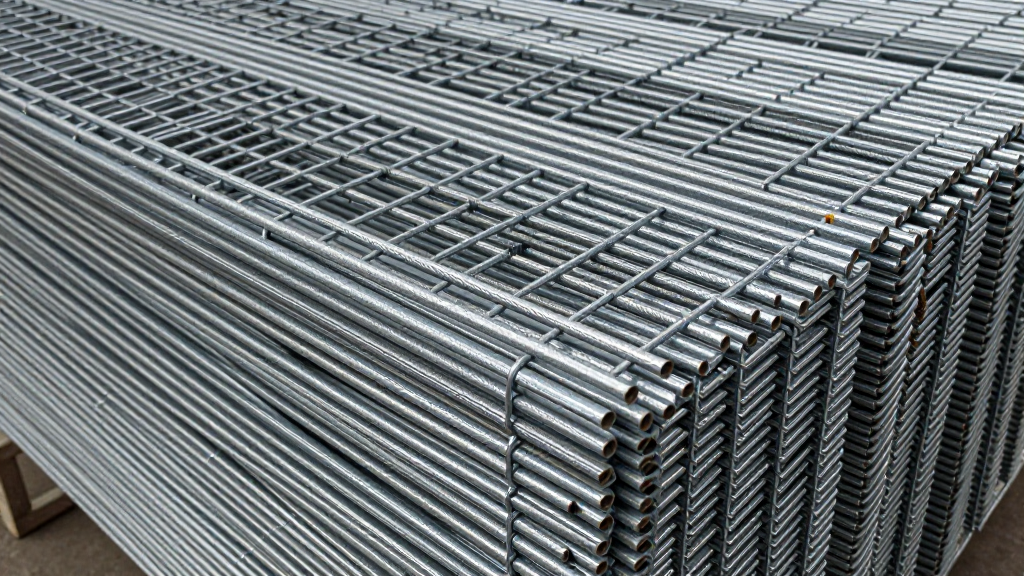
What Steel Bar Grating Is and Where You’ll Find It
If you’re specifying flooring for an industrial facility, steel bar grating is almost certainly on your bill of materials. It’s an open-grid flooring product built from load-bearing bars joined by cross bars at regular intervals, leaving roughly 50-70% open area so water, debris, snow, and air pass straight through. That open structure is exactly why it dominates wherever drainage, ventilation, and slip resistance matter more than a solid deck.
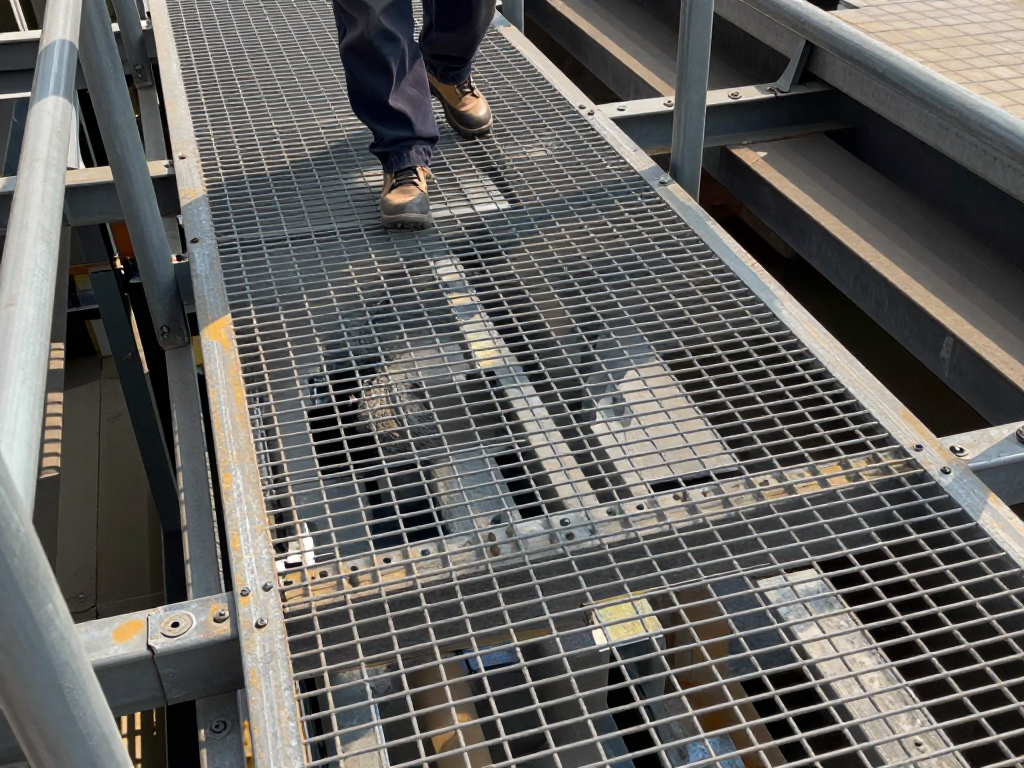
You’ll see steel bar grating in service across nearly every heavy industry: industrial platforms and walkways around process equipment, trench covers over drainage channels in refineries and plants, stair treads providing grip on elevated access, catwalks over conveyors and pipe racks, and sump and pit covers where both load capacity and drainage are non-negotiable. The same product line serves as mezzanine decking, machinery walk platforms, and dock gangways.
The reason engineers reach for grating instead of checkered plate is simple: a 30mm spaced grating panel weighs far less per square meter than solid steel plate of equivalent load capacity, sheds water and oil instead of pooling it, and gives better underfoot grip in wet or icy conditions. For a buyer, the challenge isn’t whether to use grating – it’s specifying the right type, material, and bearing bar size for the load and environment it will face.
Manufacturing Types Compared: Welded, Press-Locked, Swage-Locked, Riveted
Not all steel bar grating is built the same way. The four manufacturing methods each produce a panel with different strength, aesthetics, and cost characteristics. Knowing which one to specify prevents overpaying – or worse, specifying a panel that fails in service.
Welded Steel Bar Grating (Most Common)
Welded grating is made by resistance-welding the cross bars to the bearing bars at every intersection under pressure. It’s the workhorse of the industry – roughly 80% of grating installed worldwide is welded. The twisted square cross bars (typically 6x6mm or 8x8mm) lock into the bearing bar to give both lateral stability and a degree of anti-slip texture. If your RFQ doesn’t specify a type, this is what most mills will quote by default.
Press-Locked Grating
Press-locked (also called pressure-locked) grating is produced by notching both the bearing bars and the cross bars, then pressing them together under a hydraulic press so they interlock without welding. The result is a cleaner, more uniform appearance with a very tight joint – preferred for architectural applications, mezzanines, and any setting where the grating is visible. The cross bars sit flush in the same plane as the bearing bars, giving a smoother top surface. Load capacity is comparable to welded for the same bar sizes, but press-locked panels cost 15-25% more due to the additional notching operation.
Swage-Locked Grating
In swage-locked grating, the cross bars (usually round or hexagonal) are forced into notches cut into the bearing bars, then the steel around the notch is swaged – forged down – to lock the cross bar permanently in place. This method is favored for aluminum grating and for steel grating that needs a very rigid, high-strength joint with a smooth top. It’s less common in carbon steel because welding is cheaper, but it’s the standard for aluminum walkway systems.
Riveted Grating
Riveted grating joins bearing bars and cross bars with solid rivets. It’s the heaviest-duty construction, historically used on bridge decks and in applications with severe rolling loads. The riveted joint flexes slightly under load rather than cracking, which gives excellent fatigue resistance. Today riveted grating is a niche product – specify it only when you have heavy wheeled traffic and fatigue is a documented failure mode. It carries a premium of 30-40% over welded.
| Type | Joint Method | Typical Use | Cost vs Welded | Smooth Top |
|---|---|---|---|---|
| Welded | Resistance weld | Platforms, walkways, trench covers | Baseline (100%) | No (raised cross bar) |
| Press-Locked | Hydraulic press interlock | Architectural, mezzanines | 115-125% | Yes (flush) |
| Swage-Locked | Forged notch | Aluminum walkways, rigid decks | 110-120% | Yes (smooth) |
| Riveted | Solid rivet | Bridge decks, heavy rolling loads | 130-140% | No |
Bearing Bar Specifications: Height, Thickness, and Spacing
The bearing bar is the structural member that carries the load, so its dimensions decide what the panel can support. Three numbers define it: height, thickness, and spacing. Get these right and the panel performs; get them wrong and you get either a costly over-spec or a deflection failure.
- Bearing bar height: 20mm to 100mm. Heights of 25mm and 32mm cover most pedestrian walkways; 40mm to 50mm handles light vehicle traffic; 60mm to 100mm is for heavy-duty applications like highway trench covers and equipment platforms.
- Bearing bar thickness: 2mm to 5mm (3mm, 4mm, and 5mm are standard). Thicker bars add load capacity with minimal weight gain, but increase cost. For galvanized panels, 3mm is the practical minimum to avoid distortion during hot-dip galvanizing.
- Bearing bar spacing: 30mm, 40mm, or 60mm are the standard pitches. 30mm gives the finest grid – comfortable underfoot and suitable for pedestrian traffic including heeled footwear. 40mm is the most economical general-purpose spacing. 60mm is for applications where only wheeled or shod traffic crosses and maximum open area is wanted.
- Cross bar spacing: 50mm or 100mm are standard. 50mm gives a denser grid with better load distribution; 100mm is lighter and cheaper where cross traffic is not a concern.
Rule of thumb: closer bearing bar spacing increases load capacity only marginally, but it dramatically reduces deflection. If your limit is a deflection ceiling (L/200 or L/250), tightening the pitch is often cheaper than upsizing the bar.
Serrated vs Plain Surface: When Anti-Slip Matters
Every steel bar grating panel is offered in either a plain (flat) or serrated (toothed) top surface. Serrated grating has saw-tooth notches rolled into the top edge of each bearing bar, which bite into footwear to give a high-friction surface in wet, oily, or icy conditions.
Specify serrated whenever the walking surface is exposed to water, oil, ice, mud, or any contaminant that reduces traction – this means outdoor walkways in temperate climates, plant floors near process equipment with lubricant leaks, offshore platforms, and any stair tread. The slip resistance of serrated grating typically meets or exceeds an R11 rating under the DIN 51130 ramp test, while plain grating may only reach R9 or R10.
The cost difference is modest: serrated panels run roughly 10-15% more than plain of identical dimensions, because the serrations are rolled into the bar during production. For interior, dry, controlled-environment platforms – a clean-room mezzanine, for instance – plain surface is acceptable and saves cost. For anything outdoors or in a wet process area, the safety margin is worth the premium many times over.
Materials: Carbon Steel, Stainless, and Aluminum by Environment
The base metal you select should be driven by the corrosion environment, not by habit. The three material families serve different service conditions, and the price spread between them is large.
Carbon Steel (Hot-Dip Galvanized) – The Default
Carbon steel – typically Q235 (Chinese) or ASTM A36 / A1011 structural grade – is the baseline material for steel bar grating. With a yield strength around 235-250 MPa it carries ample load for most industrial applications. The catch is corrosion: bare carbon steel rusts within weeks outdoors, so it is almost always supplied hot-dip galvanized. A properly galvanized carbon steel panel (85μm+ zinc coating) gives 20-40 years of service in rural atmospheres and 10-20 years in industrial or coastal environments. This is the most cost-effective option and covers 70%+ of all grating sold.
Stainless Steel 304 / 316
Stainless grating is specified where galvanizing is unacceptable (food and beverage, pharmaceutical, chemical process) or where the service life target exceeds what galvanized carbon steel can deliver in a harsh environment. Grade 304 handles general atmospheric and mild chemical exposure; grade 316 with its 2-3% molybdenum content resists pitting in chloride environments – coastal sites, marine applications, and anywhere salt or brine is present. Expect to pay 3-5x the price of galvanized carbon steel.
Aluminum
Aluminum grating (typically 6063-T6 or similar alloy) is about one-third the weight of steel for the same profile, never rusts, and is non-sparking – making it the choice for explosive atmospheres (oil and gas, grain handling) and for roof platforms where dead load is a concern. Load capacity per kilogram is excellent, but absolute stiffness is lower than steel. Cost runs 2-3x galvanized carbon steel.
| Material | Yield Strength | Corrosion Resistance | Relative Cost | Best For |
|---|---|---|---|---|
| Carbon steel, galvanized | 235-250 MPa | Good (with Zn coating) | 1.0x | General industrial, outdoor |
| Stainless 304 | 205 MPa | Very good | 3-4x | Food, pharma, mild chemical |
| Stainless 316 | 205 MPa | Excellent (chloride) | 4-5x | Marine, coastal, brine |
| Aluminum 6063-T6 | 145-215 MPa | Excellent (non-rusting) | 2-3x | Roof platforms, non-sparking |
Standards: ASTM, EN, and the Chinese YB/T 4001.1
Specifying the right standard in your RFQ protects you from receiving a panel that looks right but fails in service. The three standards most often referenced for steel bar grating are:
- ASTM A36 / A1011 – material standards for the carbon steel bar stock used in welded grating. A36 covers hot-rolled structural shapes; A1011 covers hot-rolled sheet and strip, which is what most bearing bars are sheared from.
- EN 10025 – European standard for structural steel, commonly S235JR or S275JR for grating supplied to European projects.
- YB/T 4001.1 – the Chinese national standard for steel bar grating, covering dimensions, manufacturing, load ratings, and inspection. Most Chinese mills (including us) manufacture and test to YB/T 4001.1, and the product can be cross-referenced to ASTM or EN equivalents.
Load ratings within these standards are expressed as either uniformly distributed load (UDL) in kN/m² or concentrated (point) load in kN, paired with an allowable deflection limit – typically L/200 for pedestrian traffic and L/150 for vehicle traffic, where L is the clear span. When you specify load, always state both the load value and the deflection limit; a panel that holds the load but deflects past L/200 is still a service failure.
Load Capacity and Deflection: Sizing the Bearing Bar
Load capacity in steel bar grating is driven primarily by the bearing bar height and the span between supports. The cross section of the bearing bar resists bending, and the further apart your support strings, the larger the bar you need. A simplified way to think about it: doubling the bearing bar height roughly quadruples the bending strength, while doubling the span quadruples the bending stress for a given load.
For practical reference, here’s what a 40mm pitch galvanized carbon steel panel (3mm thick bearing bar) will carry at a 1m clear span:
- 25mm x 3mm bar: UDL ~30 kN/m², point load ~7 kN – pedestrian walkway, light duty.
- 32mm x 3mm bar: UDL ~50 kN/m², point load ~12 kN – general industrial walkway.
- 40mm x 3mm bar: UDL ~75 kN/m², point load ~18 kN – heavy pedestrian, light cart traffic.
- 50mm x 5mm bar: UDL ~150 kN/m², point load ~35 kN – forklift and vehicle traffic.
Always specify the maximum span between supports. A panel rated at 75 kN/m² over a 1m span may only carry 20 kN/m² over a 2m span – deflection goes up with the cube of span.
If you’re unsure how to translate your application load into a bearing bar spec, send us the traffic type (pedestrian, cart, forklift), the clear span, and the panel width, and we’ll size the bar and provide a deflection calculation back with the quote.
Surface Treatment: Galvanizing, Painting, or Mill Finish
For carbon steel grating, surface treatment is what gives the panel its service life. The three options, in order of corrosion protection:
Hot-dip galvanizing (ASTM A123) is the industry standard. After fabrication, the panel is dipped in molten zinc at ~450°C, building a coating of 70-120μm (typically specified as 85μm minimum for grating). A galvanized panel gives 20-40 years of maintenance-free life in most atmospheres. Specify ASTM A123 for North American projects and ISO 1461 or EN ISO 1461 for European projects – the coating requirements are essentially equivalent.
Painting (typically epoxy primer + polyurethane topcoat, or a single-coat alkyd) is used where galvanizing isn’t possible – very large panels that won’t fit the kettle, or where a specific color is required for safety or branding. Paint systems need maintenance every 5-10 years and offer inferior corrosion protection to galvanizing for the same cost.
Mill finish (bare steel, oiled) is supplied only when the buyer will apply their own coating on site. It’s the cheapest option upfront but offers zero corrosion protection in transit or storage, so we don’t recommend it for export shipments.
Panel Dimensions, Trimming, and Custom Cutting
Standard grating panels roll off the line at 1m wide x 6m long for welded carbon steel, with the bearing bars running the long dimension. For stainless and aluminum, 1m x 5.9m is common. But you rarely install a 6m panel as-is – real platforms need pieces cut to fit around equipment, trimmed at angles, and notched for pipe penetrations.
When you send an RFQ, specify:
- Panel size (width x length) for each unique piece, or send a layout drawing and ask for piece-marked cut-to-size panels.
- Bearing bar direction relative to your supports – this is the single most common spec error. Bearing bars must run perpendicular to the support strings.
- Trimming and notching for penetrations – send the layout and ask for shop-cut openings rather than field-cutting, which damages galvanizing.
- Band bars (the flat bar welded around the panel edge) – specify if you need open ends (no band) for drainage or banded ends for load transfer to the support.
- Stair tread fabrication – if you need treads, specify the nosing type (serrated checker plate nosing or abrasive strip), the width, and whether you need pre-drilled holes for carrier bolts.
Custom cutting adds 5-15% to the unit price but eliminates field labor, speeds installation, and preserves the galvanizing on cut edges (we re-zinc the cut ends with a zinc-rich spray). For export projects shipped to a remote site, cut-to-size is almost always the right call.
Common Applications by Industry
Different industries push grating into different service conditions. Here’s where the spec decisions land in practice:
- Oil & gas: Offshore platforms and refineries need serrated 316 stainless or heavy-galvanized carbon steel with 50mm+ bearing bars, designed for both pedestrian and maintenance vehicle loads. Fire rating and non-sparking requirements may apply.
- Power plants: Boiler house platforms and cooling tower walkways use galvanized carbon steel with 40mm bars; fly ash and moisture drive the galvanizing spec.
- Water treatment: Trench covers over process channels need 30mm pitch (so debris doesn’t fall through) in 316 stainless or heavy-galvanized carbon steel, sized for occasional vehicle loads.
- Mining: Heavy-duty platforms and conveyor catwalks use 50-60mm bearing bars at 30mm pitch, galvanized, designed for equipment loads and impact.
- Construction: Temporary site walkways and stair towers use economical galvanized 25mm or 32mm panels, often rented rather than purchased.
How Yihang Metal Supplies Steel Bar Grating to Your Spec
At Yihang Metal we manufacture and export steel bar grating to ASTM, EN, and YB/T 4001.1 standards, with full control over bearing bar size, surface type, material, and finish. Our production covers welded carbon steel grating (the bulk of export volume), press-locked panels for architectural projects, and stainless 304/316 grating for corrosive service. Every panel can be supplied hot-dip galvanized to ASTM A123 / ISO 1461, with coating thickness verified by magnetic gauge and reported on the mill test certificate.
We routinely ship cut-to-size panels banded to project layouts, stair treads with nosings pre-fitted, and trench covers in standard or custom widths up to 1.2m. Bearing bar heights from 20mm to 100mm, thicknesses 2mm to 5mm, and pitch options of 30/40/60mm are all available from stock tooling. Lead time for standard galvanized carbon steel is typically 15-25 days for full container loads; stainless and custom profiles run 25-35 days.
Ready to specify your steel bar grating? Send us your platform layout, traffic loads, span, and service environment – we’ll size the bearing bar, confirm the material and finish, and return a fixed-price quote with a deflection calculation and mill test certificate. Email [email protected] or use the quote form on this page, and our engineering team will respond within one business day.