Stainless Steel Flange Buying Guide: Weld Neck, Slip-On, Blind, and Socket Weld Types for Piping Systems
The stainless steel flange is the most frequently specified piping component in process plants, and the one most often mis-ordered. Choose the wrong face type and the gasket will not seal. Choose the wrong pressure class and the joint will leak at first heat-up. Choose the wrong grade and you will have a galvanic corrosion problem within a year. As a Chinese exporter supplying flanges to EPC contractors, fabricators, and stockists worldwide, we have put together this guide so your next RFQ goes out clean and your purchase order lands on the right truck.
What a Stainless Steel Flange Is and Why Type Matters
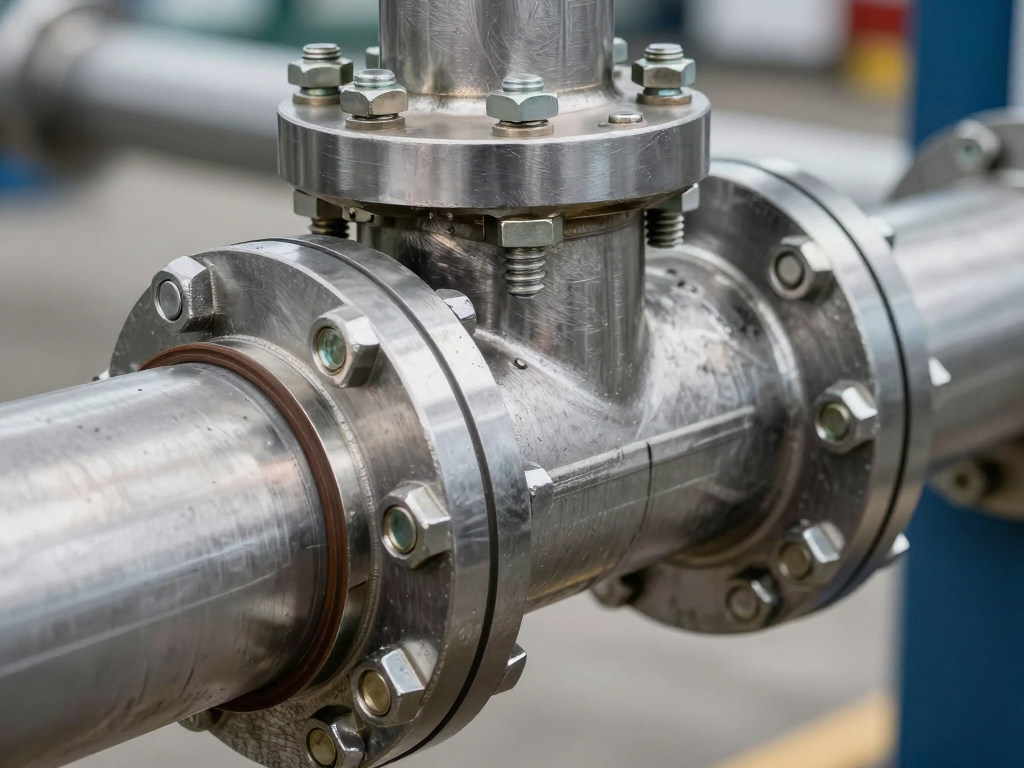
A flange is a disc-shaped fitting with bolt holes that joins two pipe sections, a pipe to a valve, or a pipe to a pressure vessel. By bolting rather than welding, flanged joints can be broken for maintenance, inspection, or equipment swap-out. In stainless systems the choice of flange type is driven by four factors: pressure, temperature, fluid hazard, and accessibility for welding.
Why does type matter so much? Because a slip-on flange in a 600# steam line is a leak waiting to happen, and a weld neck flange in a low-pressure drain line is money wasted on weld prep you did not need. Get the type right and you balance cost, integrity, and constructability.
The Six Main Stainless Steel Flange Types Compared
ASME B16.5 and EN 1092-1 recognise six principal flange types. Each has a specific structural geometry and a recommended operating envelope.
| Flange Type | Welding Required | Best For | Avoid When | Relative Cost |
|---|---|---|---|---|
| Weld Neck (WN) | Butt weld to pipe | High pressure, high temperature, hazardous fluids | Space is tight for weld prep | High |
| Slip-On (SO) | Fillet weld, both sides | Low/medium pressure, general service | Severe cyclic service | Low |
| Blind (BL) | None (caps the line) | End-of-line closure, pressure test blanks | Line needs to flow continuously | Low–Medium |
| Socket Weld (SW) | External fillet weld | Small bore (≤ 2″), high pressure | Clean service where crevice corrosion is a risk | Medium |
| Threaded (TH) | None (NPT thread) | Low pressure, non-hazardous, no-weld sites | Vibration, high temperature, hazardous fluid | Low |
| Lap Joint (LJ) | Stub end butt weld + backing flange | Stainless pipe with carbon steel backing flange, frequent dismantling | High-pressure cyclic service | Medium |
Weld Neck Flanges
The weld neck has a tapered hub that transfers stress from the flange to the pipe wall, and a butt-weld connection that can be radiographed. This is the default choice for Class 600 and above, for hazardous fluids, and for any line subject to temperature cycles. Specify a matching bore schedule (Sch 40S, Sch 80S) so the ID blends smoothly with the pipe.
Slip-On Flanges
Slip-on flanges slide over the pipe and are fillet-welded inside and outside. They are cheaper than weld necks, easier to align, and acceptable for Class 150 and Class 300 service in non-hazardous fluids. They are not recommended for lines subject to high temperature gradients.
Blind Flanges
Blind flanges cap the end of a line and are used for pressure test boundaries, future expansion, and line isolation. They carry the full pressure load across the blank, so at higher classes their thickness is significantly greater than a matching weld neck.
Socket Weld Flanges
Socket weld flanges accept the pipe into a recessed socket and are fillet-welded externally. They are common in small-bore stainless instrumentation and high-pressure hydraulic lines up to DN50. Note the gap left between pipe shoulder and socket base — this can trap fluid and crevice-corrode in chloride service, so 316L is the usual minimum grade for socket welds in process duties.
Threaded Flanges
Threaded flanges screw onto a threaded pipe end with no welding. They suit low-pressure, non-hazardous service where hot work is prohibited. In stainless systems the threads are usually NPT or BSPP and the joint is sealed with thread sealant.
Lap Joint Flanges
The lap joint combines a stub end (welded to the pipe) with a loose backing flange. This lets you use a carbon steel backing flange with a stainless stub end — a cost-effective solution for large-diameter stainless lines, and one that allows easy rotation of bolt holes during assembly.
Face Types: Raised Face, Flat Face, and Ring Type Joint
The flange face is the machined sealing surface. Three faces dominate stainless piping:
| Face Type | Geometry | Typical Gasket | Pressure Range | Notes |
|---|---|---|---|---|
| Raised Face (RF) | 1.6 mm (Class 150) or 6.4 mm (Class 300+) raised ring | Spiral wound, Kammprofile, or compressed fibre | Class 150 to Class 2500 | Most common; check serration finish |
| Flat Face (FF) | Full face, flat, no raised ring | Full-face gasket (rubber, PTFE) | Class 150, low pressure | Used with cast iron or fragile mates |
| Ring Type Joint (RTJ) | Grooved face for metal ring gasket | Oval or octagonal RTJ ring (soft iron, stainless) | Class 600 to Class 2500 | High-integrity, high-temperature sealing |
RF faces are the default for Class 150 to 400. RTJ is mandatory for most high-pressure and high-temperature hydrocarbon service and is selected when leak-tightness under thermal cycling is critical. A common procurement error is mixing an RF flange with an RTJ mate — they will not seal even under torque.
Pressure Ratings: Class 150 to Class 2500
The pressure class number is a designator, not a working pressure in psi. ASME B16.5 lists pressure-temperature ratings by class and material group. For Group 2.1 (304/304L stainless), the cold working pressure at ambient is roughly:
| Class | Cold Working Pressure (psig) | Cold Working Pressure (bar) | Indicative Rating at 200°C (bar) |
|---|---|---|---|
| 150 | ~275 | ~19 | ~14 |
| 300 | ~720 | ~50 | ~41 |
| 600 | ~1,440 | ~99 | ~82 |
| 900 | ~2,160 | ~149 | ~123 |
| 1500 | ~3,600 | ~248 | ~205 |
| 2500 | ~6,000 | ~413 | ~342 |
Two practical notes: ratings drop with temperature, so always check the B16.5 table for your design temperature; and Class 150 stainless flanges are derated sharply above 200°C, so a 150# steam line is often poor value compared with a 300# alternative.
Stainless Steel Grades: Matching the Flange to the Pipe
The flange material must be compatible with the pipe — for chemistry, for galvanic behaviour, and for weldability. The standard ASTM spec for stainless forged flanges is ASTM A182, covering forged fittings and flanges for high-temperature service.
| Grade | UNS | Key Characteristics | Typical Service |
|---|---|---|---|
| 304/304L | S30400 / S30403 | 18-8 austenitic, good general corrosion resistance, L grade for welding | Food, dairy, water, general chemical |
| 316/316L | S31600 / S31603 | 2-3% Mo, resists chloride pitting | Marine, coastal, chemical, pharma |
| 321 | S32100 | Ti-stabilised, resists carbide precipitation | High temperature, 400-800°C service |
| 347 | S34700 | Nb-stabilised, similar to 321 | High temperature, weldments prone to sensitisation |
| 904L | N08904 | High Ni/Cr/Mo, severe acid resistance | Sulphuric, phosphoric acid service |
| Duplex 2205 | S31803 / S32205 | Austenitic-ferritic, ~2x yield of 316, chloride SCC resistant | Oil & gas, seawater, chemical tankers |
Practical guidance: use the L grade (304L, 316L) wherever the flange will be welded, to avoid sensitisation in the heat-affected zone. Specify 316L as a minimum for any outdoor coastal plant. Use duplex 2205 where you need 316 corrosion resistance at higher strength — you can often drop one pressure class by upgrading the grade.
Standards: ASME B16.5, EN 1092-1, JIS B2220, GOST 12821
Standards define flange dimensions, facing, bolt holes, and pressure-temperature ratings. They are not interchangeable, even when the nominal size and class match.
| Standard | Region | Size & Class System | Bolt Hole Count / Pitch |
|---|---|---|---|
| ASME B16.5 | North America, global | NPS 1/2″ to 24″, Class 150–2500 | Imperial pitch circle, 4–20 bolts |
| EN 1092-1 | Europe | DN15 to DN600, PN2.5 to PN400 | Metric PCD, may not match ASME |
| JIS B2220 | Japan | 10K, 20K, 40K, 63K ratings | Distinct drilling — do not mix with ASME |
| GOST 12821 | Russia, CIS | PN16 to PN200, metric | Russian bolt pattern, weld neck focus |
The single most expensive mistake in cross-standard sourcing is bolting a JIS 10K flange to an ASME Class 150 flange of the same nominal size — the bolt circles do not match and the joint will not assemble. Always specify the standard, not just the size and pressure.
ASME B16.5 covers up to NPS 24″. For larger sizes (NPS 26″ and above), the governing standard is ASME B16.47 Series A or B — Series A is the MSS-SP-44 pattern (larger bolt circle, heavier), Series B is the API 605 pattern (more compact). Confirm the series with your designer before ordering.
Size Range and Sizing to Pipe OD
Stainless flanges are produced from NPS 1/2″ (DN15) up to NPS 24″ (DN600) as standard, with larger sizes available to B16.47 or custom. The critical dimension is the matching bore to your pipe outside diameter:
- Weld neck: bore must match pipe schedule (e.g. Sch 10S, Sch 40S, Sch 80S). A mismatched bore leaves a step that disrupts flow and traps fluid.
- Slip-on: ID is slightly larger than pipe OD to allow slip fit; specify the pipe schedule so the supplier machines the correct bore.
- Socket weld: socket ID matches pipe OD with a clearance of ~1.5 mm.
For stainless thin-wall pipe (Sch 5S, Sch 10S), always confirm the bore on the drawing — these schedules are increasingly common in food and pharma and a Sch 40S bore will be visibly oversized.
Forged vs Cast Flanges
For pressure piping, forged flanges are the industry standard. ASTM A182 requires forgings to be hammer or press forged from rolled bar, producing a fine, uniform grain structure with no internal porosity. Cast flanges (to ASTM A351, grades like CF8 and CF8M) are used for some valve bodies and large custom fittings, but they are not the default for piping flanges because of the risk of shrinkage cavities and lower toughness.
If a supplier offers a suspiciously cheap “A182” flange, ask for the forging route, the original bar mill certificate, and a macro-etch test report. Castings sold as forgings are a real problem in the low-cost segment of the market.
Inspection and Testing
A reputable supplier ships every flange with at least the following inspection evidence:
- Dimensional check: OD, thickness, bolt circle, raised face height, facing serration per B16.5 Table 3 (for RF, a 1.6–3.2 μm Ra finish with concentric or phonographic serrations).
- Material verification (PMI): positive material identification by XRF or OE spectroscopy on every flange, confirming Cr, Ni, Mo content. Essential when sorting 304 from 316 visually is impossible.
- Pressure test: hydrostatic or pneumatic proof of body — typically done on a sampling basis per ASTM A182, but a 100% test can be specified for critical service.
- Surface finish and marking: face finish verified by comparator; marking per B16.5 (size, grade, class, standard, heat number, manufacturer logo).
For sour service (NACE MR0175 / ISO 15156) or low-temperature service (ASTM A350 LF2 carbon equivalent, or A182 F304L tested at -196°C), additional Charpy and hardness testing applies — flag this at RFQ.
Stainless Steel Flange RFQ Checklist
Send the following data block with every enquiry and you will receive clean, comparable quotes:
- Type: WN, SO, BL, SW, TH, LJ (orifice, reducing, or long weld neck if applicable).
- Face: RF, FF, RTJ, or TG (tongue and groove).
- Rating / Class: Class 150 / 300 / 600 / 900 / 1500 / 2500, or PN6 to PN400.
- Grade: 304/304L, 316/316L, 321, 347, 904L, 2205 (UNS if in doubt).
- Standard: ASME B16.5, EN 1092-1, JIS B2220, GOST 12821, MSS-SP-44.
- Size: NPS / DN and matching pipe schedule (Sch 10S, 40S, 80S).
- Quantity per size and total.
- Surface finish: pickled and passivated (standard), or plain machined.
- Coating: none (stainless is usually bare), or paint primer on carbon steel backing flanges for lap joints.
- Inspection document: EN 10204 3.1 (standard) or 3.2 (witnessed by LR/DNV/BV/SGS).
- Special requirements: PMI 100%, NACE MR0175, low-temperature Charpy, NDT (UT or RT).
How Yihang Metal Supplies Stainless Steel Flanges to ASME B16.5 and EN 1092-1
Yihang Metal supplies forged stainless steel flange inventory in weld neck, slip-on, blind, socket weld, threaded, and lap joint types to ASME B16.5 (Class 150 to Class 2500) and EN 1092-1 (PN6 to PN400). We stock 304/304L, 316/316L, 321, 347, 904L, and duplex 2205 in sizes from 1/2″ to 24″ (DN15 to DN600), with custom large-diameter flanges to B16.47 on project lead time. Every flange ships with an EN 10204 3.1 MTC showing chemistry and mechanicals, and we can arrange 3.2 witnessed certification, 100% PMI, and NACE-compliant lots on request.
If you have a piping take-off in front of you, send us the flange list with type, face, class, grade, and standard. We will come back with a clear quotation, available inventory, and a mill rolling schedule for anything we do not have on the shelf. Contact Yihang Metal today for a stainless flange quote that holds pressure on day one and for the life of your plant.