Steel Diamond Plate (Floor Plate) Buying Guide: Anti-Slip Patterns, Grades, and Applications for Industrial Flooring
For procurement managers sourcing steel diamond plate from China, the decision is rarely as simple as picking the cheapest per-ton price. Pattern geometry, base metal grade, thickness, and the rolling standard all change how the plate performs under load, how it fabricates, and how long it lasts in service. A poorly specified floor plate can fail under dynamic loads, corrode prematurely, or arrive with a pattern that misses your customer’s anti-slip expectations. This guide walks through every decision point you need to lock down before issuing an RFQ, with technical data you can hand directly to your engineering and quality teams.
1. What Steel Diamond Plate Is and How It Differs from Checker Plate
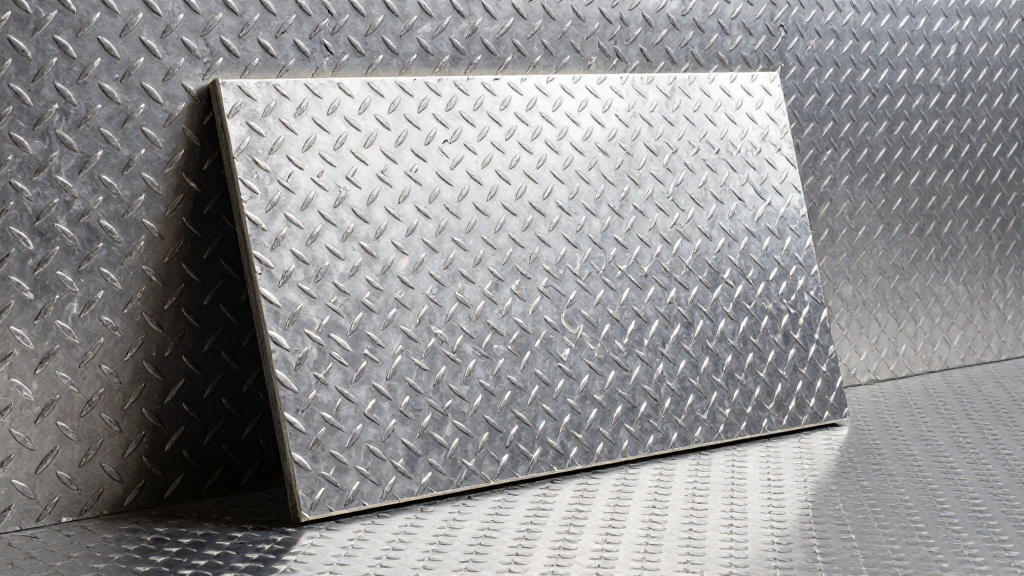
Steel diamond plate – also marketed as floor plate, tread plate, or anti-slip steel plate – is a flat rolled steel product with a raised, integrally formed pattern on one face. The pattern is rolled into the surface while the steel is hot (or, for some aluminum products, cold), so the raised lugs are part of the parent metal rather than a bonded addition. This makes the tread surface mechanically continuous with the base plate, which is why it resists peeling and wear far better than applied anti-slip coatings.
The confusion between “diamond plate” and “checker plate” is worth resolving early because it affects sourcing. In North America, checker plate vs diamond plate is largely a distinction without a difference. In European and Chinese trade usage, however, “checker plate” (花纹板) frequently refers specifically to the lentil or bean pattern, while “diamond plate” refers to the classic four-way diamond pattern. When you issue an RFQ to a Chinese mill, always specify the pattern by drawing or photo, not just by name.
Other terms you will encounter:
- Floor plate – the ASTM A786 product name; the most precise term for North American specifications.
- Tread plate – common in the UK and Australia; often applied to thinner aluminum products.
- Durbar plate – a UK trademark now generic for a specific teardrop pattern rolled to BS EN standards.
Unlike embossed or coated anti-slip surfaces, rolled raised pattern steel has lugs forged from the same heat as the flat backing. Typical lug height is 1.0–2.0 mm above the base thickness, and the raised mass represents roughly 3–8% additional metal weight per square meter. Confirm whether your supplier quotes by theoretical weight (base thickness) or actual weight – the difference can be 5% or more on volume orders.
2. Anti-Slip Patterns Compared: Raised Diamond, Lug, and Teardrop
Pattern selection affects both slip resistance and how the plate sheds liquid, mud, and debris. The three patterns most commonly rolled in Chinese mills are compared below, each with a distinct coefficient of friction (COF) profile and ideal service environment.
| Pattern | Geometry | Lug Height (mm) | Typical COF (dry, steel-to-rubber) | Best Use Case |
|---|---|---|---|---|
| Raised Diamond (菱形) | Four-way intersecting diamonds, symmetric | 1.0–1.5 | 0.60–0.75 | General industrial flooring, truck beds, platforms |
| Lug / Round Bean (圆豆形) | Discrete round or oval raised lugs in a grid | 1.2–2.0 | 0.65–0.80 | Wet/oily environments, stair treads, marine |
| Teardrop (柳叶形/Durbar) | Asymmetric teardrop lugs, one-directional | 1.0–1.6 | 0.55–0.70 | European-spec walkways, elevator cabs, architectural |
| Lentil / Bean (扁豆形) | Flattened oval lugs, single-row strip | 0.8–1.3 | 0.50–0.65 | Light-duty checker plate, decorative panels |
Four-way diamond patterns give bidirectional traction – important on surfaces where foot traffic crosses in multiple directions, such as mezzanine corners. Teardrop and lentil patterns are directional: maximum grip when walked along the lug axis, noticeably less when walked across it. For environments with oil, grease, or mud, the round lug pattern disperses liquid better than a continuous diamond grid. For visible architectural settings – elevator cabs, retail fixtures – the teardrop pattern is the most refined.
Spec tip: Request a 200 × 200 mm sample before committing to a container order. Lug height tolerance can vary ±0.3 mm between mills, and a low-lug plate that looks correct on a drawing can feel nearly flat underfoot once installed.
3. Grades and Materials: A36 Carbon, 304/316 Stainless, 5052 Aluminum
The base metal determines strength, corrosion resistance, weight, and cost – in that order of trade-off. Most floor plate sold globally is carbon steel; stainless and aluminum are specified when corrosion or weight justifies the premium. The three most common material families are compared below.
| Grade | Standard | Yield (MPa) | Tensile (MPa) | Density (g/cm³) | Relative Cost | Primary Service |
|---|---|---|---|---|---|---|
| A36 carbon steel | ASTM A786 | 250 min | 400–550 | 7.85 | 1.0 (baseline) | Structural flooring, truck/trailer beds |
| SS400 carbon steel | JIS G3101 | 245 min | 400–510 | 7.85 | 1.0 | General structural, equivalent to A36 |
| S235JR carbon steel | EN 10025-2 | 235 min | 360–510 | 7.85 | 1.0 | European-spec structural flooring |
| 304 stainless | ASTM A240 | 205 min | 515 min | 8.00 | 3.5–4.5× | Food, pharma, exterior architectural |
| 316 stainless | ASTM A240 | 205 min | 515 min | 8.00 | 4.5–5.5× | Marine, chemical, coastal |
| 5052 aluminum | ASTM B209 | 195 min (H32) | 230–290 | 2.68 | 3.0–4.0× | Trailer flooring, weight-sensitive, marine |
A36 carbon steel rolled to ASTM A786 is the workhorse spec for industrial flooring, truck beds, and stair treads. It welds readily with E7018 or ER70S-6 filler, bends cleanly in a press brake, and accepts galvanizing (hot-dip to ISO 1461 / ASTM A123, typical coating 85 µm / 610 g/m²) or powder coating. Note that lug height adds to effective thickness – a 3 mm base plate with 1.5 mm lugs will not sit flat on a 3 mm fixture without a relief recess.
304 and 316 stainless are specified in food, pharmaceutical, and coastal applications. 304 (18% Cr, 8% Ni) handles splash and humidity; 316 (16% Cr, 10% Ni, 2% Mo) is required for sustained chloride exposure – seawater, de-icing salt, bleach washdown. A No. 4 brushed finish hides scratches better than a 2B mill finish. Because yield is lower (205 vs 250 MPa), stainless diamond plate is typically specified 1.5–2.0 mm thicker than equivalent carbon steel for the same span.
5052 aluminum (H32 or H34) is a magnesium alloy with excellent marine corrosion resistance, good weldability (ER5356 filler), and roughly one-third the weight of steel. The trade-off is stiffness: aluminum’s modulus is about one-third of steel’s, so for the same deflection you need a thicker plate or closer support spacing. As a rule of thumb, a 4 mm aluminum floor plate behaves similarly to a 3 mm steel floor plate on equivalent joist spacing.
4. Thickness Selection: 1.5mm to 6mm+ by Load and Traffic
Thickness is the largest single driver of cost and service life. Underspecify and the plate oil-cans, deforms under point loads, or fatigues at welded edges. Overspecify and you pay for metal you do not need. The table below maps common thickness ranges to load and traffic class, assuming maximum joist spacing of 400 mm for steel and 300 mm for aluminum.
| Base Thickness | Service Class | Typical Load | Recommended Application | Notes |
|---|---|---|---|---|
| 1.5–2.0 mm | Light pedestrian | ≤ 1.5 kN/m² | Decorative panels, elevator cabs, light stair treads | Deforms under wheeled loads; not for carts |
| 2.5–3.0 mm | Light industrial / pedestrian + carts | 2.0–3.0 kN/m² | Mezzanine walkways, workshop access, van interiors | Most common general-purpose spec |
| 3.5–4.0 mm | Medium industrial | 4.0–5.0 kN/m² | Truck beds, trailer floors, loading ramps | Handles hand-pallet trucks and light forklift traffic |
| 4.5–5.0 mm | Heavy industrial | 5.0–7.5 kN/m² | Forklift platforms, dock plates, heavy ramps | Welded or bolted support at 300 mm max |
| 6.0 mm and above | Severe duty | ≥ 7.5 kN/m² | Mining walkways, heavy equipment decks, offshore | Often supplied to A786 Grade 50 or higher |
For truck and trailer beds specifically, 3.5–4.5 mm A36 base thickness is the industry default for light commercial vehicles (3.5–7.5 ton GVW), and 5.0–6.0 mm is standard for heavy trucks (≥ 16 ton GVW). If the bed will see forklift loading, move to 5.0 mm minimum with cross-members at 250 mm centers. For stair treads, 3.0 mm steel or 4.0 mm aluminum is the typical minimum; thinner plate flexes under foot traffic and creates a perception of poor quality even when structurally adequate.
5. Standards: ASTM A786, EN 10025, and JIS G3101
The standard you specify on an RFQ determines the chemistry, mechanical property, and tolerance regime the mill must meet. The three most relevant standards for diamond plate sourcing are compared below.
- ASTM A786 / A786M – Standard Specification for Hot-Rolled Carbon, Low-Alloy, and High-Strength Low-Alloy Floor Plate. The dominant North American spec. Covers both the raised pattern (pattern height must not reduce base thickness below the ordered minimum) and the underlying chemistry. Most Chinese mills can roll to A786 on request and issue an MTR to that standard.
- EN 10025-2 – European structural steel standard. S235JR, S275JR, and S355JR are the common grades. Pattern itself is governed by pattern-specific EN/BS documents (e.g., the historic BS 1449 for durbar). Specify both base grade and pattern explicitly.
- JIS G3101 – Japanese rolled steels for general structure. SS400 is the workhorse, broadly equivalent to A36. Patterned plate in Japan is often rolled to JIS G3134 or mill standards. Chinese mills routinely produce SS400 floor plate for Japanese and Southeast Asian markets.
For Chinese domestic supply, the controlling standard is GB/T 3277 (hot-rolled pattern steel plates). A mill rolling for export to ASTM A786 will typically cross-reference GB/T 3277 for pattern geometry and ASTM A786 for chemistry/mechanical – confirm this dual reference appears on the MTR.
Always request the mill test certificate (EN 10204 3.1 or 3.2) before shipment, not after. For floor plate, verify the certificate lists both base metal chemistry and the actual measured pattern height. A plate that meets base chemistry but rolls with a low pattern height will pass paperwork but fail in service.
6. Surface Finishes: Mill, Polished, Anodized (Aluminum)
Finish affects appearance, corrosion resistance, and post-installation maintenance. For carbon steel floor plate, the default is mill finish – hot-rolled, descaled, shipped with a light oxide. Acceptable for industrial service, but prime within 30 days of receipt to prevent atmospheric rust. Common protective options include:
- Hot-dip galvanizing – 70–85 µm zinc coating (510–610 g/m²) to ISO 1461 / ASTM A123. Pattern stays functional; best long-term outdoor protection.
- Pre-primer (shop primer) – 15–25 µm epoxy or alkyd primer at the mill. Holds plate for 3–6 months of indoor storage before topcoat.
- Powder coating – applied post-fabrication, typically 60–80 µm polyester. Good for architectural and elevator cabs; COF drops slightly.
For stainless steel, finish options mirror sheet products: No. 1 (hot-rolled, annealed, pickled) for industrial; No. 2B (cold-rolled, bright annealed) for general; No. 4 (brushed) for architectural and food; No. 8 (mirror) for decorative elevator cabs. No. 4 brushed is the most common visible-stainless choice because it hides installation scratches and matches typical handrail trim.
For 5052 aluminum floor plate, the standard finish is mill finish (a uniform matte from the rolling mill). For marine and architectural service, optional finishes include:
- Anodizing – ASTM B580, Type II (sulfuric, 10–25 µm) for architectural; Type III (hardcoat, 25–50 µm) for high-wear. Builds aluminum oxide into the surface and is far more durable than any organic coating on aluminum.
- Clear chromate conversion – improves paint adhesion and mild corrosion resistance without changing appearance.
- Polished / brushed – for decorative truck and trailer trim. Polished aluminum is more slippery than mill finish and should not be used in load-bearing anti-slip service.
7. Common Applications: Truck Beds, Stair Treads, Platforms, Elevator Cabs
Truck beds and trailer floors
The single largest volume application for steel diamond plate. Typical spec: 3.5–5.0 mm A36 base, raised diamond pattern, supplied as flat sheets (cut to bed dimensions) or pre-formed drop-side panels. Cross-member spacing on the chassis is typically 250–350 mm. For tipper trucks and dump trailers, 5.0–6.0 mm Hardox 450 or equivalent wear-grade floor plate extends floor life from 3–5 years to 8–10 years where abrasive aggregates are hauled.
Stair treads and nosings
Fabricated from 3.0 mm steel or 4.0 mm aluminum diamond plate, cut to width, bent to a 25–50 mm nosing lip, and welded or bolted to stringers. The leading edge should have the pattern running perpendicular to direction of travel for maximum grip. Pre-galvanized or aluminum treads are standard for exterior fire escapes; powder-coated steel for interior industrial stairs. Drill 10 mm drainage holes at the inside corner of each tread to prevent water pooling.
Industrial platforms and walkways
Platforms use 3.0–4.5 mm steel floor plate welded or clip-fixed to joists at 300–400 mm centers. For grating replacement (where crews complain open-bar grating drops tools), solid diamond plate at 4.0 mm is a typical upgrade. Solid plate does not drain – if exposed to rain or washdown, specify 25 mm drainage holes on a 300 mm grid, or use a perforated-back design.
Elevator cabs and architectural
Interior elevator cab wall panels, door cladding, and kick plates are a high-margin specialty market. Spec is typically 1.5–2.5 mm 304 stainless or 5052 aluminum, teardrop or fine diamond pattern, No. 4 brushed or anodized finish. Pattern alignment across panel seams is critical – specify that pattern direction must be continuous across the cab, and order all panels for one cab from a single mill heat lot to avoid subtle color/texture variation.
8. Forming and Fabrication: Bending, Welding, Cutting
Bending
In a press brake, the pattern side should face the punch (inside of the bend) wherever possible. Bending with the pattern outside risks lug cracking, particularly on hot-rolled carbon steel with a tight radius. Minimum inside bend radius: 1.5× base thickness for A36; 1.0× for 5052-H32 aluminum; 2.0× for 304 stainless due to work hardening. If you must bend with the pattern outside, increase the radius by one thickness increment.
Welding
A36 floor plate welds with standard SMAW (E7018), GMAW (ER70S-6, 75/25 Ar/CO2), or FCAW (E71T-1). For full-penetration structural welds, grind the pattern flat at the weld joint to ensure proper fusion. Stainless (304/316) requires matched filler (ER308/ER316) and low heat input to avoid carbide precipitation. Aluminum (5052) requires ER5356 or ER5554 filler, AC TIG or pulsed MIG, and complete oxide removal in the weld zone.
Cutting
All standard methods work: plasma (most economical for >3 mm steel), laser (best edge quality for architectural stainless/aluminum), waterjet (no heat-affected zone, ideal for pre-galvanized plate), and shearing (fast for straight cuts up to 4 mm). For thick steel floor plate (>6 mm), oxy-fuel is acceptable but leaves a scale edge that needs grinding. When laser-cutting aluminum, use nitrogen assist gas to avoid the black oxide edge oxygen produces.
9. How to Specify in an RFQ (Checklist)
A complete RFQ leaves no ambiguity for the supplier. Use the following checklist for every inquiry – it will reduce back-and-forth by 80% and eliminate the most common causes of dispute at inspection.
- Material grade: A36 / SS400 / S235JR / 304 / 316 / 5052-H32 – specify the exact designation, not a generic “carbon steel.”
- Standard: ASTM A786 / EN 10025-2 / JIS G3101 / GB/T 3277 – and whether MTR to EN 10204 3.1 is required.
- Pattern: Raised diamond / round lug / teardrop / lentil – attach a drawing or sample photo. Specify lug height (typical 1.0–1.5 mm) and tolerance.
- Base thickness: In mm, with tolerance (e.g., 3.0 mm ±0.15 mm per ASTM A786).
- Dimensions: Length × width in mm. State whether cut-to-size or supplied as standard mill sheets (commonly 1220 × 2440 mm or 1500 × 6000 mm).
- Flatness tolerance: Per ASTM A6 or as agreed; critical for platforms and elevator cabs.
- Finish: Mill / galvanized (specify coating mass) / pre-primed / powder-coated / anodized (Type II or III and µm).
- Quantity: In pieces, square meters, and kilograms (state whether theoretical or actual weight is the payment basis).
- Edge preparation: Mill edge, sheared, or beveled for welding.
- Packaging: Export-standard wooden pallets or steel crates, with rust-inhibitor paper and desiccant for sea freight.
- Marking: Heat number, grade, dimensions, and PO number stenciled on each bundle.
- Inspection: Pre-shipment inspection (PSI) by SGS, BV, or customer representative – state whether mandatory for release.
- Documentation: MTR, packing list, commercial invoice, CO (Certificate of Origin), and mill warranty.
- Incoterms and lead time: FOB / CIF / DDP, port of loading, and weeks to shipment from PO.
10. How Yihang Metal Supplies Diamond Plate
Yihang Metal (www.yihangmetal.com) is a Chinese steel and metal exporter specializing in patterned and structural plate for industrial buyers worldwide. Our diamond plate program is built around the spec flexibility that overseas B2B buyers need – not a single catalog SKU, but a configurable supply chain from mill to container.
- Full grade range: A36 / SS400 / S235JR carbon steel, 304 / 316 stainless, and 5052-H32 aluminum, rolled to ASTM A786, EN 10025, JIS G3101, or GB/T 3277 as your RFQ requires.
- All four pattern types: raised diamond, round lug, teardrop, and lentil – with lug height controlled to ±0.2 mm and verified on every bundle.
- Thickness from 1.5 mm to 8.0 mm, in standard 1220 × 2440 mm and 1500 × 6000 mm sheets, or cut to your exact dimensions with ±1.0 mm tolerance.
- Value-added fabrication: bending to nosing profiles, drilling drainage holes, plasma/laser cutting to shape, and welding of sub-assemblies – so the plate arrives ready to install, not just ready to cut.
- Surface treatments: hot-dip galvanizing to ISO 1461, epoxy pre-primer, powder coating, and aluminum anodizing (Type II and III), all managed under one PO.
- Quality documentation: EN 10204 3.1 MTR with every shipment, third-party inspection (SGS, BV, TUV, Intertek) supported on request, and full traceability from heat number to bundle.
- Export packaging: seaworthy wooden pallets or steel crates with VCI rust-inhibitor paper, desiccant, and stretch film – designed for 30–45 day ocean transit without corrosion complaints.
We work with procurement teams, fabricators, and trading houses across Southeast Asia, the Middle East, Africa, and the Americas. Whether you need a trial container of 3.0 mm A36 raised diamond plate for a truck-bed program, or a 200-ton platform project in 316 stainless with full fabrication, we will quote against your RFQ line by line – with realistic lead times, honest tolerance data, and mill-direct pricing.
Request a quote today. Send your diamond plate RFQ – including grade, pattern, thickness, dimensions, quantity, and destination port – to the Yihang Metal team at www.yihangmetal.com. You will receive a detailed quotation with mill options, theoretical/actual weight breakdown, lead time, and EN 10204 3.1 documentation within one business day. For project buyers, we flag any spec issues in your RFQ before quoting, so you can adjust drawings before they reach your customer. Partner with a Chinese supplier that treats your spec sheet as a contract – contact Yihang Metal and start your next diamond plate order with confidence.