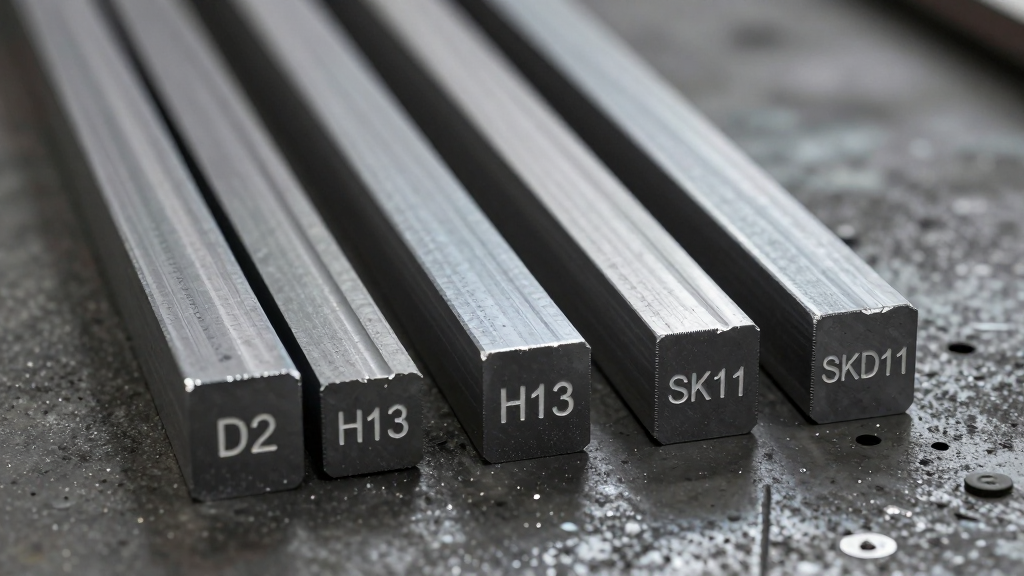
Ordering tool steel is nothing like ordering structural steel. A structural beam is specified by yield strength and sold as-is; a tool steel is specified by chemistry and sold as a starting point that only becomes a working tool after precision machining and heat treatment. Get the grade, supply condition, or hardness target wrong and you do not get a slightly weaker part – you get a die that cracks in the first 100 shots, a punch that chips on day one, or a cutting tool that loses its edge mid-run.
This guide covers the four families that dominate overseas sourcing from China – cold work tool steel (D2, O1, SKD11, Cr12MoV), hot work tool steel (H13, SKD61), shock-resistant (S7), and high-speed (M2, SKH51) – with real chemistry, hardness values, and heat treatment temperatures in °C, plus the supply-condition logic that decides what you pay for. Yihang Metal supplies all of these grades from Chinese mills, so the recommendations come from real RFQs for dies, molds, punches, and cutting tools.
1. What Tool Steel and Die Steel Are (and How They Differ from Structural Steel)
Tool steel is the family of high-carbon, high-alloy steels hardened by heat treatment so they can cut, form, shear, or contain other materials without deforming. Die steel is the working subset used to make dies and molds – cold stamping, die casting, and plastic injection tooling. Every die steel is a tool steel; not every tool steel is a die steel, and in mold making, mold steel covers the grades for plastic and rubber tooling, typically P20 or pre-hardened H13/SKD61.
Structurally, the difference from structural steel is stark:
- Carbon. Structural steels run 0.05-0.45% C; tool steels run 0.32-2.5% C, which is what allows hardening to 45-65+ HRC.
- As-supplied condition. Tool steel is normally delivered annealed – soft, about 200-260 HB, so it can be machined – reaching working hardness only through later heat treatment.
- Cost and tolerance. Tool steel costs multiples of structural steel per tonne, is sold in smaller lots, and is specified to tighter tolerances – the buyer machines it into an expensive tool.
Key mental model: structural steel is a finished material; tool steel is a semi-finished one. When you buy D2 or H13 you buy a chemistry and a machinability condition – performance is created later by heat treatment, and a supplier that cannot state annealed hardness or heat treatment response is not really supplying tool steel.
2. The Four Families: Cold-Work, Hot-Work, Shock-Resistant, and High-Speed
Tool steels are grouped by the job they do; each family fights a different failure mode – wear, heat, impact, or cutting speed.
Cold-work tool steel (D2, O1, A2, SKD11, Cr12MoV)
Cold work tool steel runs below about 200°C: stamping dies, punches, and shear blades, holding an edge against abrasive wear without chipping. Workhorse grades are D2 and O1; SKD11 and Cr12MoV are the JIS and GB equivalents of D2.
Hot-work tool steel (H13, SKD61)
Hot work tool steel keeps its hardness at service temperatures of 300-650°C: die casting, extrusion, and forging dies. H13 is the global standard; SKD61 and 4Cr5MoSiV1 are its JIS and GB near-equivalents, alloyed for temper resistance rather than maximum hardness.
Shock-resistant tool steel (S7)
Shock-resistant tool steel trades hardness for toughness: chisels, punches, shears, and riveting tools that take repeated impact. S7 runs at 46-57 HRC while absorbing blows that would chip a cold-work grade.
High-speed steel (M2, SKH51)
High-speed steel keeps its hardness even when the cutting edge glows – the “red hardness” behind drills, taps, end mills, hobs, and broaches. M2 is the workhorse; SKH51 and W6Mo5Cr4V2 are the JIS and GB equivalents.
| Family | Representative grades | Service temperature | Typical hardness | Primary failure mode fought |
|---|---|---|---|---|
| Cold-work | D2, O1, A2, SKD11, Cr12MoV | Up to ~200°C | 57-62 HRC | Abrasive wear, edge breakdown |
| Hot-work | H13, SKD61 | 300-650°C | 44-52 HRC | Softening, heat checking, thermal fatigue |
| Shock-resistant | S7 | Ambient to ~300°C | 46-57 HRC | Cracking, chipping under impact |
| High-speed | M2, SKH51 | Up to ~600°C at the edge | 62-65 HRC | Edge softening from cutting heat |
3. D2 vs SKD11 vs Cr12MoV: The Cold-Work Trio
If you source tool steel from Asia, you will meet this trio constantly: the same high-carbon, high-chromium cold work tool steel defined by three standards with slightly different chemistry windows – D2 per ASTM A681, SKD11 per JIS G4404, and Cr12MoV per GB/T 1299.
| Element | D2 (ASTM A681) | SKD11 (JIS G4404) | Cr12MoV (GB/T 1299) |
|---|---|---|---|
| Carbon, C | 1.40-1.60% | 1.40-1.60% | 1.45-1.70% |
| Chromium, Cr | 11.00-13.00% | 11.00-13.00% | 11.00-12.50% |
| Molybdenum, Mo | 0.70-1.20% | 0.80-1.20% | 0.40-0.60% |
| Vanadium, V | 1.10% max (0.50-1.10% typical) | 0.20-0.50% | 0.15-0.30% |
| Silicon, Si | 0.60% max | 0.40% max | 0.40% max |
| Manganese, Mn | 0.60% max | 0.60% max | 0.40% max |
| Hardening temperature | 1010-1065°C | 1000-1040°C | 1020-1040°C |
| Quench | Air or interrupted oil | Air | Oil |
| Working hardness | 58-62 HRC | 58-62 HRC | 58-63 HRC |
| Annealed hardness | 200-255 HB | ~230 HB max | 207-255 HB |
For most buyers, D2, SKD11, and Cr12MoV are interchangeable for blanking, stamping, and shearing – all three harden to roughly 58-62 HRC. The differences are at the edges: Cr12MoV carries less molybdenum and vanadium, making it cheaper but more prone to grain coarsening at high hardening temperatures; SKD11’s higher molybdenum gives more hardening depth; and the D2 steel grade’s vanadium refines the carbide structure.
Practically: if your drawings say D2, you can usually substitute SKD11 or Cr12MoV if the heat treatment shop adjusts the cycle – but the safe move is to specify one standard and let the mill supply to it. Beware Cr12 (without Mo and V), a cheaper, coarser cousin with lower toughness that still appears in some Chinese quotations. Where dimensional stability is critical, choose O1, which reaches 57-62 HRC from a modest 790-815°C with minimal distortion.
4. H13: The Hot-Work Standard for Die Casting and Extrusion
H13 steel (ASTM A681: 0.32-0.45% C, 4.75-5.50% Cr, 1.10-1.75% Mo, 0.80-1.20% V, 0.80-1.20% Si) is the default hot work tool steel because it resists softening at temperature, resists heat checking (the crack network that kills die casting dies), and survives thermal cycling. Its JIS equivalent is SKD61; the GB equivalent is 4Cr5MoSiV1, both with near-identical chemistry.
H13’s strength comes from secondary hardening rather than carbon alone. The standard cycle: preheat 760-815°C; austenitize 995-1040°C (most die casting work runs 1010-1030°C); quench by forced air or oil; double temper at 540-650°C, two hours minimum per temper. Typical targets: 44-48 HRC for aluminum die casting, 48-52 HRC for extrusion tooling, 40-46 HRC for large forging dies.
Buyers often ask why H13 is sold at 44-52 HRC when D2 runs at 60 HRC. The answer is the job: a die casting die surface reaches 300-400°C with every shot, and H13 steel at 60 HRC would temper itself soft and heat-check within days. At 44-48 HRC it keeps its temper resistance and toughness – which is why pre-hardened H13/SKD61 at 40-44 HRC is a normal supply condition for mold builders (section 8).
5. S7: Shock-Resistant Tool Steel for Chisels and Punches
S7 (ASTM A681: 0.45-0.55% C, 3.00-3.50% Cr, 1.30-1.80% Mo, 0.20-0.35% V) is the answer when the tool fails by chipping or breaking rather than wearing out. Chisels, punches, shear blades, and hammer tooling are S7 territory.
S7’s toughness comes from its lean carbon content and flexible heat treatment. Austenitize at 940°C, quench in oil (or air in thin sections), then temper to the hardness the job needs: 205-315°C gives about 55-57 HRC for maximum wear resistance; 400-480°C gives about 50-54 HRC, the general-purpose punch and chisel range; 540-595°C gives about 46-50 HRC for maximum toughness. When you RFQ S7, state the working hardness and tool type – 57 HRC and 47 HRC behave like two different materials.
6. M2 High-Speed Steel: When Cutting Speed Demands It
M2 (ASTM A600: 0.78-0.88% C, 3.75-4.50% Cr, 4.50-5.50% Mo, 5.50-6.75% W, 1.75-2.20% V) is the workhorse high-speed steel behind most drill, tap, end mill, and hob bars. Its JIS equivalent is SKH51 (JIS G4403) and the GB equivalent is W6Mo5Cr4V2 – the name literally spells the alloy: W6, Mo5, Cr4, V2.
What makes M2 special is red hardness: tungsten and molybdenum carbides keep the cutting edge hard at the 500-600°C temperatures of continuous cutting, where an ordinary tool steel would temper itself soft. The heat treatment: austenitize 1190-1230°C (typically ~1220°C); quench in oil, salt, or forced air; then triple temper at 540-565°C, two hours minimum each – M2 is always multiple-tempered because the first temper converts retained austenite, which the second and third refine. The result is 62-65 HRC with usable hot hardness.
7. Hardness, Toughness, and Wear Resistance: How to Read the Trade-Off
Every tool steel purchase is a decision inside one triangle: you cannot maximize hardness, toughness, and wear resistance at once. Hardness buys wear resistance and edge-holding; toughness resists cracking – and every point of hardness above the sweet spot costs toughness, and vice versa.
| Grade | Working hardness | Wear resistance | Toughness | Best for |
|---|---|---|---|---|
| M2 | 62-65 HRC | Excellent | Low | Cutting tools, drills, taps, end mills |
| D2 / SKD11 / Cr12MoV | 58-62 HRC | Excellent | Low-moderate | Blanking, stamping, slitting dies |
| O1 | 57-62 HRC | Good | Moderate | Precision dies, low-distortion cold work |
| H13 (hot work) | 44-52 HRC | Good at temperature | High | Die casting, extrusion, forging dies |
| S7 | 46-57 HRC | Moderate | Highest | Punches, chisels, shears, impact tools |
Read the table by failure mode, not by hardness number. If the tool fails by abrasive wear or lost edge, move up in hardness – but if it is also chipping, the next step is a tougher grade, not a harder one; a blanking die that chips at 62 HRC is not improved by going to 64 HRC. The most common tooling mistake is specifying maximum hardness because “harder is better” – specify the hardness at which the tool stops failing.
8. Annealed vs Pre-Hardened vs Hardened Supply Condition: What You Actually Buy
This is the single most misunderstood part of tool steel procurement, because the same grade is sold in three conditions that look similar and cost very differently:
- Annealed. Delivered soft (D2 at 200-255 HB, H13 at 180-230 HB, M2 at 241-269 HB) and fully machinable by conventional CNC. You machine the die, then send it out for hardening – the standard for D2/SKD11/Cr12MoV tooling, where the buyer owns the heat treatment and the risk. It is the cheapest condition per kilo and the only one that lets you machine complex cavities before hardening.
- Pre-hardened. Delivered already at or near working hardness – most commonly H13/SKD61 at 40-48 HRC. You machine the die with no hardening step afterward; the cost is poorer machinability and limited rework. Preferred for mold cores and cavities where heat treatment distortion is the bigger risk.
- Hardened and tempered. Delivered at final working hardness (D2 at 58-62 HRC, M2 at 62-65 HRC). You can only grind, wire-cut, or EDM the material – for finished punches and inserts where the buyer wants zero heat treatment responsibility.
The rule: buy annealed when the tool is machined then hardened (almost all cold-work tooling), pre-hardened when it is used without further heat treatment (most plastic mold work), hardened when you only grind or wire-cut to finish. A supplier quoting “tool steel” without the condition is not giving you a comparable quote.
9. Common Standards: ASTM A681, GB/T 1299, JIS G4404 (SKD11, SKH51)
The same nominal grade exists in four standards families, with slightly different chemistry windows:
- ASTM A681 – “Tool Steels Alloy”: D2, O1, A2, H13, S7 – the default for North American buyers.
- ASTM A600 – “Tool Steel High Speed”: M2, M42, and other high-speed grades.
- GB/T 1299 – Chinese tool steels: Cr12MoV (D2-type), 4Cr5MoSiV1 (H13-type), 5CrNiMo/5CrMnMo forging die steels.
- JIS G4404 – Japanese alloy tool steels: SKD11 (D2-type), SKD61 (H13-type), SKS3 (O1-type).
- JIS G4403 – Japanese high-speed tool steels: SKH51 (M2-type), SKH9, SKH2.
The map that covers 90% of sourcing: D2 ≈ SKD11 ≈ Cr12MoV (cold work), H13 ≈ SKD61 ≈ 4Cr5MoSiV1 (hot work), M2 ≈ SKH51 ≈ W6Mo5Cr4V2 (high speed), O1 ≈ SKS3 (oil hardening). The “≈” is deliberate: the chemistry windows differ, so specify the standard your part is designed around rather than the equivalent.
One practical note: Chinese mills routinely certify GB/T 1299 grades on EN 10204 3.1 mill test certificates, and the MTC chemistry is what you check against the section 3 table – certification matters more here than in structural steel, because one out-of-spec heat can ruin a whole batch of expensive dies.
10. Machining, Heat Treatment, and EDM Considerations
Machining the annealed stock
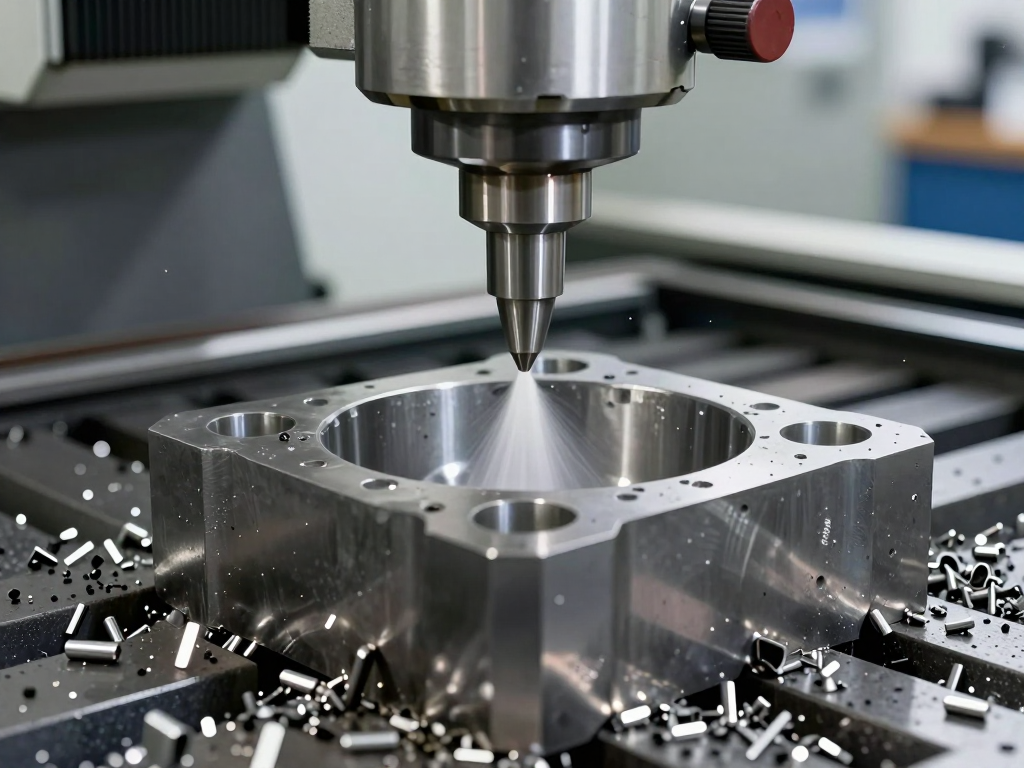
Annealed tool steel machines well with carbide tooling but needs roughly half the cutting speed of mild steel and rigid setups, because D2 and Cr12MoV work-harden if the tool rubs instead of cuts. Leave allowance for heat treatment distortion – D2 and Cr12MoV grow about 0.1-0.2% during hardening, H13 about 0.05-0.1%.
Heat treatment ownership
Who heat treats is a procurement decision as much as a technical one. If you buy annealed, your heat treatment shop owns the austenitizing temperature, quench medium, tempering schedule, and the risk of decarburization (surface carbon loss that leaves a soft, un-hardenable skin – why precision tooling is vacuum hardened). The heat treatment specs in sections 3-6 are the values to write into your PO. For D2, an optional cryogenic treatment at about -150°C between tempers improves dimensional stability and edge wear.
EDM after hardening
Wire and sinker EDM are how hardened tooling gets its final cavities – but EDM leaves a recast (white) layer with micro-cracks and tensile stresses, and dies that skip finishing steps crack from it under load. The correct sequence: EDM roughing, a low-energy finishing pass, grind or polish off the recast layer, then a final temper (15-30°C below the last tempering temperature) to relieve EDM stresses.
11. RFQ Checklist for Tool Steel
A tool steel RFQ that returns comparable quotes contains these ten items – anything missing invites the mill to interpret, and interpretation is where problems start:
- Grade and standard together: e.g., “D2 per ASTM A681”, “SKD11 per JIS G4404”, “H13 per ASTM A681”, “M2 per ASTM A600”. Never “tool steel” alone.
- Supply condition: annealed, pre-hardened (with target HRC), or hardened and tempered (with target HRC range).
- Form and dimensions: round bar, flat bar, plate, or square, with tolerance class and surface condition (black, peeled, or ground for M2 bar).
- Quantity in pieces and total weight – pricing changes dramatically between one bar and a full heat.
- Working hardness target (e.g., 58-62 HRC for D2, 44-48 HRC for H13) so the supplier can confirm the grade.
- Application or tool type: stamping die, die casting die, punch, shear blade, drill blank – one sentence of context lets a good supplier flag mismatches before you pay for them.
- Certification: EN 10204 3.1 mill test certificate with full chemistry per heat (3.2 witnessed certificates for critical programs). Our guide to reading MTCs covers what to check on arrival.
- Delivery terms (FOB, CIF, DDP) and port – tool steel is usually consolidated with other steel, so lead time matters more than freight.
- Special requirements: ultrasonic testing for die blocks, restricted sulfur for EDM-grade material, decarburization limits on round bar.
- Hardness conversion basis if you compare HB and HRC values – the tables in our HB/HRC/HV guide are the reference we use.
12. How Yihang Metal Supplies Tool Steel and Die Steel
Yihang Metal supplies the full range covered in this guide – D2, O1, and A2 cold work; H13 and SKD61 hot work; S7 shock-resistant; and M2/SKH51 high-speed steel – in round bar, flat bar, plate, and square, certified to ASTM, GB/T, or JIS as you specify. A Yihang Metal quotation includes:
- Grade and standard called out explicitly, with supply condition stated – no ambiguity about what you are buying.
- Full chemistry on the EN 10204 3.1 MTC per heat, checked against the grade windows before shipment.
- Heat treatment guidance with the austenitizing and tempering temperatures for your grade and target hardness.
- Processing options: cutting to length, sawing, peeling/grinding for M2 bar, flatness guarantees for die plates.
- Export packing for tool steel: rust-preventive oil, VCI wrap, and moisture-barrier protection.
- Consolidation with other steel orders, so a small tool steel requirement rides in the same container instead of paying airfreight.
Because we quote all four families side by side, we can also tell you when the requested grade is not the cheapest that will do the job.
Ordering D2, H13, SKD11, S7, or M2 for a die, mold, or cutting tool program? Send us your specifications – grade and standard, supply condition, dimensions, quantity, target working hardness, and the tool type. The team at Yihang Metal will confirm the correct grade and heat treatment cycle to reach your target HRC, and quote delivered to your port with full EN 10204 documentation. Send us your RFQ today for a quoted price within 24 hours.