Steel Coil and Sheet Storage & Rust Prevention Guide: VCI Packaging, Climate Control, and Warehouse Practices for Imports
Every coil of steel starts its corrosion clock the moment it leaves the mill. For importers buying from China, the four to ten weeks of ocean transit, equatorial heat, condensation, and warehouse time between “shipped” and “on your line” is where rust claims are born — and prevented. This guide covers steel rust prevention, what VCI packaging can and cannot do, humidity steel corrosion thresholds, desiccant sizing, and steel warehouse storage practices for imported coils and sheets.
The single most important number in steel storage is 60% relative humidity. Below it, steel corrodes slowly. Above it, the rate climbs fast. At 80% RH and above, you are storing steel in a rainstorm you cannot see.
1. Why Steel Rusts in Transit and Storage (and Who Is Responsible)
Rust is electrochemical: iron dissolves into ions wherever a thin film of water exists on the surface, while oxygen completes the circuit. Clean steel needs surprisingly little water: above roughly 60% relative humidity a microscopic moisture layer forms even without visible condensation. Supply chains add accelerants: chlorides from sea air, dust holding moisture against the surface, temperature swings condensing water inside containers, and acid residues.
Responsibility splits three ways: the exporter for seaworthy, export-grade packing (ASTM D3951 describes minimum levels); the carrier for physical damage in transit; the consignee for storage after discharge. Under most INCOTERMS risk passes at the port of loading, but goods must still arrive merchantable. The practical lesson: specify packing in your contract, photograph every coil at discharge, and know your claim window — typically 14 to 30 days, with a third-party survey (SGS, Bureau Veritas) required.
2. The Corrosion Timeline: Mill Scale, Flash Rust, White Rust, and Red Rust
The corrosion stage tells you how long it has been forming and whether it is recoverable:
- Mill scale — the blue-black magnetite layer from hot rolling. It slows corrosion but cracks under coiling and handling, exposing fresh steel at the cracks.
- Flash rust — a thin orange-brown deposit that can form within hours on a wet surface. It wipes off and is not rejectable by itself.
- White rust — the chalky zinc deposit on galvanized steel kept wet — covered in section 9.
- Red rust — active corrosion of the iron itself. Once it pits into the base metal, the affected area is a permanent defect.
The timeline is environment-driven. Clean steel at 40–50% RH sits for months; at 60–70% RH it stains within weeks; above 80% RH, or with condensation and salt, it can flash-rust within 24–48 hours and show red rust within days. A wet coil stacked in a humid warehouse — “wet stacking” — can develop white rust across much of its surface in under two weeks.
3. VCI (Volatile Corrosion Inhibitor) Packaging: How It Works, Film Types, and Limitations
How VCI works
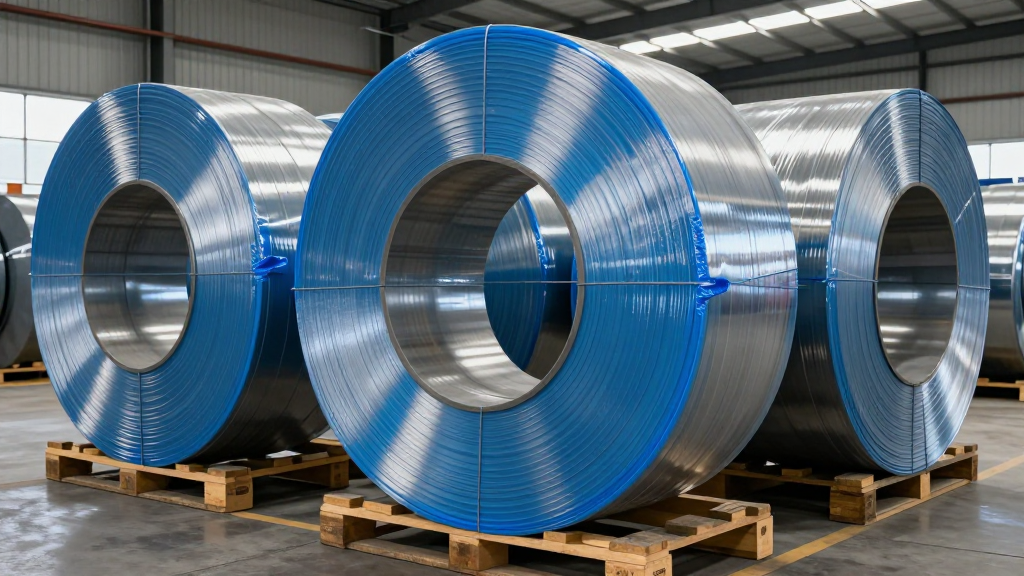
VCI packaging is the workhorse of export steel protection. VCI compounds — usually amine-based salts — sublimate inside a sealed package, diffuse into every crevice, and adsorb onto the metal as a monomolecular layer blocking the electrochemical reaction. Because it works through vapor, it reaches surfaces that never touch the film — including the inside of a tightly wound coil.
VCI film types and grades
VCI film is low-density polyethylene (LDPE) compounded with inhibitor — single-layer, or co-extruded multilayer with a nylon or EVOH barrier for humid routes. Practical grades: standard film at 60–100 µm for short transit and dry destinations; high-barrier film at 100–150 µm for long ocean routes, tropical climates, and storage beyond a few months; metallocene film for better puncture resistance. Sealed VCI film protects steel 12–24 months; reputable exporters use film tested to MIL-PRF-3420 or GB/T 19532.
Limitations you must know
- VCI only works sealed. A torn bag or punctured shroud vents the inhibitor away, often within days.
- VCI is not a desiccant. Wet steel wrapped in VCI film still corrodes, and trapped moisture makes it worse.
- It cannot protect oil-covered surfaces and will not repair existing rust.
- Performance drops above roughly 60–70 °C.
Mental model: VCI film is the umbrella, desiccant the dehumidifier, and dry, clean steel the requirement before either goes on.
4. VCI Film vs Paper vs Powder vs Emitters: Which to Choose
VCI comes in several forms with clear best uses — for coils and sheets, film is nearly always the right primary barrier, with paper for interleaving and emitters for sealed cavities.
| Type | How it protects | Typical life | Best for | Limitations | Relative cost |
|---|---|---|---|---|---|
| VCI film (LDPE, 60–150 µm) | Vapor emission inside a sealed wrap | 12–24 months sealed | Coils and sheet packs in transit and long-term storage | Needs airtight seal; punctures shorten life | $$ |
| VCI paper (kraft, 40–120 g/m²) | Inhibitor coating; contact plus vapor | 6–12 months | Interleaving between sheets in crates; small parts | Less robust outdoors; pair with film for transit | $ |
| VCI powder (loose or sprayed) | Direct application to large exposed surfaces | 3–12 months before reapplication | Container interiors, hard-to-wrap shapes | Messy; needs clean, dry surface; reapplication required | $ |
| VCI emitters (capsules, foam inserts) | Concentrated vapor release from a single point | 12+ months per emitter | Crates and sealed containers where film is impractical | Limited coverage radius; only works in a sealed space | $$ |
Use high-barrier VCI film as the inner wrap against the steel, VCI paper between layers in sheet crates, and one or two emitters inside large sealed packages; powder is rarely right for finished coils. Whatever you choose, the package is only as good as its seal — a loose corner turns VCI packaging into plain plastic.
5. Climate Control: Humidity, Temperature, and the 60% RH Rule
The 60% RH rule
Corrosion specialists call 60% relative humidity the “critical humidity” for steel — where humidity-driven steel corrosion starts accelerating. Below 40–50% RH, corrosion is negligible on clean steel; between 60% and 80% it climbs as the adsorbed moisture layer thickens; above 80%, and whenever condensation occurs, you are in severe-corrosion territory. The warehouse rule: target 40–55% RH, alarm at 60%, act at 65%.
Temperature and condensation
Relative humidity is temperature-dependent, so temperature control matters as much as dehumidification. A container crossing the equator can reach 50–60 °C by day and drop 10–15 °C at night; when steel surface temperature falls within a few degrees of the dew point, condensation forms directly on the metal. So: keep coils off cold floors and exterior walls; ventilate or dehumidify so daily swings never cross the dew point; store at 10–30 °C and 40–55% RH.
Dehumidification in practice
For warehouses, desiccant or refrigerant dehumidifiers sized to the building hold RH at target; log twice daily. For sealed containers, use container desiccant rods — sizing in section 6. The goal everywhere: keep the air around the steel below the 60% RH line.
6. Desiccants and Silica Gel: When They Help and When They Don’t
Desiccant types and capacity
Desiccants remove water vapor from sealed air, rated by absorption at given humidity. Silica gel, the classic: one unit (typically 30 g) absorbs about 3 g of water at 20% RH, 6 g at 40% RH, and 9 g at 80% RH, with indicator types changing color when saturated. Clay desiccant: cheaper, slightly lower capacity, fine for short transits. Calcium chloride: two to three times the capacity of silica gel, but it deliquesces and must be contained in permeable bags or hanging rods — the standard for ocean containers.
Sizing and placement
A practical rule is roughly one kilogram of high-capacity container desiccant per 5–10 m³ of sealed air, adjusted for route and transit length; most ocean shipments use 2–4 rods per 20-ft container and 4–8 per 40-ft container. Inside packaged coils, a few units of silica gel per cubic meter of package volume is the usual starting point; keep desiccants off the metal and replace them when indicators show saturation.
When desiccants do not help
Desiccants fail in three situations: an open or leaky package (they only dry air sealed with the steel); liquid water (they remove vapor, not water, and never dry a coil packed wet); and an open warehouse (a dehumidifier’s job). Corollary at receiving: never wrap wet or damp steel in VCI film — dry it first, then seal it.
7. Warehouse Storage Best Practices: Dunnage, Air Circulation, Coil Positioning
Dunnage and ground isolation
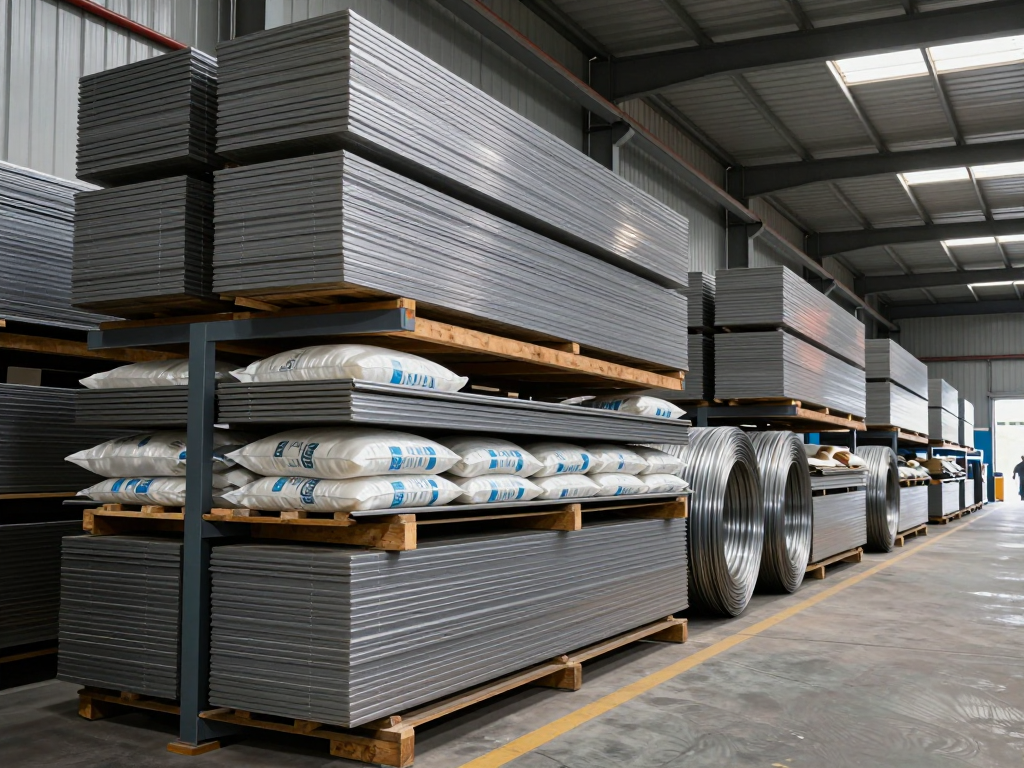
Good steel warehouse storage never puts steel directly on concrete — concrete is cold, porous, and releases moisture, the classic source of “rust on the bottom wrap” claims. Use wooden or steel dunnage to raise coils and sheet packs at least 10–15 cm off the floor, place a moisture barrier (PE film or waterproof kraft paper) between dunnage and steel, and keep stacks away from exterior walls and roof leaks.
Air circulation
Stagnant floor-level air holds the most moisture. Maintain aisles, keep coils off walls and vents, and let air move around every package — tight wall-to-wall stacking defeats ventilation.
Coil positioning
Steel coil storage basics: do not stack coils more than two to three high; use separators between stacks, aligned over the coil ID; for long-term storage stand coils on their flat face (eye to the sky), since resting soft strip on its edges deforms bottom wraps, and protect eyes and edges with cardboard protectors. Segregate galvanized and uncoated stock, and rotate FIFO so nothing sits past its protection window.
8. Oil-Coated vs Dry Material: Surface Condition and Its Storage Implications
Imported steel arrives either dry or with a rust-preventive oil film, and the choice changes everything downstream. Dry material — typical for cold-rolled and galvanized coils — is clean and ready to process, but depends entirely on packaging and climate for rust protection. Oil-coated material carries a thin film of rust preventive oil (RPO), typically 3–20 g/m², that blocks moisture contact and extends unprotected storage life to six months or more. The trade-offs:
| Factor | Oil-coated (RPO) | Dry (no oil) |
|---|---|---|
| Rust protection | High — oil film blocks moisture contact | Low to medium — depends on VCI and climate control |
| Storage life (covered warehouse) | 6–12+ months without re-treatment | 1–3 months unprotected; up to 24 months sealed with VCI |
| Processing readiness | Needs degreasing before painting, welding, plating | Ready for direct processing |
| Handling | Oily, slippery, attracts dust | Clean, easy to handle |
| Cost | Oil application plus degreasing | Higher packaging and storage cost |
| Best use | Hot-rolled, long storage, coastal and tropical transit | Material for quick processing or VCI-packed supply |
The decision rule: if material sits more than a month or two, match surface condition to your process — dry material with proper VCI film packaging if you need it clean for immediate line use; oiled material if you want storage flexibility and can absorb a degreasing step. State your preference in the order, not after the coil arrives.
9. White Rust on Galvanized Coils: Causes, Prevention, and Acceptance Limits
What causes white rust
White rust — wet storage stain — is the chalky zinc hydroxide/carbonate deposit that forms when galvanized steel stays wet. It is the number-one surface complaint on imported galvanized coils, and its cause is almost always trapped moisture: wet stacking, temperature cycling condensing water between tight wraps, or packaging that sealed moisture in with the coil. It matters because the zinc layer is the coil’s protection — every micron consumed is service life lost, and severe cases pit through to red rust.
Acceptance limits
Standards are more lenient than most buyers expect: ASTM A653 sets no numeric rejection threshold for white rust, and inspection practice accepts light, non-pitting stain that wipes off with a dry cloth. Claims start where zinc is actually consumed: light — superficial film, no pitting, normally acceptable; moderate — dense deposit with shallow etching, evaluate per contract, often settled with a price allowance; severe — pitting into base metal or red rust breakthrough, rejectable. Verify by cleaning a test area and comparing zinc coating weight against the certificate (ASTM A90) — weight loss confirms real consumption.
Prevention
Prevention is simple: keep the zinc dry — dry material at packing, dehumidified containers with desiccant, intact VCI film, no tight stacking of wet coils, storage at 40–55% RH. For tropical or long routes, ask for tropical-route packaging: extra desiccant, higher-grade barrier film, documented dry-pack inspection.
10. Handling Damage vs Rust: Telling the Difference at Receiving
Claims live or die on telling rust from mechanical damage, because they are claimed against different parties: rust against the exporter or packer; handling damage (forklift marks, crushed edges, dents, strap cuts) against the carrier or warehouse. The two look similar but tell different stories:
- Rust patterns follow moisture — edges, labels, contact points with dunnage or straps, and condensate flow lines. It is a uniform surface film that wipes off unless it has pitted.
- Handling damage is mechanical — bright-metal gouges, dents, and tool marks in localized spots, often on one side matching a forklift or grapple. Exposed metal flash-rusts afterward, but the deformation underneath is the real story.
- Test before deciding — clean a patch with a dry cloth: rust lifts off, a dent does not. Then ask: does rust follow a mechanical mark (damage first) or spread across a clean surface (moisture first)?
Photograph the first wrap and the last wrap of every coil at discharge, with a ruler in frame. Edge damage and rust patterns tell different stories — and both stories need a date.
Receiving procedure: inspect before signing the delivery receipt, note exceptions in writing, photograph everything, file carrier claims within the bill of lading window, and arrange a third-party survey for supplier claims within your contract’s 14–30-day period.
11. Storage and Preservation Checklist for Buyers
Use this checklist as the operating manual for your steel yard.
- Before shipment: specify packing in the contract — VCI film grade and thickness, desiccant quantity, dunnage, crate construction, and surface condition (oiled vs dry).
- At discharge: check container condition and log interior RH if possible; photograph every coil’s outer wrap and edges; inspect the first and last wraps; note exceptions on the delivery receipt.
- First week: spot-check inner wraps; wipe-test any staining; re-wrap with VCI film and fresh desiccant before long-term storage; never seal wet steel.
- Ongoing: log warehouse RH twice daily; inspect stocks monthly; rotate FIFO; replace saturated desiccants; re-treat anything approaching the end of its protection window.
| Parameter | Target / limit | Action |
|---|---|---|
| Warehouse relative humidity | 40–55% (never above 60%) | Run dehumidifiers; log twice daily |
| Surface temperature swing | Below 5–10 °C per day | Ventilate, insulate floors, keep steel off concrete |
| Unprotected storage duration | Under 3 months | Re-wrap with VCI film and desiccant at 3 months |
| Sealed VCI storage | Up to 24 months | Inspect quarterly; verify seal integrity |
| Container RH (sealed) | Below 60% | Desiccant rods: 2–4 per 20-ft, 4–8 per 40-ft container |
| White rust at receiving | Light stain acceptable; pitting or red rust is a defect | Wipe test, photos, third-party survey within 14 days |
12. How Yihang Metal Packs and Protects Steel for Ocean Transit
At Yihang Metal (www.yihangmetal.com), export packing is treated as part of the product. Every shipment of hot-dip galvanized, cold-rolled, and coated coils and sheets is packed for the actual route: inner VCI film in export grades matched to transit time, waterproof kraft paper and steel strapping, wooden or steel pallets and crates for sheets, edge protection, and dunnage laid so coils arrive square and dry. For tropical and high-humidity destinations the package is upgraded with extra desiccant, higher-barrier film, and container desiccant rods, and every order can be documented with third-party inspection (SGS, Bureau Veritas, Intertek) and pre-shipment photos. Mill test certificates travel with every shipment.
Tell us your destination port, transit time, and how long material will sit in your warehouse, and a sales engineer will match packaging, surface condition, and desiccant loading to your real conditions — the difference between steel that arrives looking like the certificate and steel that arrives looking like a claim.
Get a Packing Proposal with Your Next Quote
Rust claims are expensive, slow, and almost always preventable — the cheapest corrosion control is a packing specification written before the coil is made. Yihang Metal ships thousands of tons of galvanized and cold-rolled steel yearly to buyers across Southeast Asia, Africa, the Middle East, and Latin America, tailoring packaging to tropical routes, long transits, and long warehouse holds. Send us your destination port, transit time, and storage plans, and we will respond with a complete quote plus a free storage and packaging recommendation. Request a quote today at www.yihangmetal.com — and get the rust prevention steel buyers actually need: packaging matched to your route.