Carbon Equivalent (CEV, Pcm, CET) Explained: How Buyers Should Judge Weldability Before Ordering Steel
Carbon equivalent is the number that decides whether a steel plate, pipe, or section can be welded in the field without preheat, whether it needs a controlled procedure, and whether the finished weld will crack in service. It is also the number most often missing from a purchase order — and the one that causes the most expensive surprises after delivery.
The problem is not that CEV is difficult. The problem is that there are three different formulas in common use, they give different numbers for the same steel, and each standard that defines one also defines its own acceptable limit. A buyer who asks for “CEV ≤ 0.40” without naming the formula has not actually specified anything enforceable.
This guide explains what each formula measures, which standard to reference for which product, and how to write a requirement that a mill can accept or reject unambiguously.
What Carbon Equivalent Actually Predicts
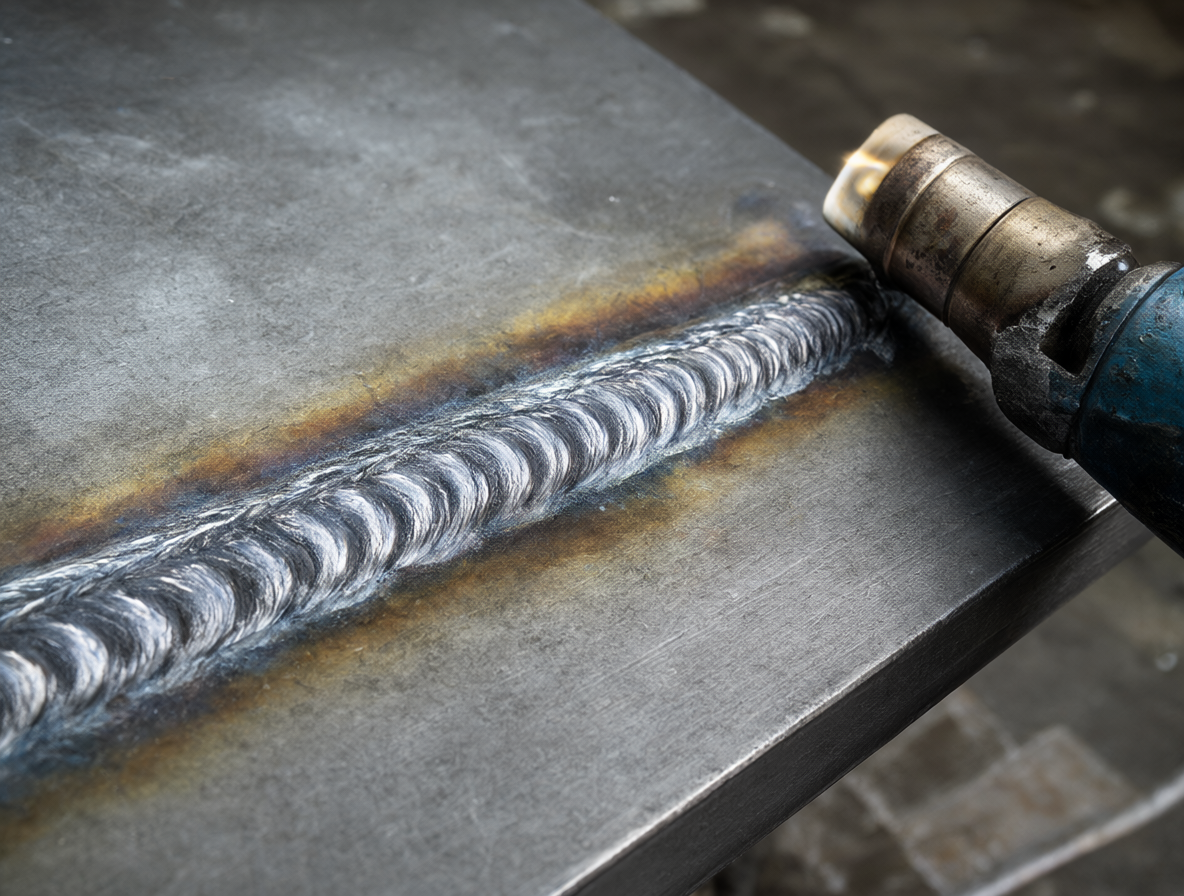
When you weld steel, the metal next to the weld pool — the heat-affected zone, or HAZ — is heated rapidly and then cools rapidly, because the surrounding cold metal acts as a heat sink. That fast cooling transforms the steel into hard martensite if there is enough carbon and enough alloying element to make it harden.
Hard martensite in the HAZ is the root cause of hydrogen-assisted cold cracking. The harder the HAZ, the more sensitive it is to hydrogen trapped in the weld, and the more likely a crack appears hours or days after welding — often after the component has been shipped.
Carbon equivalent compresses all the hardening elements into one number, so a fabricator can decide preheat temperature and heat input from a single figure rather than a full composition analysis. That is its entire purpose: CEV is a weldability index, not a quality grade.
| CEV range | Practical weldability | Typical action |
|---|---|---|
| ≤ 0.35 | Excellent | No preheat for thin sections; routine procedures |
| 0.36 – 0.40 | Good | Preheat 50–100 °C for thicker sections; controlled heat input |
| 0.41 – 0.45 | Moderate | Preheat 100–150 °C; qualified WPS; low-hydrogen electrodes |
| 0.46 – 0.50 | Difficult | Preheat 150–200 °C; strict heat input control; PWHT may be required |
| > 0.50 | Restricted | Special procedure qualification; consider a different grade |
These bands are indicative, not universal. Section thickness matters as much as CEV — a 6 mm plate at CEV 0.45 is far easier to weld than a 60 mm plate at the same CEV, because the thicker section removes heat faster. Any preheat decision must consider both.
The Three Formulas and What Each One Is For
This is where most purchase orders go wrong. The formulas are not interchangeable.
1. IIW / CEV formula — the general-purpose one
The original International Institute of Welding formula, adopted by AWS and used throughout ASTM and EN product standards for carbon and carbon-manganese steels:
CEV = C + Mn/6 + (Cr + Mo + V)/5 + (Ni + Cu)/15
This is the number you will see quoted for structural plate (ASTM A36, A572, EN 10025 S275/S355), pipe (API 5L, ASTM A106, A53), and most general engineering steels. When a standard says “carbon equivalent shall not exceed 0.43” without further definition, it almost always means this formula.
Note the weighting: manganese counts one-sixth of carbon, chromium/molybdenum/vanadium one-fifth, nickel/copper one-fifteenth. Carbon dominates, which is why a small carbon reduction buys a large CEV reduction.
2. Pcm formula — for low-carbon and high-strength steels
The IIW formula was calibrated on steels with 0.10–0.25% carbon. For modern low-carbon micro-alloyed steels — where carbon may be 0.05–0.09% and the hardening comes from niobium, titanium, and boron rather than carbon — the IIW formula under-predicts cracking risk.
Pcm = C + Si/30 + (Mn + Cu + Cr)/20 + Ni/60 + Mo/15 + V/10 + 5B
The boron term (multiplied by 5) is the giveaway. Even 0.002% boron has a strong effect on hardenability, and the IIW formula ignores it entirely. Pcm is standard in API 5L for higher-grade line pipe (roughly X70 and above) and in offshore specifications.
A steel with CEV of 0.36 could have a Pcm of 0.20 or 0.24 — the two numbers are not comparable and must never be mixed in one specification.
3. CET formula — the EN 1011-2 approach
EN 1011-2 uses a different formula intended specifically to drive preheat calculation:
CET = C + (Mn + Mo)/10 + (Cr + Cu)/20 + Ni/40
CET gives lower numbers than IIW CEV for the same steel, typically by 0.03–0.05. It exists because the preheat nomograms in EN 1011-2 were built around it. If you specify CET but your fabricator’s procedure uses IIW nomograms, the preheat will be wrong.
Which Formula Applies to Which Product
| Product / standard | Formula normally referenced | Typical requirement |
|---|---|---|
| ASTM A36, A572, A588 plate | IIW CEV | ≤ 0.45 (A572 Gr.50), varies by grade |
| EN 10025-2 S275 / S355 | IIW CEV | ≤ 0.40 / ≤ 0.45 typical; option for ≤ 0.39 |
| API 5L line pipe X52–X65 | IIW CEV, Pcm for higher grades | ≤ 0.43 / ≤ 0.25 Pcm |
| API 5L X70 and above | Pcm | ≤ 0.23 – 0.25 |
| ASTM A106 / A53 pipe | IIW CEV | ≤ 0.50 typical |
| EN 10217 / EN 10216 tube | IIW CEV or CET | Per grade and option |
| Shipbuilding AH36 / DH36 | IIW CEV | ≤ 0.40 (AH) / ≤ 0.39 (DH) |
| Quenched and tempered plate (S690) | Pcm or CET | Low carbon design; procedure-led |
The practical rule: for carbon-manganese structural steels, quote IIW CEV. For low-carbon high-strength and line pipe X70+, quote Pcm. For anything where EN 1011-2 preheat tables will be used, quote CET — and say so explicitly.
How CEV Is Controlled at the Mill
Buyers often assume CEV is measured. It is not — it is calculated from the ladle analysis, and the mill adjusts the heat composition to keep it inside the limit for the grade. That has three consequences worth understanding.
- The number comes from ladle analysis, not product analysis. Product analysis (a sample cut from the finished plate) may differ slightly from ladle analysis because of segregation. Most standards apply the CEV limit to ladle analysis and allow a small product-analysis tolerance. If your specification does not say which, you will argue about it later.
- A tight CEV cap costs money. Requiring CEV ≤ 0.38 on an S355 order forces the mill to use lower-carbon or cleaner scrap and more careful alloy addition. Asking for a limit well below what the grade naturally produces will either raise the price or get the order declined.
- CEV explains strength variation. Two heats both meeting S355 can differ in CEV by 0.05, and the higher-CEV heat will be stronger and harder but less weldable. If your fabrication needs consistent forming behaviour, specify a CEV range, not just a maximum.
What to Put on the Purchase Order
A CEV clause that cannot be misread needs four elements:
| Element | Weak wording | Enforceable wording |
|---|---|---|
| Formula | “CEV max 0.40” | “Carbon equivalent per IIW formula: CEV = C + Mn/6 + (Cr+Mo+V)/5 + (Ni+Cu)/15” |
| Basis | (unstated) | “Calculated from ladle analysis” |
| Limit type | “low CEV” | “CEV ≤ 0.40, maximum” |
| Verification | (unstated) | “Composition reported on EN 10204 3.1 MTC for each heat” |
The verification line matters more than it looks. A CEV limit with no composition reporting requirement is unverifiable — you receive a certificate that says “CEV: 0.38” with no supporting chemistry, and you have no way to check it. Requiring the full chemical analysis on the MTC lets you recompute the number yourself.
If welding will happen in a critical application — pressure, structural, offshore, low temperature — also require the weldability option in the product standard where one exists, and ask for the heat numbers so welding procedures can be traced to specific plates.
Common Buying Mistakes
Mixing formulas. Specifying “CEV ≤ 0.40 (Pcm)” on an S355 plate order. The mill will apply Pcm, the number will look excellent, and the plate may still be difficult to weld because its IIW CEV is 0.47.
Ignoring thickness. Applying a thin-plate CEV limit to a 50 mm section. Thick sections need lower CEV, not the same CEV, because heat extraction is faster.
Forgetting the HAZ hardness check. Some specifications cap HAZ hardness (commonly 350 HV10) as an alternative or additional control. If hardness is the real requirement, say so — CEV is a proxy, and a proxy can be satisfied while the outcome is not.
Over-tightening on commodity grades. Requiring CEV ≤ 0.36 on A36 plate that routinely runs 0.42 will cause rejections or a price premium disproportionate to the benefit. Match the limit to the actual welding procedure.
FAQ
Is lower CEV always better? No. Lower CEV usually means lower carbon and therefore lower strength and hardness. If the application needs wear resistance or strength from the base metal, a very low CEV may force a thicker section or a different grade. Weldability and base-metal performance trade against each other.
Can a mill guarantee CEV on every plate? It guarantees it per heat, from ladle analysis. Within-heat variation across a large plate is small but real. For critical work, ask for the heat number on each plate so the composition can be traced.
Does CEV apply to stainless steel? Not in the same way. Austenitic stainless is not hardened by martensite formation in the HAZ, so carbon equivalent is not the controlling index. Stainless weldability is governed by carbon content (hence the “L” grades), stabilisation with titanium or niobium, and ferrite content — a different set of rules.
What if the MTC does not state CEV? Recompute it from the chemistry. All the elements needed are normally on the certificate. If any are missing — boron in particular, for Pcm — request the full analysis before accepting.
Does CEV replace a welding procedure qualification? No. CEV tells you roughly how much care is needed; a WPS/PQR tells you what actually works. CEV is a screening tool to avoid buying steel that cannot be welded economically, not a substitute for procedure qualification.
Why Source Weldability-Controlled Steel from Yihang Metal
We supply carbon, carbon-manganese, and low-alloy steel as plate, coil, sheet, pipe, tube, bar, and structural sections, with the composition reporting that makes a carbon equivalent requirement actually enforceable.
- Full chemistry on the MTC — C, Mn, Si, P, S, Cr, Mo, Ni, V, Cu, and B where relevant, so you can recompute CEV, Pcm, or CET yourself rather than trusting a single printed number.
- Formula stated on the certificate — we will state which carbon equivalent formula the limit is measured against, so there is no ambiguity at goods-in inspection.
- Heat number traceability — plate and pipe marked with heat numbers that match the certificate, so welding procedures can be tied to specific material.
- Grade and standard coverage — ASTM A36, A572, A588, A106, A53, API 5L, EN 10025 S275/S355, and shipbuilding AH36/DH36, in the thickness range where CEV control actually matters.
Send us the welding procedure, section thickness, and service temperature, and we will confirm which grades and carbon equivalent limits are realistic for your order — rather than quoting a limit the mill cannot hold.
Request a quote or technical review: contact@yihangmetal.com — include the grade, standard, thickness, quantity, and any weldability or impact requirement, and we will respond with availability, mill origin, and documentation scope.