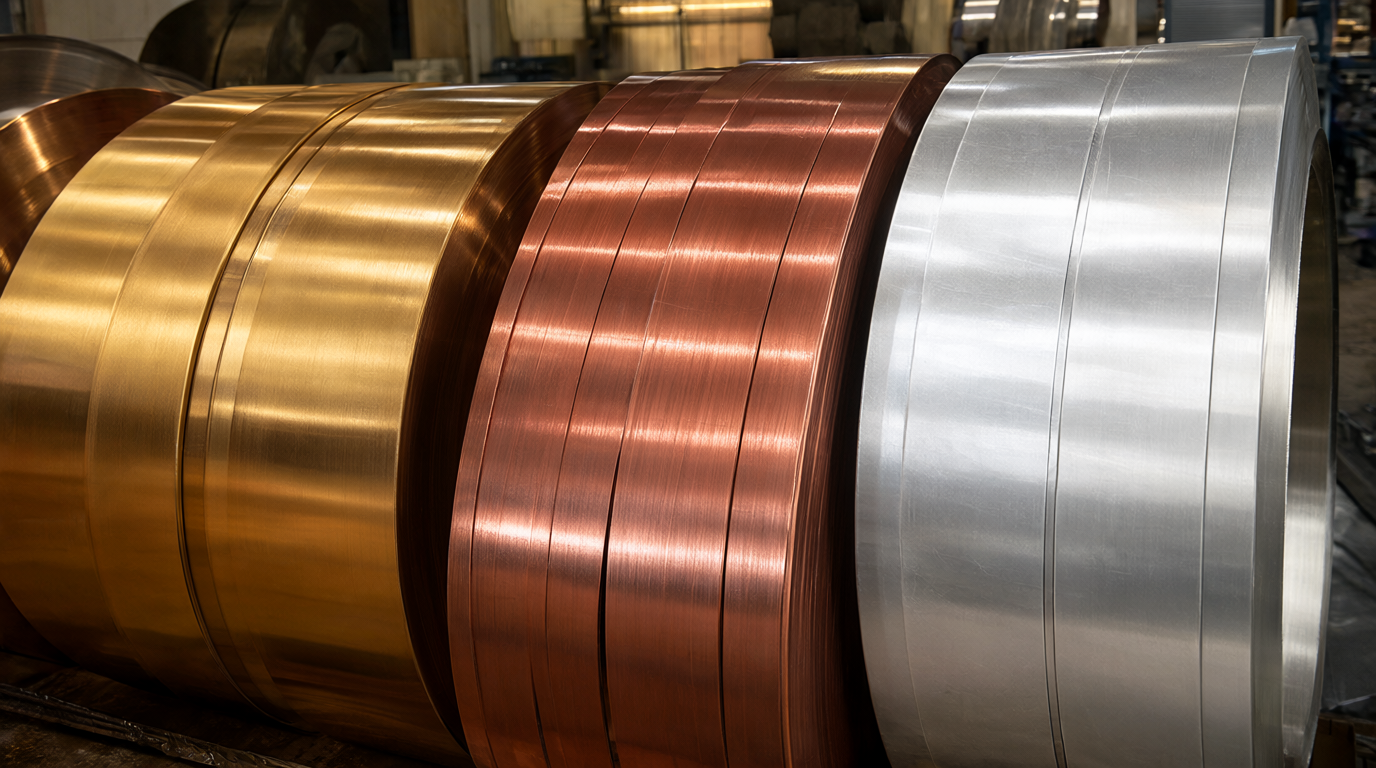
Copper Alloy Selection Guide: Phosphor Bronze vs Nickel Silver vs Aluminium Bronze — How to Specify C51000, C7521, and C95400 by Conductivity, Strength, and Corrosion
Copper alloy buyers face a specific problem: the three families that come up most often — phosphor bronze, nickel silver, and aluminium bronze — are all “copper alloys,” all sold in sheet, strip, bar, and wire, and all visually similar, yet they behave almost nothing alike. Specify the wrong one and you either lose conductivity you needed, lose strength you needed, or discover in service that the alloy is not resistant to the water it sits in.
Unlike steel grades, where a standard number usually settles the question, copper alloys are commonly ordered by trade name — and trade names overlap across regions and composition ranges. This guide maps the three families to their UNS numbers and to the property that should actually drive your choice.
The Three Families at a Glance
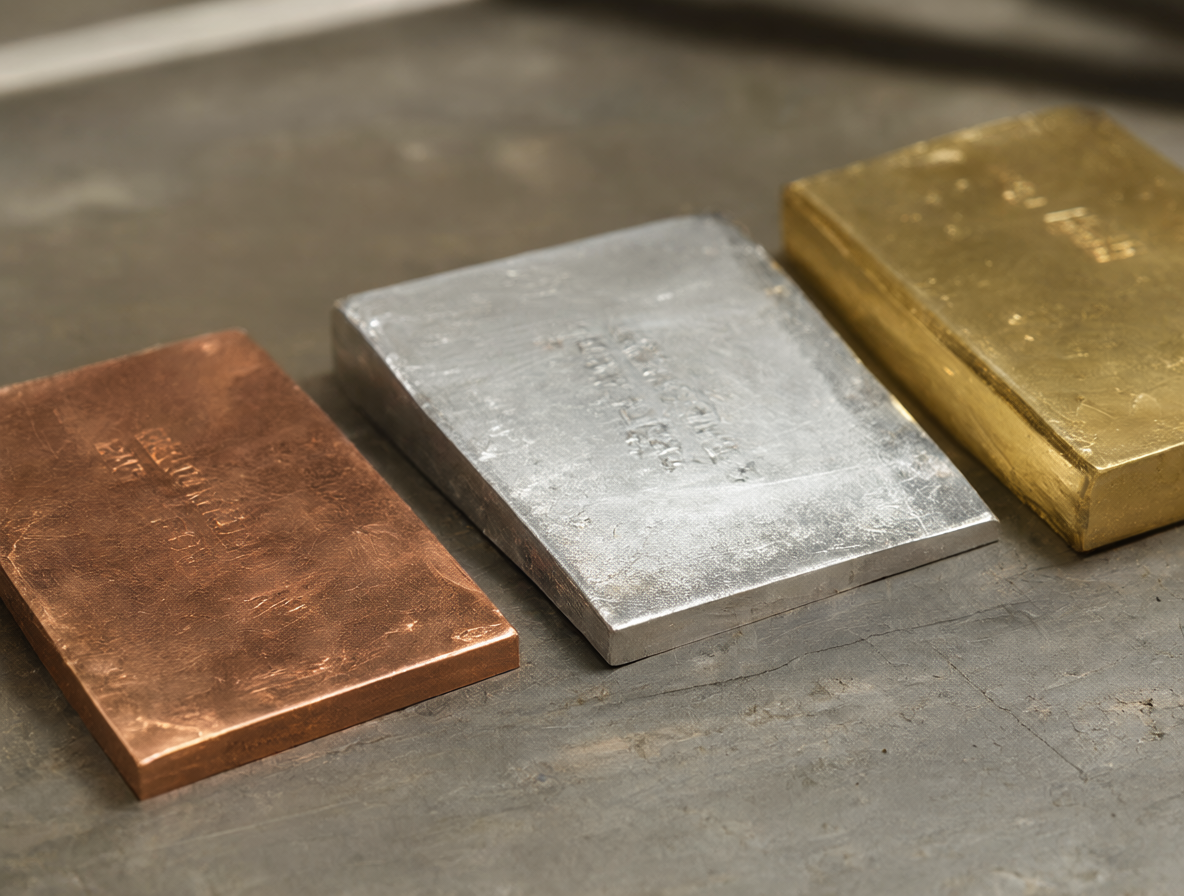
| Phosphor Bronze | Nickel Silver | Aluminium Bronze | |
|---|---|---|---|
| UNS examples | C51000 (5% Sn), C52100 (8% Sn) | C7521 (CuNi12Zn24), C7701 | C95400 (CuAl11Fe4), C95800 (Ni-Al-Bronze) |
| Base system | Cu-Sn-P | Cu-Ni-Zn | Cu-Al-Fe (Ni) |
| Colour | Reddish bronze | Silver-white | Golden yellow |
| Key property | Spring temper, fatigue resistance, low friction | Corrosion resistance with a white colour, good formability | Highest strength and seawater resistance |
| Conductivity | ~15% IACS | ~7–9% IACS | ~12–15% IACS |
| Typical form | Strip, wire, bar, sheet | Strip, sheet, wire | Bar, plate, castings |
None of these is a conductor-grade alloy. If your requirement is conductivity, none of the three is the right answer — you want ETP or OFHC copper (C11000 / C10200). These families are chosen for strength, wear, colour, or corrosion resistance, and their conductivity is incidental.
Phosphor Bronze: The Spring and Wear Alloy
Phosphor bronze is copper with 4–8% tin and a small phosphorus addition (which deoxidises the melt and improves fluidity). It is the classic spring material and the classic bearing and bushing material.
| Property | Character |
|---|---|
| Strength | Rises sharply with cold work; spring tempers reach 600–800 MPa tensile |
| Fatigue resistance | Excellent — the reason it dominates connector and switch contacts |
| Wear and friction | Low friction, good bearing characteristics, used for bushings and thrust washers |
| Corrosion | Good in fresh water and atmosphere; not for seawater or strong acids |
| Formability | Good in annealed temper; limited in spring temper |
| Conductivity | ~15% IACS — adequate for contacts, not for current-carrying bus |
C51000 vs C52100: C51000 has 5% tin and is the general-purpose grade — better formability, slightly lower strength. C52100 has 8% tin, higher strength and better wear resistance, but reduced ductility. For a formed contact spring, C51000; for a bushing or a high-cycle spring, C52100.
Temper is the real specification. Phosphor bronze is supplied in a range of tempers from annealed (O) through quarter-hard, half-hard, and spring (H) to extra-spring (EH). The same C51000 at O and at EH are different products. Specify the temper and the resulting mechanical properties, and state the grain direction if the part is formed across the strip.
Nickel Silver: Colour and Corrosion, Not Conductivity
Nickel silver contains no silver — it is copper, nickel, and zinc, and it is called “silver” only for its colour. This naming causes real procurement errors, including buyers expecting silver-bearing properties or silver-like conductivity.
- Colour is the primary reason it is specified: a warm silver-white that takes a high polish and does not tarnish like brass. Used for cutlery, instrument parts, costume jewellery, nameplates, and architectural trim.
- Corrosion resistance is good in atmosphere and fresh water, better than brass, and it resists dezincification better than ordinary brass because of the nickel.
- Formability is good — it deep draws and cold forms well, which is why it is popular for drawn shells and housings.
- Strength is moderate, improved by cold work; it is not a structural alloy.
- Conductivity is low (~7–9% IACS) — it is not an electrical conductor alloy.
C7521 (CuNi12Zn24) is the workhorse grade: 12% nickel, 24% zinc, the balance copper. It is the standard nickel silver for sheet and strip. Higher-nickel grades (C7701, 18% Ni) are whiter and more corrosion resistant but harder to form and more expensive.
Watch for: nickel silver strip is frequently specified by colour match rather than by UNS number, and different nickel contents give visibly different colours. If colour consistency matters across batches, specify the alloy and a colour reference, not just “nickel silver.”
Aluminium Bronze: Strength and Seawater
Aluminium bronze is copper with 9–11% aluminium and iron, often with nickel. It is the strongest of the copper alloys and the only one of the three that is genuinely a seawater material.
| Property | Character |
|---|---|
| Strength | Highest of the three — 600–800 MPa and above in wrought and heat-treated conditions |
| Seawater resistance | Excellent — the standard alloy for marine propellers, valves, pumps, and fittings |
| Cavitation and erosion | Good resistance, far better than phosphor bronze or nickel silver |
| Wear | Good, with high load capacity for bushings and worm gears |
| Formability | Poor at room temperature — usually hot worked, cast, or machined |
| Machinability | Moderate; the iron content makes it abrasive on tooling |
C95400 (CuAl11Fe4) is a cast aluminium bronze, widely used for bushings, gears, and pump components. C95800 (nickel-aluminium-bronze, CuAl9Ni5Fe4) adds nickel for improved seawater corrosion resistance and is the grade for marine valves and propellers. Wrought versions (C61400, C63000) exist for bar and plate.
The one thing to get right: aluminium bronze is not a substitute for phosphor bronze in a formed part. It does not cold form like phosphor bronze, and specifying it for a stamped component will produce cracking and tooling problems. It is a cast, hot-worked, or machined alloy.
Selection by Requirement
| If your requirement is… | Choose | Why |
|---|---|---|
| A spring or contact with fatigue life | Phosphor bronze C51000/C52100, spring temper | Fatigue resistance and strength from cold work |
| A low-friction bushing or thrust washer | Phosphor bronze C52100 or cast C90500 | Wear and friction characteristics |
| A silver-white decorative or cutlery surface | Nickel silver C7521 | Colour and tarnish resistance |
| Seawater valves, pumps, or propellers | Aluminium bronze C95800 / C95400 | Seawater corrosion and cavitation resistance |
| High-load worm gear or heavy bushing | Aluminium bronze or manganese bronze | Load capacity and wear |
| Electrical conductivity | None of these — use C11000 or C10200 | These alloys are 7–15% IACS, not conductor grades |
Tempers, Standards, and Forms
| Form | Phosphor bronze | Nickel silver | Aluminium bronze |
|---|---|---|---|
| Strip / sheet | ASTM B103, EN 1654 | ASTM B122, EN 1652 | Limited; ASTM B171 for plate |
| Bar / rod | ASTM B139, B140 | ASTM B151 | ASTM B150, B505 (continuous cast) |
| Wire | ASTM B159 | ASTM B206 | Rare |
| Tube | ASTM B315 | Limited | ASTM B315 / B171 |
Temper designations for strip follow ASTM B601 (O, H01, H02, H04, H08, etc.). Always specify the temper alongside the alloy — “C51000 strip” without a temper is an incomplete order and will be quoted against an assumption.
What to Verify on Receipt
- Alloy identity by PMI or spectrochemical analysis — nickel silver and phosphor bronze are hard to distinguish visually from brass once formed, and a brass substitution is a common cost-down trick.
- Temper verification by hardness and tensile test — the temper is what you paid for and it is not visible.
- Dimensions and tolerance — strip thickness tolerance matters directly for stamping and for spring rate.
- Surface — scratches, roll marks, and oxide are rejection criteria on decorative nickel silver.
- Grain size for deep-drawn nickel silver — coarse grain gives orange peel.
- Certificate to EN 10204 3.1 with chemistry and mechanical properties per lot.
RFQ Checklist
- Alloy by UNS number, with the trade name as a cross-check: C51000, C52100, C7521, C95400, C95800
- Product form and standard: strip to ASTM B103, bar to B139/B150, sheet to B122
- Temper, stated explicitly, with target mechanical properties
- Dimensions and tolerances: thickness × width for strip; diameter × length for bar
- Edge condition for strip: slit, rolled, or sheared
- Surface and colour requirement, especially for nickel silver
- Application described: spring, contact, bushing, marine fitting, decorative
- Test requirements: 3.1 certificate, PMI, hardness, tensile, grain size
- Quantity, packing (coil, spool, bundle), destination port, Incoterm
FAQ
Does nickel silver contain silver? No. It is copper-nickel-zinc and is named for its colour. If a specification requires silver content, nickel silver does not meet it.
Can I use phosphor bronze for seawater? No. It corrodes in seawater and is prone to dezincification-type attack in aggressive waters. Use aluminium bronze or a cupronickel for marine duty.
Which copper alloy conducts electricity best? None of these three. Phosphor bronze is ~15% IACS, nickel silver ~8%, aluminium bronze ~13%. For conductors, use ETP copper C11000 (~100% IACS) or OFHC C10200.
Why did my nickel silver part turn yellow after forming? Either the alloy is not nickel silver (a brass substitution), or the surface has been contaminated. Verify by PMI.
Can aluminium bronze be cold formed? Not practically. It is cast, hot worked, or machined. Specifying it for a stamped part will cause cracking.
Why Source Copper Alloys from Yihang Metal
Yihang Metal supplies phosphor bronze (C51000, C52100, C51900), nickel silver (C7521, C7701), and aluminium bronze (C95400, C95800, C61400, C63000) in strip, sheet, bar, rod, wire, and tube to ASTM B103, B122, B139, B150, B151, and B171, in tempers from annealed through extra-spring as specified. Every lot ships with an EN 10204 3.1 certificate stating chemistry and mechanical properties, with PMI verification and grain size testing available on request. Standard production runs typically ship in 25–35 days.
Ready to specify your copper alloy? Send us the UNS number, form and standard, temper, dimensions, and the application the part performs in service, and we will confirm mill availability and lead time with a fixed-price quote and test certificates. Email contact@yihangmetal.com or use the quote form on this page — our team replies within one business day.