Carbon Steel Pipe Fittings Buying Guide: Elbow, Tee, Reducer, and Cap Types, Pressure Ratings, and Standards (ASTM A234, A105)
Pipe fittings are the smallest line items on a piping material take-off and the most common source of site rework. A carbon steel elbow, tee, or reducer ordered with the right size but the wrong schedule, end preparation, or grade will not fit the pipe it must join – and a container of mismatched fittings stops the line. We supply fittings to overseas buyers from China, and three questions return on every RFQ: will a 2-inch SCH 80 90-degree elbow match my 2-inch SCH 80 A106 pipe, what pressure can a Class 3000 forged coupling hold, and why does one supplier quote A234 WPB where another quotes A105? This guide answers those questions in the order a procurement manager works – types, manufacturing, standards, pressure, certification, RFQ.
1. What Carbon Steel Pipe Fittings Are and the Full Product Family
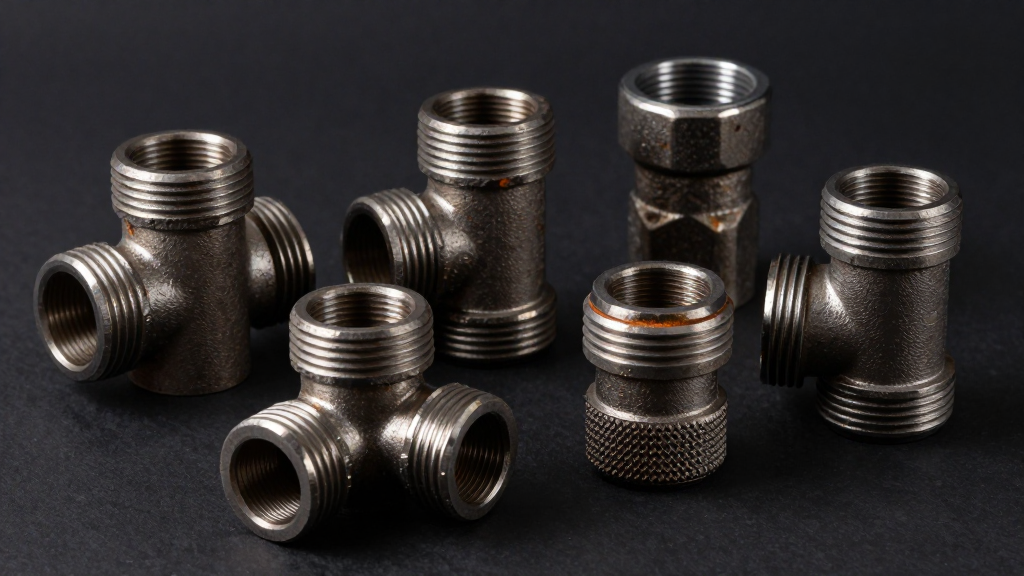
A steel pipe fitting is any component that connects, changes the direction of, branches, reduces, or terminates a pipe. Fittings come in two families, and the first decision in any RFQ is which family your pipe needs:
- Buttweld fittings – welded end-to-end onto the pipe; the weld is the joint. Governed by ASME B16.9 (dimensions) and ASTM A234 (material); for pressure piping and anything above about 2-inch NPS.
- Forged pipe fittings – small-bore threaded and socket-weld parts made from solid forgings, governed by ASME B16.11 and ASTM A105. Typical range 1/2 to 2 inch, up to about 4 inch.
The full family a buyer should be able to name on an RFQ: direction changers (LR and SR elbows, 45-degree elbows, returns), branches (equal and reducing tees, crosses, weldolets), size changers (concentric and eccentric reducers), terminators (caps, plugs), and joiners (couplings, unions, bushings, nipples, stub ends for lap-joint flanges).
Practical rule: a fitting order is only complete when every line of the pipe spec – NPS, schedule, grade, standard, end preparation – appears identically on the fitting spec. “2-inch carbon steel elbow” is not a spec; “NPS 2, SCH 80, ASTM A234 WPB, ASME B16.9, 90-degree LR, beveled ends” is a spec.
2. Fitting Types Explained: Elbow, Tee, Reducer, Cap, Coupling, Union
Elbows (90-Degree and 45-Degree)
The carbon steel elbow is the most-ordered fitting. ASME B16.9 defines two radius families: long-radius (LR), center-to-end 1.5 times nominal pipe size, and short-radius (SR), 1.0 times. On a 2-inch line, a 90-degree LR elbow measures 76 mm (3.0 in) center-to-end, a 90-degree SR elbow 51 mm (2.0 in), and a 45-degree LR elbow 35 mm (1.38 in). LR is the default – same cost, less turbulence, less pressure drop. SR elbows save space in skids and pipe racks; long-sweep 3D/5D bends for pigging lines are custom-fabricated, not stock B16.9.
Tees (Equal and Reducing)
Tees branch the line. An equal tee has all three openings the same size – a 2-inch equal tee measures 64 mm (2.5 in) center-to-end on run and branch. A reducing tee (the pipe tee reducer buyers search for) has a smaller branch, e.g., 2 x 2 x 1-1/2 inch. Tees see the highest stress because the branch interrupts the run wall; above about SCH 80, specify a reinforced weld-o-let branch instead of a cut-and-weld tee. Forged small-bore tees come threaded or socket-weld in Classes 3000-9000.
Reducers (Concentric and Eccentric)
Reducers change line size, and concentric vs eccentric is a hydraulics decision. A concentric reducer tapers on the centerline – use it on vertical lines. An eccentric reducer keeps one side flat: flat-side-down keeps drainage slope on horizontal liquid lines (no trapped pocket); flat-side-up vents gas. A 2 x 1 inch concentric reducer is 76 mm (3.0 in) long. Reducers are pressure-drop components – stepping from 2 inch to 1 inch roughly quadruples velocity – so match the small end to the small pipe’s schedule.
Caps, Couplings, and Unions
Caps terminate the line and are the standard closure for pressure testing and future tie-ins. A 2-inch B16.9 cap is 38 mm (1.5 in) long with a wall at least as heavy as the pipe it closes; hemispherical caps are preferred for pressure retention, and a cap at the same schedule as the pipe can later be cut off and re-welded. Couplings join pipe ends without welding the pipe itself – threaded (NPT) for screwed lines, socket-weld where space is tight, half-couplings for instrument outlets. Unions are the disassembly fitting: a three-piece forged assembly (two ends and a nut) that breaks a connection for maintenance without cutting the line; they exist only in the forged B16.11 world, in Class 3000 and 6000.
3. Manufacturing Methods: Seamless vs Welded (Fabricated) Fittings, Forging
How a fitting is made determines price, pressure integrity, and available sizes – and buyers routinely overpay for “seamless” where a forged or fabricated part is correct.
Seamless (Hot-Formed) Fittings
Seamless fittings are hot-formed from seamless pipe or hollows: the blank is heated, then pushed or drawn over a mandrel (elbows, returns) or pressed in dies, leaving a one-piece body with no seam weld. No seam means no weld to inspect, so seamless is the default for high-pressure, high-temperature, hydrogen, and sour service. Seamless dominates up to about 12 inch; above that, seamless hollows get expensive and scarce.
Welded (Fabricated) Fittings
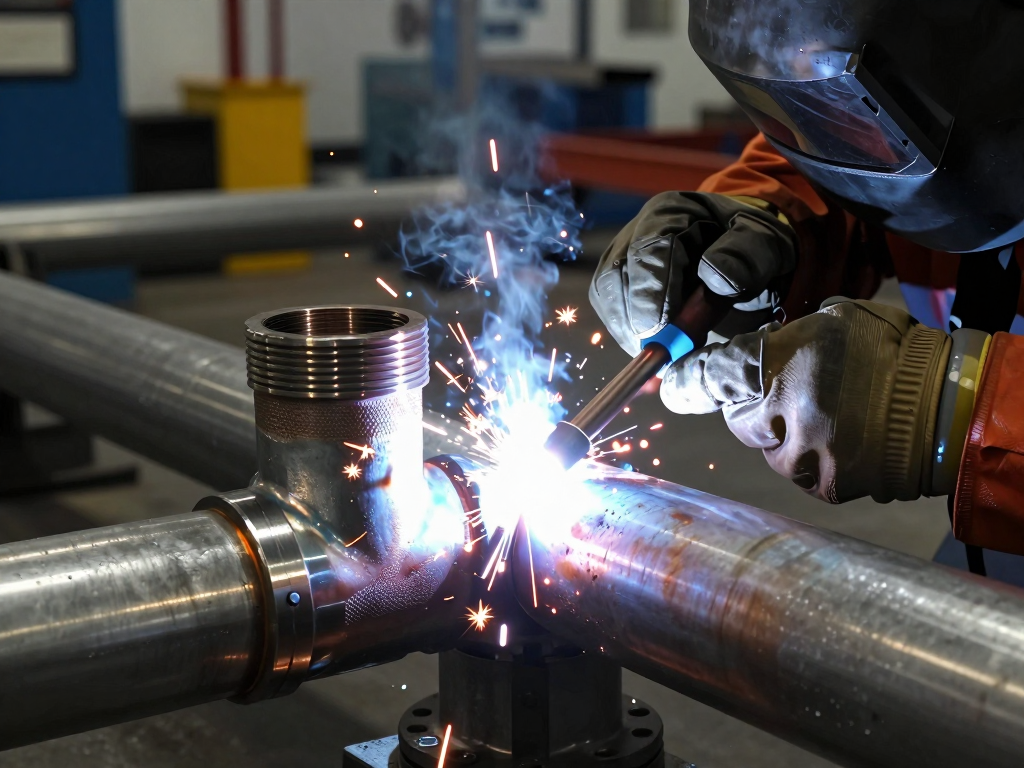
Above roughly 14-24 inch, fittings are fabricated – rolled from plate or built from welded pipe, the seam often 100% radiographed. Mitred (segmented) elbows are the extreme case: bevel cuts welded into a large-radius bend, cheap at big sizes but with more pressure drop and weld inspection. When a quote says “welded fitting,” ask what code the seam was welded to (ASME B31.3 or B31.8) and what NDT was done.
Forged Fittings
Forged pipe fittings are closed-die hot forgings (or hot-extruded blanks) of ASTM A105, machined to threaded or socket-weld profile. Forging aligns grain with part shape, letting Class 3000 and 6000 forged fittings out-rate threaded pipe itself. Heavy sections are ordered normalized – A105N – to guarantee Charpy impact performance.
4. Key Standards: ASTM A234 WPB, ASTM A105, MSS-SP-75, ASME B16.9 vs B16.11
Four standards govern nearly every carbon steel fitting quotation – two describe material, two describe dimensions.
ASTM A234 – Buttweld Fitting Material
ASTM A234 WPB is the default material spec for carbon steel buttweld fittings: chemistry (carbon max 0.30%, manganese 0.29-1.06%), tensile min 485 MPa (70 ksi), yield min 240 MPa (35 ksi) – the grade matching A106 Gr B and A53 Gr B pipe. The family also includes WPC (matching A106 Gr C) and low-temperature WPL6 and WPL9. An “A234” without a grade letter is not a complete spec.
ASTM A105 – Forged Fitting Material
ASTM A105 covers forged carbon steel piping components – flanges, forged fittings, valve bodies – with carbon max 0.35%, manganese 0.60-1.05%, tensile min 485 MPa, yield min 250 MPa (36 ksi). A105 covers the B16.11 family (couplings, unions, threaded and socket-weld elbows and tees); A105N (normalized) is specified whenever impact toughness is required.
ASME B16.9 vs ASME B16.11 – The Two Dimension Standards
ASME B16.9 covers factory-made wrought buttweld fittings from 1/2 to 48 inch – center-to-end dimensions, walls, tolerances. ASME B16.11 covers forged threaded and socket-weld fittings from 1/8 to 4 inch in Classes 2000, 3000, 6000, and 9000. The rule that prevents ordering errors: pipe over about 2 inch with beveled ends = B16.9 buttweld; small-bore threaded or socket connections = B16.11 forged. “B16.9 threaded fittings” do not exist.
MSS-SP-75 – High-Yield Buttweld Fittings
When the pipeline is API 5L X60-X70 line pipe, A234 WPB fittings (35 ksi yield) would be the weak link. MSS-SP-75 covers high-test wrought buttweld fittings in WPHY 42 through WPHY 70 grades matching line pipe yields, with Charpy impact testing at low temperature as standard. If your pipe is X65, the fitting should read “WPHY 65 per MSS-SP-75,” not WPB.
5. Pressure Ratings and Schedule Matching (SCH 40, SCH 80, SCH 160)
Buttweld fittings carry no pressure class number – their rating comes from matching the pipe schedule. A B16.9 fitting of a given schedule has a wall at least equal to pipe of that schedule (minimum 87.5% of nominal), so the joint is no weaker than the pipe. The fitting schedule must equal the pipe schedule: a SCH 80 elbow on SCH 40 pipe wastes money; a SCH 40 elbow on a SCH 80 line is a hidden failure point.
| NPS | OD (mm) | SCH 40 wall (mm) | SCH 80 wall (mm) | SCH 160 wall (mm) | Approx. working pressure, 2″ A106 B (psi, ambient) |
|---|---|---|---|---|---|
| 1/2″ | 21.3 | 2.77 | 3.73 | 4.78 | – |
| 3/4″ | 26.7 | 2.87 | 3.91 | 5.54 | – |
| 1″ | 33.4 | 3.38 | 4.55 | 6.35 | – |
| 1-1/2″ | 48.3 | 3.68 | 5.08 | 7.14 | – |
| 2″ | 60.3 | 3.91 | 5.54 | 8.74 | SCH 40 ≈ 2,600 |
| 3″ | 88.9 | 5.49 | 7.62 | 11.13 | – |
| 4″ | 114.3 | 6.02 | 8.56 | 13.49 | SCH 40 ≈ 2,200 |
| 6″ | 168.3 | 7.11 | 10.97 | 18.26 | – |
Reading the table: on a 2-inch line, stepping SCH 40 to SCH 80 raises the wall from 3.91 mm to 5.54 mm and the straight-pipe allowable pressure (Barlow calculation, A106 Gr B, ambient, no corrosion allowance – a sizing aid, not ASME B31.3) from roughly 2,600 psi to about 3,700 psi; SCH 160 reaches about 5,800 psi. Fittings must track the pipe wall exactly, so specify the schedule, not just the NPS. Pressure derates with temperature; above about 425 °C carbon lines need alloy grades, not heavier walls.
Forged fittings are the exception: B16.11 Classes 2000, 3000, 6000, and 9000 carry their own cold working pressure ratings (nominally the class number in psi at ambient, derated per the B16.11 pressure-temperature tables). Class 3000 is the workhorse for threaded and socket-weld lines; 6000 and 9000 cover hydraulic and high-pressure injection service. A threaded joint is the weakest point – the thread removes wall – so step up a class or switch to socket weld.
Practical tip: state schedule in both worlds – “SCH 80 (wall 5.54 mm)” – because some suppliers quote by OD/wall, others by schedule.
6. Material Grades: A234 WPB, A105, WPL6 – and When to Upgrade
Grade selection comes down to temperature, pressure, and environment. The table below covers the three grades that answer 95% of carbon fitting RFQs.
| Grade | Product form | Typical temp. range | Min. yield | Key requirement | Use when |
|---|---|---|---|---|---|
| A234 WPB | Buttweld fittings | -29 °C to +425 °C | 240 MPa (35 ksi) | Matches A106 B / A53 B pipe | General carbon piping, default |
| A105 / A105N | Forged fittings, flanges | -29 °C to +425 °C | 250 MPa (36 ksi) | Forging quality; A105N = normalized | Threaded / socket-weld fittings |
| A234 WPL6 | Buttweld fittings | -46 °C to +425 °C | 240 MPa (35 ksi) | Charpy 27 J min at -46 °C | Low-temperature and arctic service |
Three upgrade triggers worth the money:
- Low temperature. Below -29 °C (-20 °F), standard WPB and A105 lose guaranteed impact properties – a code boundary, not a precaution. Specify A234 WPL6 buttweld fittings (Charpy 27 J average at -46 °C) and A105N forged fittings for cold and arctic service.
- High temperature. Above about 425 °C, carbon steel enters creep territory; move to alloy grades (A234 WP11, WP22 chrome-moly), not heavier carbon walls.
- Sour service. For wet H2S (NACE MR0175 / ISO 15156), fittings must meet hardness limits (typically max 22 HRC) and often require normalization plus 100% PMI. Say “NACE compliant” on the RFQ, not “hardened.”
Match the pipe grade too: WPB matches A106 B and A53 B; A106 C pipe takes WPC fittings; API 5L X65 pipe takes MSS-SP-75 WPHY 65. Pipe-grade cross-references are in our ASTM vs DIN vs JIS standards guide and the base pipe spec in our ASTM A53 carbon steel pipe guide.
7. Surface Treatment: Black, Galvanized, Shop-Primed, and Painted
Surface finish is where cost leaks out of a fitting order – an unspecified finish defaults to the cheapest option, which may not survive storage.
- Black (bare): mill finish with a light oil or varnish film for short-term storage. The default for pressure piping painted or insulated in the field, and for anything welded.
- Galvanized: hot-dip zinc per ASTM A153, typically 45-85 µm, for water, air, and outdoor service. Confirm threads are cut after galvanizing (correct for NPT) and never weld galvanized fittings without stripping the zinc.
- Shop-primed: inorganic zinc-rich or red-oxide primer, typically 25-75 µm DFT, protecting fittings until the site topcoat.
- Painted: full systems – epoxy, polyurethane, or fusion-bonded epoxy for buried lines – when fittings go straight into service.
Whatever the finish, fittings sit in containers for weeks: specify moisture-barrier packing (VCI paper, desiccant) rather than discovering rusted threads at the port – see our export-packing checklist.
8. Dimensional Tolerances and End Preparation (Beveled, Threaded, Socket Weld)
End preparation is the most common mismatch between ordered and delivered fittings – invisible in photos and impossible to correct on site without rework.
- Beveled ends (buttweld): per ASME B16.25 – a 37.5° ± 2.5° bevel with a 1.6 mm root face for full penetration. Confirm the angle against your weld procedure; a 30° bevel delivered against a 37.5° procedure stops the line.
- Threaded ends: NPT taper threads per ASME B1.20.1 (taper 1 in 16, 60° form). Threads are cut, not cast – thread gauging on receipt is the only reliable check.
- Socket weld ends: per B16.11, the socket bore leaves about a 1.6 mm gap before the shoulder, absorbing thermal expansion and preventing cracking.
Dimensional tolerances for buttweld fittings come from B16.9: center-to-end ± 2 mm up to about NPS 10 and ± 3 mm above, out-of-roundness max 1% of OD, minimum wall 87.5% of nominal. Every fitting should carry permanent marking per MSS-SP-25 (standard, grade, schedule, size, heat).
9. Testing and Certification: Hydrostatic, PMI, MTC EN 10204 3.1/3.2
The paperwork is the product when you buy fittings from overseas – a complete file proves itself at project inspection, not at ordering.
- Mill Test Certificate (MTC): per EN 10204, a 3.1 certificate declares chemistry and mechanicals (yield, tensile, elongation) per heat under the manufacturer’s responsibility. A 3.2 certificate adds an independent third party (SGS, BV, TÜV, Intertek) who witnesses testing and signs. For pressure and project-critical lines, specify 3.2 from the start – upgrading afterward is expensive and slow. Our guide to reading a mill test certificate covers the fields to check.
- Hydrostatic testing: buttweld fittings per B16.9 are not individually hydro-tested – the installed system is, typically at 1.5 times design pressure. If your project requires fitting-level proof, forged B16.11 fittings can be proof-tested with certificate.
- PMI: X-ray fluorescence (XRF) verifies actual delivered chemistry. When buying mixed grades in one container, specify “100% PMI with report” – it catches grade mix-up at the port, not at hydrotest.
- Impact testing: Charpy V-notch at -46 °C for WPL6 (27 J average) and at -29 °C or lower for A105N; request the impact report with the MTC.
- NDT on welds: fabricated fitting seams must be inspected (RT or UT per project code), the report part of the certified file.
10. RFQ Checklist for Pipe Fittings
A complete fitting RFQ line has eleven fields. Missing any one invites a quotation that is cheaper because it is different, not because it is better:
- Type: 90° LR / 90° SR / 45° elbow, tee, reducer, cap, coupling, union, etc.
- Size (NPS): e.g., 2 inch; for reducers and reducing tees, both ends – 2 x 1 inch.
- Schedule / wall: SCH 40 / 80 / 160 / XXS and wall in mm.
- Grade and material standard: A234 WPB, A105, WPL6, or MSS-SP-75 WPHY xx.
- Dimension standard: ASME B16.9 (buttweld) or ASME B16.11 (forged, Class 2000/3000/6000/9000).
- End preparation: beveled per B16.25, threaded NPT per B1.20.1, or socket weld.
- Surface finish: black, galvanized, shop-primed (with DFT), or painted.
- Quantity: per size and type; consolidated take-offs price best.
- Certification: EN 10204 3.1 or 3.2, PMI report, impact report if applicable.
- Inspection: third-party witness (SGS/BV/TÜV) or dimensional check.
- Packing and Incoterm: crates/pallets, moisture-barrier packing, FOB / CIF / CFR.
For the full RFQ format – grade, size, schedule, quantity, Incoterm – so quotations come back comparable, our quote-request template guide.
11. How Yihang Metal Supplies Pipe Fittings
We supply the full carbon steel fitting family from our China-based sourcing and inspection operation: ASTM A234 WPB and WPL6 buttweld fittings to ASME B16.9 from 1/2 to 48 inch in SCH 10 through SCH 160 and XXS, seamless and fabricated; ASTM A105 forged fittings to ASME B16.11 (Class 2000-9000); and MSS-SP-75 WPHY fittings for high-yield line pipe. Fittings ship alongside pipe and flanges from the same mills – one container, one inspection file.
A Yihang Metal quotation includes grade and standard on every line, schedule and wall called out explicitly, end preparation confirmed against your pipe, EN 10204 3.1 MTC as standard (3.2 on request), PMI where specified, and moisture-barrier export packing in plywood crates. Quoting fittings with pipe and flanges gives a schedule-coordinated package – elbow and pipe from the same table.
Not sure which fitting grade, schedule, or standard your line needs? Send us the pipe spec you are matching (NPS, schedule, grade, design pressure and temperature, service), the fitting types and quantities, and your certification level. The team at Yihang Metal will confirm the correct grade, lock the end preparation, and return a complete quotation with MTC documentation within 24 hours. Request your pipe fitting quote today.