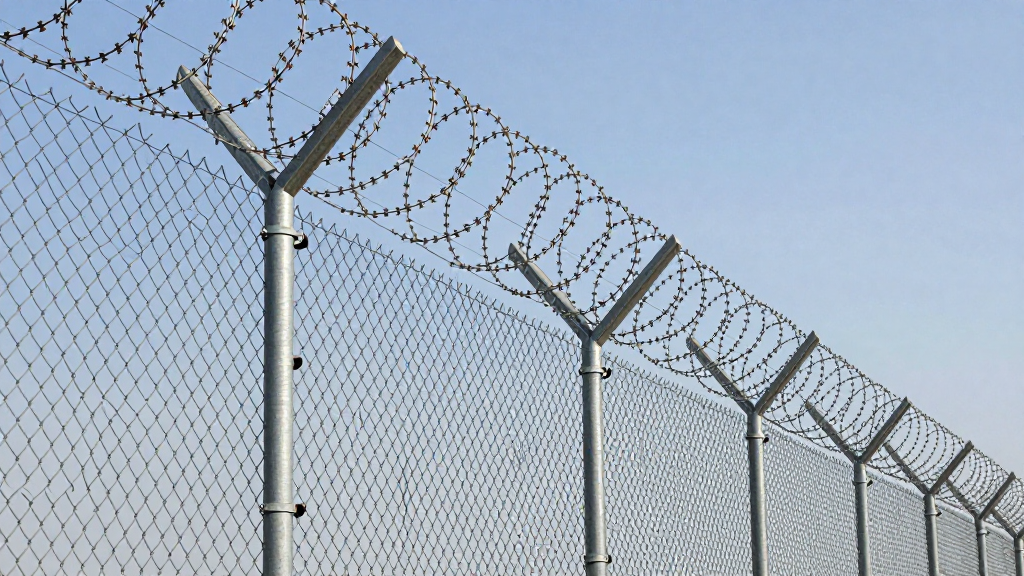
Chain link fence buying guide: galvanized, PVC-coated, and razor wire options, mesh sizes, gauges, and post systems. If you are sourcing chain link fence from China for an industrial perimeter, an airport boundary, a solar farm, or a construction compound, the numbers on the quotation sheet decide both price and service life. A 2.0 mm wire fence and a 3.5 mm fence look identical in a photo but differ by a factor of three in price — and by decades in longevity. This guide gives a procurement manager everything needed to specify correctly: coating systems and zinc weights, fence wire gauge and chain link mesh size tables, razor and barbed wire options, governing standards, post systems and fittings, roll formats, and a ready-to-use RFQ checklist.
1. What Chain Link Fence Is and the Full System
Chain link fence is a diamond-mesh fabric machine-woven from cold-drawn, coated steel wire, in which each loop interlocks with the four loops around it and is twisted closed — no welding, no joints to break. The mesh is measured flat-side to flat-side of the diamond aperture (50 mm × 50 mm is the standard “2-inch” North American mesh). Because it is woven in continuous rolls, it follows uneven ground, arrives compact, and installs faster than rigid welded panels.
But the fabric is only half the system. A complete fence order consists of four element groups, and a mismatch between them is the most common cause of premature failure:
- Fabric: the woven mesh roll, in the wire gauge, mesh size, coating, and roll format you specify.
- Posts: line posts every 2.4–3.0 m, heavier terminal (pull) posts at every end, corner posts at each change of direction, and gate posts at openings.
- Top and bottom support: a top rail (42 mm or 33 mm galvanized pipe) or tension wire, plus a bottom tension wire to stop the mesh lifting.
- Fittings: tension bars through the ends of each roll, brace bands, eye tops or loop caps, tie wires, J-bolts, and gate hardware.
A common buying error is pairing a heavy 3.5 mm fabric with thin 1.5 mm wall posts — the mesh outlives the posts. Specify fabric and posts together, from the same supplier, so height, wind load, and security level are calculated as one system.
2. Coating Types Compared: Hot-Dip Galvanized, Electro-Galvanized, PVC-Coated, and Vinyl
The coating determines how long the fence survives rain, salt air, and industrial atmosphere. Four options dominate the Chinese export market, and the difference between them is measured in grams of zinc per square meter of wire surface. Galvanized chain link is the workhorse. Hot-dip galvanized (HDG) wire carries 60–400 g/m² of zinc applied in molten zinc; for the woven fabric itself, ASTM A392 defines coating classes by minimum zinc weight — Class A at 366 g/m² (1.2 oz/ft²), Class B at 244 g/m² (0.8 oz/ft²), Class C at 137 g/m² (0.45 oz/ft²). Electro-galvanized (EG) wire carries only 20–60 g/m² applied in a plating bath — cheaper and bright, but a poor choice outdoors.
PVC coated chain link starts with a galvanized core wire and adds an extruded PVC layer of 0.3–0.5 mm. Vinyl is the softer, thicker plasticized-PVC variant used where the coating must survive physical abuse, such as sports fencing that takes ball impacts. PVC-coated fences are sold in green, dark green, black, and RAL-matched colors, and hold color for 10–20 years outdoors.
| Coating type | How it is applied | Coating weight / thickness | Typical service life (outdoor) | Best for |
|---|---|---|---|---|
| Electro-galvanized (EG) | Zinc electroplated onto wire | 20–60 g/m² zinc | 2–6 years rural; 1–3 years coastal | Short-term projects, interior use, temporary fencing |
| Hot-dip galvanized (HDG) | Wire or fabric dipped in molten zinc; A392 Classes A/B/C | 60–400 g/m² zinc | 15–30 years rural; 8–15 years industrial; 5–10 years marine | Permanent industrial and utility perimeters, airfields |
| PVC-coated over galvanized core | HDG wire + extruded PVC 0.3–0.5 mm | 60–135 g/m² zinc + 0.3–0.5 mm PVC | 15–25 years with PVC intact; holds color 10–20 years | Residential, schools, coastal sites, visual appeal |
| Vinyl-coated (plasticized) | HDG core + thicker plastisol/PVC 0.5 mm+ | 0.5 mm+ soft coating over HDG wire | 15–25 years; most damage-resistant coating | Sports fields, high-impact areas, anti-climb color coding |
Rule of thumb for security fencing: never buy electro-galvanized for an installation meant to last more than two years. It saves only 15–25% of fabric cost, and the extra zinc usually pays back in under 18 months.
3. Wire Gauge and Mesh Size: The Two Numbers That Define the Fence
Every chain link fence is defined by two numbers: the wire diameter (gauge) and the mesh aperture. Change either and the strength, weight, price per square meter, and security rating all change.
Fence wire gauge is the diameter of the drawn wire before coating. Standard export range is 2.0 mm (14 gauge) to 3.5 mm (9–10 gauge nominal). Fabric weight rises roughly with the square of the wire diameter — a 3.5 mm mesh weighs about three times a 2.0 mm mesh at the same aperture — so gauge is the single biggest price driver in your quotation.
Chain link mesh size is the flat dimension of the diamond aperture, 50 mm × 50 mm or 60 mm × 60 mm being the export standards (100 mm × 50 mm and 100 mm × 100 mm exist for economy runs). Smaller apertures use roughly 15–20% more wire per square meter, contain small animals and objects better, and are harder to climb because the diamonds are tighter underfoot.
| Wire dia. (mm / ga) | Common mesh (mm) | Approx. fabric weight (kg/m²) | Relative cost | Typical use |
|---|---|---|---|---|
| 2.0 mm / 14 ga | 50 × 50, 60 × 60 | 1.7–2.0 | Lowest | Temporary construction fencing, livestock, low-risk perimeters |
| 2.5 mm / 12.5 ga | 50 × 50, 60 × 60 | 2.5–2.8 | Low | General commercial and municipal fencing |
| 2.7 mm / 12 ga | 50 × 50, 60 × 60 | 2.9–3.2 | Medium | Industrial perimeters, airports outer zones |
| 3.0 mm / 11 ga | 50 × 50 | 3.6–3.9 | High | High-security perimeters, substations, ports |
| 3.5 mm / 9–10 ga | 50 × 50, 60 × 60 | 4.5–5.0 | Highest | Military, prison, high-risk assets with razor wire |
Wire tensile strength for woven fence fabric is typically 350–500 N/mm². When an RFQ says only “chain link fence,” expect the supplier to quote the cheapest combination — insist on both numbers: wire diameter and mesh aperture.
4. Razor Wire and Barbed Wire: Adding Security to the Top
The fabric stops casual intrusion; the top of the fence stops determined ones. Two families of deterrent wire are used above chain link, and they are not interchangeable in specification.
Barbed wire is the economical option: two or four galvanized barbs twisted around a double line wire of 2.0–2.8 mm, barb spacing 75–150 mm, hot-dip galvanized at 60–240 g/m². It arrives in coils of 200–500 m (250 m is the export standard). It deters climbing and grazing animals; it does not seriously delay a determined intruder, and it sags if tensioning is sloppy.
Razor wire — the full name is razor wire concertina — is a spiral coil of galvanized (or stainless) steel strip with razor-sharp barbs, held together by a center core wire, and expanded into a concertina or single coil. It is the standard for airports, prisons, refineries, and data centers. The two dominant Chinese export types are BTO-22 and CBT-65.
| Specification | BTO-22 (barbed tape obstacle) | CBT-65 (cross blade type) |
|---|---|---|
| Strip (blade) width | 15 mm | 22 mm |
| Core wire diameter | 2.5 mm ± 0.05 | 2.8 mm ± 0.10 |
| Strip thickness | 0.5 mm ± 0.05 | 0.6 mm ± 0.10 |
| Coil (loop) outer diameter | 450 / 600 / 800 / 980 mm | 450 / 600 / 980 mm |
| Rings (barbs) per meter | 10 or 18 | 10 or 18 |
| Standard length per coil | 10 m (also 20 m splayed) | 10 m (also 20 m splayed) |
| Typical use | Defense upgrades, prison, military | High-security industrial and military perimeters |
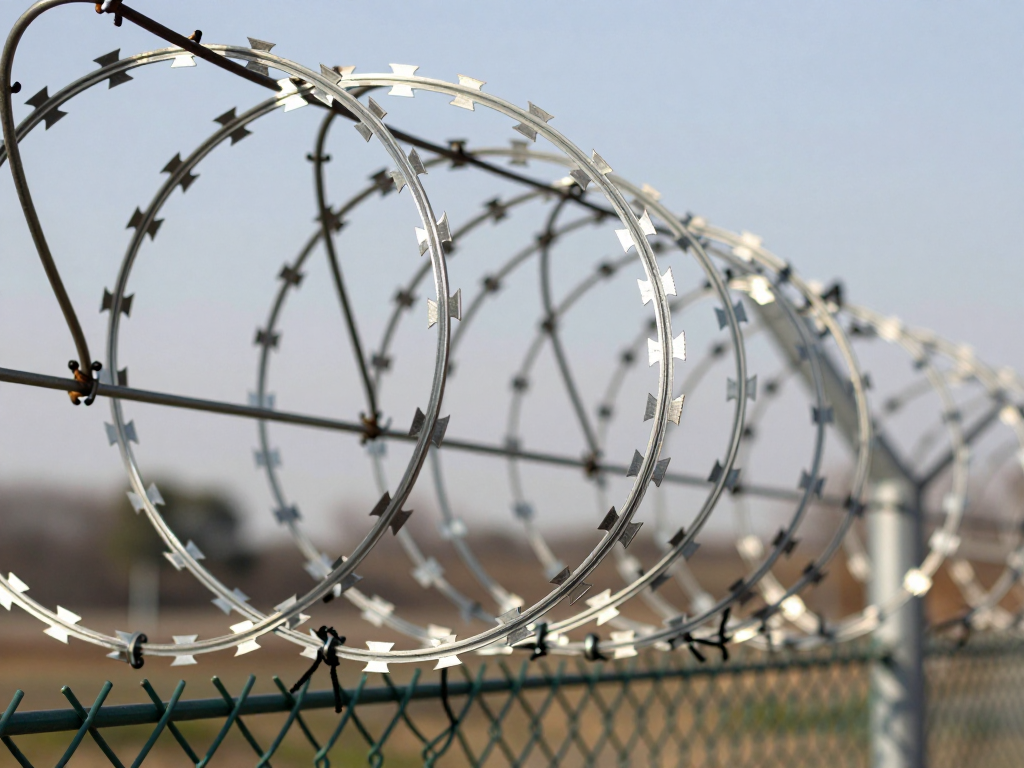
For coastal installations, specify stainless-steel razor wire (304 or 316) or PVC-coated bars over 200 g/m² galvanizing — salt air eats ordinary razor wire in 3–5 years. Ask also for the clip quantity and spacing (U-clips every 20–30 cm), because under-specified clipping is how concertinas slide down the fence within a year.
5. Chain Link vs Welded Mesh vs Razor Mesh: When Each Makes Sense
Three fence families compete for the same budget, and each has a genuine home.
- Chain link: lowest cost per square meter, fastest installation, self-draining diamonds that never collect water, and rolls that follow slopes without cutting. Choose it for large perimeters — airports, warehouses, substations, construction sites — where the boundary is long and the threat model is “keep out.”
- Welded mesh (rigid panels): every intersection welded, usually 2.0–3.0 m high in 2.0–3.0 m panels fixed to posts with brackets. Far more tamper-resistant — no loops to pry open — and far better looking, at roughly 1.5–2.5× the cost of chain link at equal height. Choose it for high-visibility facades, schools, and mid-security sites where appearance matters.
- Razor mesh (flat wrap / welded razor panels): razor blades welded into rigid mesh panels. The industry’s response to climbing attacks — prisons, data centers, military sites. A 3.0 m razor-mesh wall is effectively non-climbable without tools and time.
Most high-security projects combine the three: chain link for the run, welded mesh near gates and entrances, razor wire or razor mesh across the top. State the threat level in your RFQ and let the supplier price the right mix.
6. Standards: ASTM F567, ASTM A392, BS 1722, GB/T 5330
Standards are the contract’s grammar. Four matter most for chain link sourced from China:
| Standard | Governs | What it specifies |
|---|---|---|
| ASTM A392 | Zinc-coated steel chain link fence fabric | Wire diameters, mesh apertures, coating classes (A: 366 g/m², B: 244 g/m², C: 137 g/m² zinc), knuckle/barbed ends, tie wire |
| ASTM F567 | Chain link fence installation | Post spacing, terminal post bracing, tensioning procedure, brace band and fitting practice |
| BS 1722-1 | Mild steel chain link fences (UK market) | Fence heights, mesh and wire combinations per height, galvanizing specification, post sizes |
| GB/T 5330 | Industrial woven wire mesh tolerances (Chinese production base) | Aperture and wire-diameter tolerances for square woven mesh, applied alongside the named fence standard |
When your RFQ names ASTM A392 with a coating class, you protect yourself from “hot-dip zinc-coated” claims that carry 60 g/m² when you paid for 366 g/m². Always name the standard and the coating weight in grams per square meter — one is a marketing word, the other is a measurable number.
7. Posts and Fittings: Rolled vs Tubular, Line, Pull, and Corner Posts
A chain link fence is only as straight as its posts. Two post families dominate export supply:
- Rolled posts: cold-formed from hot-rolled strip into an open section (U, T, or star profile) with pre-punched holes. Cheaper per meter, very stiff for their weight, and the traditional choice for farm and utility fencing.
- Tubular posts: round galvanized pipe (typically 48 mm OD, 2.5–3.2 mm wall) or square tube (40–60 mm, 1.5–2.5 mm wall). Cleaner, easier to add top rail and fittings, and the default for institutional and high-security work. Heavier wall = longer life and better resistance to being pulled out of line.
Post functions, in order of load:
- Line posts — carry tension along the run; spacing 2.4–3.0 m (ASTM F567 allows up to 10 ft / 3.05 m).
- Pull (terminal) posts — at every end of a run, anchor the tension bars; heavier section than line posts.
- Corner posts — where direction changes; same section as pull posts, with diagonal bracing or deeper embedment.
- Gate posts — carry gate weight and slam loads; the heaviest in the system, often with extra bracing and concrete haunching.
Fittings complete the kit: tension bars (sized to mesh aperture), brace bands, eye tops or loop caps, tie wires, J-bolts and nuts, brace truss rods, and — for PVC-coated fences — PVC sleeves and bands so the coating is not broken at the fixing points. Specify fittings in the same coating as the fabric; bare-galvanized fittings on a PVC fence rust and streak within two years.
8. Roll Widths, Roll Lengths, and the Knot Types
Export rolls are standardized to fit containers: standard widths 1.5 m, 1.8 m, 2.0 m, and 2.4 m; standard lengths 10 m, 20 m, and 30 m (the North American market also quotes 50-ft / 15.2 m rolls for 3, 4, and 6 ft heights). A typical heavy-duty roll — 2.0 m wide × 10 m long, 3.0 mm wire, 50 mm mesh — covers 20 m² and weighs roughly 70–80 kg, which matters for forklift handling and freight cubic booking.
Two knot/end details decide how the ends of each roll behave:
- Knuckle weave: both selvage ends are rolled smooth over the last wire — safe to handle, used where the fence borders public areas or protects animals.
- Barbed weave (knuckle and barb / twisted barb): one or both ends are twisted into sharp barbs — a climbing deterrent and the standard for security work. Specify “barbed top, knuckle bottom” and every installer will know what you mean.
Rolls arrive compressed and coiled over a mandrel, sewn shut, and bundled in PP or PE wrapping, palletized for 20 ft / 40 ft container loading. One 40 ft container holds on the order of 20,000–25,000 m² of standard 50 mm fabric depending on gauge — plan freight as early as budget.
9. Common Applications: Industrial Perimeters, Airports, Sports Fields, Construction Sites
The correct specification is set by the application, not by habit:
- Industrial perimeters (substations, refineries, data centers, warehouses): 2.7–3.0 mm wire, 50 × 50 mm mesh, 2.4–3.0 m high, HDG Class A or PVC-coated, top rail with razor wire concertina on Y-arm brackets at 45°.
- Airports and military: 3.0–3.5 mm wire, 50 × 50 mm mesh, 3.0 m plus 600 mm of BTO-22 or CBT-65 razor wire; stainless or heavy HDG for coastal airports.
- Sports fields (tennis, baseball, football): PVC or vinyl-coated, 50 × 50 mm, 2.0–2.5 mm wire for surrounds; baseball backstops run 3.0–5.0 m high, often welded mesh for ball visibility.
- Construction sites: 2.0–2.5 mm electro- or hot-dip galvanized on rolled posts, 1.8–2.4 m high, sometimes with privacy slats; maximum coverage at minimum cost, reused across phases.
- Agriculture and livestock: 2.5 mm, 60 × 60 mm mesh (smaller apertures trap hooves), 1.2–1.8 m high, HDG — the lowest-maintenance option in rural air.
10. RFQ Checklist for Chain Link Fence
A fence RFQ that specifies only “chain link, galvanized, 2 m high” invites the cheapest possible answer to everything you did not say. A complete RFQ contains all of the following:
- Area and quantity: square meters of fabric (or rolls × width × length) and linear meters of fence; separate fabric, posts, and fittings quantities.
- Wire gauge: exact wire diameter in mm — e.g., 2.5 mm or 3.0 mm — plus tensile range if your project demands it.
- Mesh size: 50 × 50 mm or 60 × 60 mm, flat aperture dimension.
- Height and roll format: e.g., 2.0 m height, 2.0 m × 10 m rolls, knuckle or barbed ends.
- Coating: coating type, zinc weight in g/m² (e.g., HDG 240 g/m² or ASTM A392 Class A), PVC thickness in mm and RAL color if coated.
- Post system: rolled or tubular, section and wall thickness (e.g., 48 mm OD × 2.5 mm round tube), post spacing, line/pull/corner/gate quantities.
- Fittings and top support: top rail size, tension bars, brace bands, tie wires, gate set, all in matching coating.
- Top security: razor wire type (BTO-22 / CBT-65), coil diameter, rings per meter, clips, attachment method.
- Standard and testing: named standard (ASTM A392 / BS 1722-1), required certificates, third-party inspection if required.
- Logistics: 20 ft / 40 ft container count, destination port, Incoterms, target delivery.
A working RFQ line: “Required: 12,000 m² chain link fence fabric, 2.5 mm wire, 50 × 50 mm mesh, 2.0 m height, 2.0 × 10 m rolls, knuckle top and bottom, hot-dip galvanized 240 g/m² minimum per ASTM A392 Class B; 2,400 m of 48 mm OD × 2.5 mm tubular posts with fittings; 1,200 m BTO-22 razor wire, 500 mm coil, 10 rings/m, galvanized clips; supply per BS 1722-1. Quote FOB Tianjin with 40 ft container loading plan and mill test certificates.”
Send that paragraph to five suppliers and compare zinc weight, wall thickness, and razor strip thickness — not headline price per roll.
11. How Yihang Metal Supplies Chain Link Fence and Security Wire
Yihang Metal (www.yihangmetal.com) exports chain link fence fabric, posts, fittings, razor wire concertina, razor mesh, and welded mesh to buyers across Europe, the Middle East, Africa, Southeast Asia, and the Americas. We draw and galvanize wire in controlled batches (electro and hot-dip up to 400 g/m²), weave 50 × 50 mm and 60 × 60 mm mesh from 2.0 mm to 3.5 mm in knuckle and barbed weaves, extrude PVC coating in any RAL color, and produce BTO-22 and CBT-65 razor wire in stainless or galvanized strip. Each order is cut, rolled, sewn, and palletized to the container plan, with mill test certificates and third-party inspection (SGS, BV, or your nominee) available at our Tianjin and Tangshan facilities.
We routinely pack 20,000–25,000 m² of fabric per 40 ft container and can bundle the complete system — fabric, posts, fittings, razor wire, and gates — on one bill of lading, the cheapest freight per kilometer a perimeter project can buy.
If you are planning a fence investment next quarter, send us your perimeter length, height, threat level, destination country, and target port — or simply paste the RFQ checklist above into an email. You will receive a detailed quotation with zinc weights, wall thicknesses, exact specifications, and container loading quantities within one working day. Every order is quoted on the numbers above — the same numbers you will verify on delivery. Get your quote at www.yihangmetal.com.