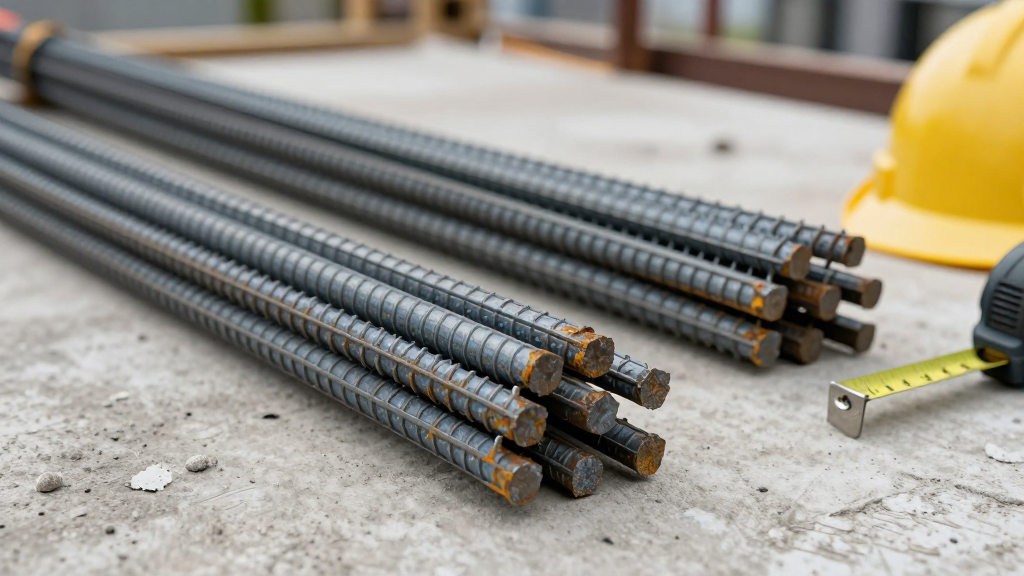
If you are buying steel rebar (reinforcing bar) for a concrete project and the quotation says “Grade 60” or “Grade 420” without naming the ASTM standard, the number you are reading is the minimum yield strength – and that is only one of three things that decide whether the bar is legal for your structure. The other two are the standard itself (ASTM A615 carbon vs A706 low-alloy weldable) and the ductility / weldability class, which is what a seismic or welded detail actually checks. A Grade 60 bar that is A615 is not interchangeable with a Grade 60 bar that is A706 – and ordering the wrong one for a seismic or welded application is a rejection at the jobsite, or worse, a structural compliance failure after the concrete is poured.
This guide breaks down what rebar grades mean, gives you a side-by-side of ASTM A615 Grade 40 / 60 / 75, explains when you must step up from A615 to the low-alloy A706, covers the metric equivalents (Grade 420 / 520), the bar marking system, and the coating decision (black, epoxy, galvanized). We supply rebar from Yihang Metal to project buyers and contractors, so the recommendations come from real RFQs.
What a Rebar “Grade” Actually Means
In ASTM rebar standards, the grade number is the minimum yield strength in ksi (thousands of psi). Grade 60 means the bar yields at a minimum of 60,000 psi (≈420 MPa); Grade 75 means 75,000 psi (≈520 MPa). Higher grade = higher strength = less steel tonnage for the same design capacity, but also lower ductility (elongation) and, for some grades, reduced weldability.
Two standards dominate US-spec and international rebar buying:
- ASTM A615 – carbon-steel deformed and plain bars for concrete reinforcement. The default structural rebar; Grades 40, 60, 75 (and 80, 100). Billet steel, not optimized for welding.
- ASTM A706 – low-alloy steel deformed bars, specifically for applications requiring controlled weldability and ductility (seismic, welded splices, fabrication). Grade 60 (and 80). Lower carbon and controlled chemistry so it can be welded and meets seismic ductility.
Key mental model: “Grade 60” tells you the strength; it does NOT tell you whether the bar is weldable or seismic-ductile. For welded or seismic details, you need A706 – and “Grade 60 A615” is not a substitute for “Grade 60 A706” even though the strength number is the same.
ASTM A615 Grade 40 vs 60 vs 75 Compared
Here is the side-by-side at the properties a structural buyer or QA inspector actually checks:
| Property | Grade 40 | Grade 60 | Grade 75 |
|---|---|---|---|
| Min yield strength | 40,000 psi (280 MPa) | 60,000 psi (420 MPa) | 75,000 psi (520 MPa) |
| Min tensile (UTS) | 60,000 psi | 90,000 psi | 100,000 psi |
| Metric equivalent (A615M) | Grade 300 | Grade 420 | Grade 520 |
| Typical use | Light/low-stress, residential | General structural (the default) | High-stress, columns, high-rise |
| Elongation | Highest | Medium | Lowest of the three |
| Tonnage for same capacity | Highest | Medium | Lowest |
Read the table two ways. First, stepping from Grade 40 to Grade 60 to Grade 75 raises yield strength and reduces the tonnage needed for the same design capacity – which is why high-rise and heavily loaded columns often specify Grade 75 or 80. Second, higher grade means lower elongation (less ductility), which is why seismic and ductile-detailing codes push toward controlled-ductility grades (A706) rather than simply the highest strength.
When You Must Step Up from A615 to A706
ASTM A615 is the workhorse, but several situations require the low-alloy A706 instead:
- Welded splices or welded fabrication. A615’s chemistry is not controlled for weldability; welding A615 can cause brittle heat-affected zones. A706 is formulated to be weldable per the structural welding code.
- Seismic detailing. ACI 318 seismic provisions require rebar with controlled yield-to-tensile ratio and minimum elongation (ductility). A706 meets these; A615 generally does not unless specially tested.
- Tight yield-control applications. A706 caps the yield strength above the nominal grade (a maximum yield), which prevents over-strong rebar from changing the failure mode of a carefully designed ductile joint.
For the base structural-steel logic around reinforced-concrete construction (the structural carbon steel that rebar sits alongside in a project BOM), our construction steel requirements guide and the A36 vs Q355 guide cover the structural-grade selection, and the A36 vs A572 Grade 50 guide covers stepping up to higher-strength structural steel.
Metric Equivalents and International Specs
International and metric-spec projects use the “M” version of the standard (A615M) with metric grade numbers:
- A615M Grade 300 = A615 Grade 40 (300 MPa yield)
- A615M Grade 420 = A615 Grade 60 (420 MPa yield) – the international default
- A615M Grade 520 = A615 Grade 75 (520 MPa yield)
Other national rebar standards you will see on quotations: GB 1499.2 (HRB400 / HRB500, China), BS 4449 (B500B, UK), EN 10080 / ISO 15630 (B500). These are broadly comparable to A615 Grade 60 / 75 by strength, but ductility class and weldability differ – confirm the standard the drawing cites, and do not assume a B500B is identical to an A615 Grade 60 for a seismic detail. The standards-mapping approach is covered in our ASTM vs DIN vs JIS standards guide.
Bar Markings: Reading the Roll Stamp
A deformed rebar carries roll-marked letters/numbers in the deform pattern that identify the producer, bar size, type, and grade. The two that matter most to a buyer:
- Type letter: “S” = billet steel (A615); “W” = low-alloy (A706). This single letter tells you whether the bar is the weldable/seismic grade.
- Grade mark: a number or deform pattern indicating the yield grade (60, 75, etc.).
Reading the stamp at receipt is the fastest way to catch a wrong-grade or wrong-standard shipment before it reaches the cage. The full receipt-inspection discipline (grade, size, deformation pattern, certificate match) is in our steel quality inspection checklist, and the certificate that proves the chemistry and mechanicals behind the stamp is covered in our MTC guide.
Coatings: Black, Epoxy, Galvanized
- Black (uncoated) – the default for indoor or non-corrosive service; cheapest, standard A615/A706.
- Epoxy-coated (ASTM A775 / A934) – for corrosive service (bridge decks, marine, parking structures); the epoxy isolates the bar from chlorides. Requires careful handling to avoid coating damage.
- Galvanized (ASTM A767) – hot-dip galvanized rebar for corrosive service where a metallic coating is preferred over epoxy.
Common Mistakes
- Specifying “Grade 60” without the standard. A615 Grade 60 and A706 Grade 60 have the same strength but different weldability/ductility; name the ASTM standard.
- Using A615 where A706 is required. Welded or seismic details need A706; substituting A615 is a compliance failure.
- Over-specifying Grade 75 “for strength”. Higher grade reduces ductility and may not meet seismic ductility; use the grade the design specifies, not the highest available.
- Ignoring the metric/US grade mapping. Grade 60 = Grade 420; Grade 75 = Grade 520. Mixed-unit projects need both called out.
- Not checking the roll mark at receipt. A wrong-grade or wrong-standard bar looks identical until you read the stamp; inspect at unloading.
What to Lock in Your RFQ
- Standard + grade: e.g., “ASTM A615 Grade 60” or “ASTM A706 Grade 60” or “A615M Grade 420”. Do not write “Grade 60 rebar” alone.
- Bar size: number (#4, #5, #6) or metric diameter (12 mm, 16 mm, 20 mm), with deformation pattern (deformed).
- Length: standard 12 m (40 ft) or custom cut-to-length, with end condition (plain cut).
- Coating: black, epoxy-coated (A775/A934), or galvanized (A767) – state if uncoated.
- Standard and MTC: EN 10204 3.1 with chemistry and mechanicals (yield, UTS, elongation) per heat; 3.2 third-party witnessed for project-critical or seismic rebar.
For the RFQ structure, the quote-request template guide gives the spec format (standard, grade, size, length, qty, Incoterm) that returns a comparable quotation, and because rebar is imported in heavy bundles, the import-from-China guide and the export-packing checklist cover the logistics and packing that get bundles to site without transit rust or short-shipment.
How Yihang Metal Supplies Rebar
We supply carbon and low-alloy deformed rebar in ASTM A615 (Grades 40/60/75), A615M (Grades 300/420/520), and A706 (Grade 60, weldable/seismic), in standard and metric sizes, black or coated. A Yihang Metal rebar quotation includes:
- Standard + grade called out explicitly (A615 vs A706, Grade 60 vs 75, US vs metric) so weldability and ductility are unambiguous.
- Bar sizes from #3 to #18 (or metric 10-57 mm), deformed, in 12 m / 40 ft or custom cut length.
- Coating options – black, epoxy-coated (A775/A934), galvanized (A767).
- EN 10204 3.1 MTC with chemistry and mechanicals (yield, UTS, elongation) per heat, and 3.2 third-party witnessed certificates for seismic or project-critical rebar programs.
- Sea-worthy bundle packing with moisture barrier – bare rebar rusts in transit; see our export-packing checklist.
Because we ship A615 and A706 side by side, we can give you a like-for-like cost comparison at the exact grade and coating each structural detail needs – so your rebar specification is driven by the design (strength, weldability, seismic ductility), not by which single grade a one-product mill wants to push.
Not sure which rebar grade and standard to specify? Tell us the structure (building, bridge, foundation, seismic zone), whether the detail is welded, the design yield requirement, and the service environment (indoor, marine, corrosive). The team at Yihang Metal will recommend the correct ASTM standard (A615 vs A706), grade, size, and coating that meets the structural and seismic requirement at the lowest cost – and back it with full EN 10204 documentation. Send us your specifications today for a quoted price within 24 hours.