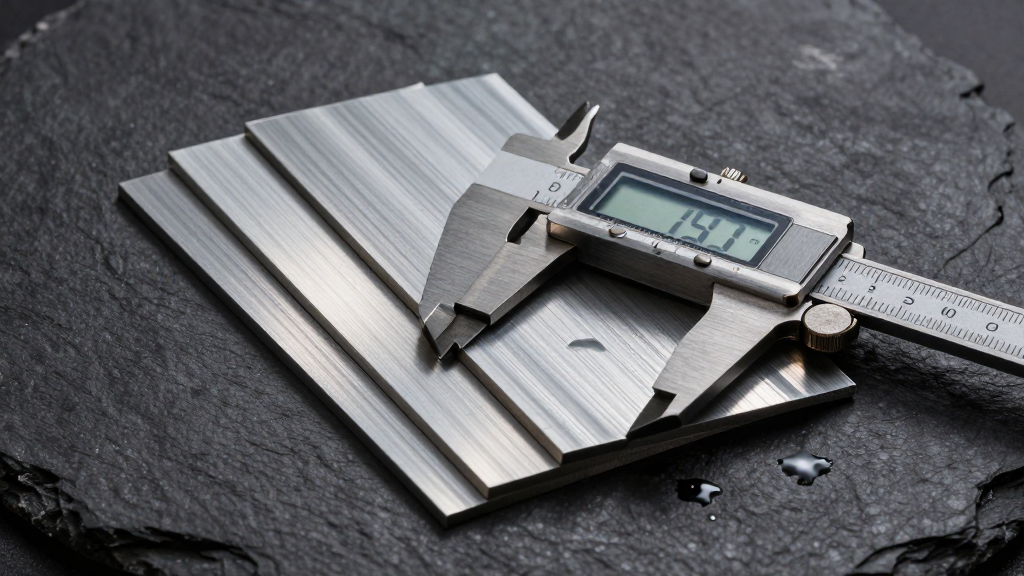
If you are buying steel sheet and the quotation is written in gauge – 16ga, 18ga, 20ga, 22ga – the first thing to know is that gauge is backwards: a higher gauge number means a thinner sheet, so 20ga is thinner than 16ga. The second thing to know is that “gauge” is not a millimetre measurement; it is a legacy weight-based system (the Manufacturers’ Standard Gauge for sheet steel), and the gauge-to-mm conversion is different for carbon steel, galvanized steel, stainless, and aluminum – which is exactly why a buyer who quotes “20ga” without naming the material and standard gets a sheet whose thickness does not match the drawing.
This guide gives you a working steel sheet gauge chart (16ga through 28ga) with the exact millimetre and inch equivalents buyers need, explains why gauge exists and why it causes disputes, shows how to convert gauge to weight per square metre, and tells you why the safe RFQ always specifies thickness in millimetres alongside the gauge. We supply sheet steel from Yihang Metal in cold-rolled, hot-rolled, galvanized, and stainless grades, so the conversions below come from real quotations.
What “Gauge” Actually Is (and Why It’s Backwards)
Sheet steel gauge originates from the Manufacturers’ Standard Gauge (MSG), a 19th-century system that defined sheet thickness by the weight of a square foot of steel at a reference density. Because the system is weight-based, a “gauge” is a fixed weight – and because steel is dense, a heavier weight means a thicker sheet. The numbering runs counter-intuitively: the higher the gauge number, the thinner the sheet, because the gauge series was numbered from the thick end.
Three things make gauge error-prone for buyers:
- It is not a direct dimension. You cannot derive mm from the gauge number by a formula; you must read a chart.
- It differs by material. The gauge-to-mm table for carbon steel is not the same as for galvanized, stainless, or aluminum – a “16ga” carbon sheet and a “16ga” galvanized sheet are close but not identical, and “16ga aluminum” is a different thickness entirely.
- It collides with other gauge systems. BWG (Birmingham Wire Gauge) is used for wire and tube wall and has different values; confusing sheet MSG with BWG is a classic tube-ordering error.
Key mental model: gauge is a legacy weight-based thickness label, higher = thinner, and it is material-specific. The robust RFQ states the thickness in millimetres (and the standard/tolerance) and treats gauge as a secondary reference only – never the sole dimension.
Steel Sheet Metal Gauge Chart (Carbon Steel, MSG)
Below is the gauge-to-mm/inch chart buyers most often need, for mild/carbon steel sheet per the Manufacturers’ Standard Gauge. Galvanized and stainless use very close (but not always identical) values – confirm against the specific material standard when tolerances matter.
| Gauge | Inch | Millimetre | Weight (kg/m², approx) | Typical use |
|---|---|---|---|---|
| 16ga | 0.0598 | 1.52 | 11.9 | Heavy sheet, brackets, auto body patch |
| 18ga | 0.0478 | 1.21 | 9.5 | Ducts, enclosures, general fab |
| 20ga | 0.0359 | 0.91 | 7.1 | Roofing, light enclosures |
| 22ga | 0.0299 | 0.76 | 5.9 | Light roofing, flashings |
| 24ga | 0.0239 | 0.61 | 4.7 | Thin wall duct, light trim |
| 26ga | 0.0179 | 0.45 | 3.5 | Corrugated roofing, cladding |
| 28ga | 0.0149 | 0.38 | 2.9 | Thin cladding, deep-draw cans |
Read the table two ways. First, the step from 16ga to 20ga roughly halves the thickness (1.52 mm to 0.91 mm) and roughly halves the weight per square metre – which is why a roofing buyer who lets gauge drift from 26ga to 28ga saves a lot of money but loses meaningful strength and dent resistance. Second, the weight-per-square-metre column lets you convert a gauge into an approximate coil weight, which is how mills price sheet.
Gauge vs Millimetre: Why to Specify mm
The reason every robust RFQ states thickness in millimetres (with gauge as a secondary reference) is that millimetres are unambiguous and gauge is not. A “1.2 mm cold-rolled sheet per EN 10130” is a single, verifiable thickness; a “18ga sheet” could be the carbon value (1.21 mm), a slightly different galvanized value, or – if the supplier misreads the system – something else entirely. For tolerance-critical work (stamping, perforation, laser cutting), the millimetre-and-standard spec is the only one that holds.
The substrate question – cold-rolled vs hot-rolled for thin sheet – is covered in our cold-rolled vs hot-rolled guide (gauge-thin sheet is almost always cold-rolled for tolerance and surface), and the flatness and surface-condition detail that decides whether a thin sheet laser-cuts cleanly is in our flatness and coil-set guide.
How Gauge Differs Across Materials
Buyers who quote gauge across material families get burned because the gauge-to-mm tables differ:
- Carbon steel sheet (MSG) – the chart above; the default “gauge” on a carbon-steel quotation.
- Galvanized steel sheet – uses a galvanized gauge table with slightly different values; a “16ga galvanized” sheet is marginally different in thickness from “16ga carbon”. For galvanized coil and the coating-weight logic, see our ASTM A653 galvanized coil guide and the hot-dip vs electro-galvanized guide.
- Stainless steel sheet – uses a stainless gauge table (close to carbon at common sizes); the grade selection (304 vs 316L) and finish are in our 304 vs 316L guide and stainless finishes guide.
- Aluminum sheet – a completely different gauge-to-mm table; do not assume a “16ga aluminum” equals a “16ga steel”.
Common Uses by Gauge (Carbon Steel)
- 16ga (1.52 mm): brackets, heavy enclosures, auto-body panels, structural thin sheet.
- 18ga (1.21 mm): HVAC ducts, electrical enclosures, general fabrication – the “default” fabrication gauge.
- 20ga (0.91 mm): light enclosures, roofing underlay, appliance panels.
- 22-24ga (0.61-0.76 mm): light roofing, flashings, trim, thin-wall duct.
- 26-28ga (0.38-0.45 mm): corrugated roofing, cladding, deep-drawn cans.
The cutting route for sheet depends on thickness and tolerance: thin gauge is laser-cut or turret-punched; our laser vs plasma vs waterjet guide covers which process suits which gauge, and the carbon-steel sheet for laser-cutting guide covers the flatness and surface-condition detail.
Common Mistakes
- Quoting gauge without material. “20ga sheet” is ambiguous across carbon, galvanized, stainless, and aluminum; always state material + mm.
- Forgetting higher = thinner. A buyer who assumes “20ga is thicker than 16ga” over-specifies weight and cost.
- Mixing sheet MSG with BWG. Birmingham Wire Gauge is for wire and tube wall; do not apply it to sheet.
- Quoting gauge without tolerance. Even in mm, sheet has a thickness tolerance (EN 10131 / ASTM A1008) that matters to stamping and fit-up; state it.
- Sizing by gauge when the drawing is in mm. Convert the drawing mm to the nearest gauge only as a reference; the binding spec is the mm value and its tolerance.
What to Lock in Your RFQ
- Thickness in mm + tolerance + standard: e.g., “1.2 mm nominal, tolerance per EN 10131” (gauge “18ga” as a secondary reference only).
- Material and grade: cold-rolled carbon (SPCC/DC01 per EN 10130 / JIS G3141), galvanized (DX51D+Z per EN 10346), or stainless (304/316L per ASTM A240). Don’t write “sheet metal” alone.
- Surface and finish: oiled/dry, surface class, and (for stainless) the finish (2B/BA/No.4).
- Dimensions: width x length (e.g., 1219 x 2438 mm / 4×8 ft) or coil with width and ID.
- Standard and MTC: EN 10204 3.1 with chemistry and mechanicals per heat; reading the certificate is covered in our MTC guide.
For the RFQ structure, the quote-request template guide gives the spec format (grade, thickness-in-mm, size, qty, Incoterm) that returns a comparable quotation.
How Yihang Metal Supplies Steel Sheet
We supply cold-rolled, hot-rolled, galvanized, and stainless steel sheet across the full gauge range – from 16ga (1.52 mm) down to 28ga (0.38 mm) and below – in carbon (SPCC/DC01), galvanized (DX51D+Z), and stainless (304/316L) grades. A Yihang Metal sheet quotation includes:
- Thickness in millimetres + tolerance called out explicitly, with gauge as a secondary reference – no ambiguity.
- Grade range per EN 10130 / JIS G3141 / ASTM A1008 (cold-rolled carbon), EN 10346 (galvanized), and ASTM A240 (stainless), at the surface class your process needs.
- Standard widths and cut-to-length (4×8 ft / 1219×2438 mm, 1500 mm coil, etc.) with coil ID for stamping lines.
- EN 10204 3.1 MTC with chemistry and mechanicals per heat, and surface matched to your downstream process (painting, powder coat, laser cutting).
- Sea-worthy, moisture-barrier export packing – thin sheet rusts and scratches in transit if exposed; see our export-packing checklist.
Because we ship cold-rolled, galvanized, and stainless sheet side by side, we can give you a like-for-like cost comparison at the exact millimetre thickness and surface class each application needs – so your sheet specification is driven by the drawing and the process, not by which single gauge a one-product mill wants to push.
Not sure which gauge, millimetre thickness, and grade to specify for your steel sheet? Tell us the application (duct, enclosure, roofing, stamping, deep-draw), the material (carbon, galvanized, stainless), and the downstream process (laser, punch, bend, paint). The team at Yihang Metal will recommend the millimetre thickness, tolerance, surface class, and grade that fits your drawing at the lowest cost – and back it with full EN 10204 documentation. Send us your specifications today for a quoted price within 24 hours.