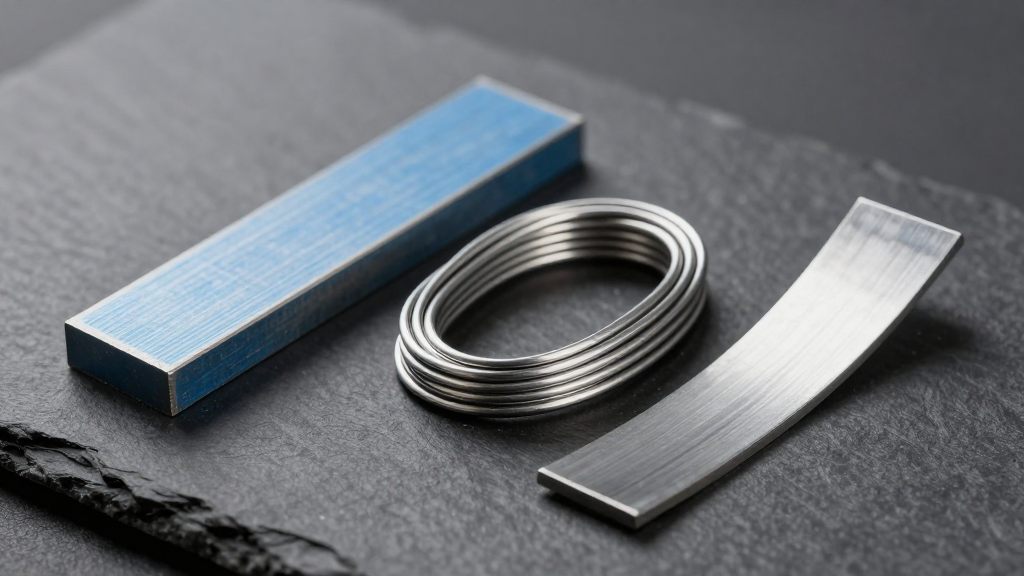
If you are sourcing steel for springs – leaf springs, coil springs, flat springs, die springs, disc springs, or strip-spring clips – you are choosing between a small set of high-carbon and low-alloy spring-steel grades whose differences decide whether your spring takes a set, fatigues early, or holds its load for a million cycles. The three grades buyers actually weigh are 65Mn (a high-carbon manganese steel), 60Si2Mn (a silicon-manganese alloy spring steel), and SUP9 / 55Cr3 (a chromium-alloy spring steel) – plus the higher-end 50CrV4 / SUP10 for the most demanding cyclic loads. Pick the wrong grade and the spring either costs more than it needs to, or fails its fatigue test at a fraction of design life.
This guide breaks down 65Mn vs 60Si2Mn vs SUP9 for spring applications: composition, hardenability, the quench-and-temper heat treatment that defines a spring, working stress and fatigue behavior, form (wire, strip, flat bar, hot-rolled plate), the JIS / EN / ASTM / GB cross-reference (SUP9 vs 55Cr3 vs 6150 vs 51CrV4), and the applications each is actually specified for. We supply spring steel wire, strip, and bar from Yihang Metal to spring manufacturers, suspension-component OEMs, and hardware exporters, so the recommendations below come from real RFQs and real heat-treat feedback.
What a Spring Asks of the Steel
A spring stores and releases elastic energy under repeated load. The steel has to satisfy four requirements that pull against each other:
- High elastic limit and yield strength after heat treatment. A spring must return to its shape after deflection – so the steel, after quench and temper, must reach a high yield strength (often 1,200-1,600 MPa) so the working stress stays below the elastic limit. Higher strength = more energy stored per unit of material.
- Hardenability matched to section size. A spring is only as good as its heat treatment, and heat treatment is only as good as hardenability – the depth to which the steel hardens on quenching. A thin wire spring can be made from a low-alloy steel; a thick leaf spring or heavy coil spring needs a more alloyed grade (Si or Cr) to through-harden. Mismatched hardenability is the #1 cause of spring “taking a set.”
- Fatigue resistance and surface quality. Springs see millions of cycles; fatigue life is dominated by surface condition (decarburization, scratches, seams). A high-quality spring steel with controlled surface and minimal decarburization outlasts a “same grade” steel with a poor surface by an order of magnitude.
- Cost discipline. 65Mn is cheap and plentiful; 60Si2Mn carries a modest alloy adder; SUP9/50CrV4 carry more. Specifying a chromium-vanadium grade where 65Mn would do is a common overspend – and specifying 65Mn where hardenability demands 60Si2Mn is a common failure.
The grades that balance these requirements are 65Mn, 60Si2Mn, SUP9 (55Cr3), and 50CrV4 (SUP10), supplied as wire (cold-drawn or oil-tempered), cold-rolled strip, hot-rolled flat bar, or round bar, to GB/T 1222, EN 10089, JIS G4801 (SUP), or ASTM A689 / A682.
Key mental model: spring-steel selection is driven by section size and cyclic load, not by chasing the highest strength number. A thin clip spring is perfectly served by 65Mn; a heavy truck leaf spring demands 60Si2Mn or SUP9 for hardenability; a high-cycle valve spring demands 50CrV4 for fatigue. The grade follows the section and the cycle count.
65Mn vs 60Si2Mn vs SUP9 (55Cr3) – Side by Side
| Property | 65Mn (GB) | 60Si2Mn (GB) / 9260 | SUP9 (JIS) / 55Cr3 (EN) |
|---|---|---|---|
| Type | High-carbon manganese spring steel | Silicon-manganese alloy spring steel | Chromium alloy spring steel |
| Nominal composition | ~0.65% C, ~1.0% Mn | ~0.60% C, ~1.7% Si, ~0.8% Mn | ~0.55% C, ~0.8% Cr, ~0.8% Mn |
| Key alloying role | Mn for hardenability and strength | Si raises elastic limit and fatigue strength | Cr for hardenability in heavier sections |
| Hardenability | Low – thin sections only | Good – medium sections | Good – medium/heavy sections |
| Typical tempered tensile (MPa) | ~1,000-1,300 | ~1,300-1,600 | ~1,300-1,550 |
| Elastic limit / yield (MPa) | ~800-1,000 | ~1,200-1,400 | ~1,100-1,300 |
| Relative cost | Lowest (baseline) | Slightly above 65Mn | Above 60Si2Mn |
| Typical section | Thin wire, strip, small flat springs | Medium leaf/coil springs, flat springs | Heavier leaf/coil springs, suspension |
| Best-fit use | Clips, retainers, small flat springs, low-cycle springs, hand-tool springs | Automotive leaf and coil springs, machinery springs, die springs | Automotive suspension leaf/coil springs, heavier cyclic-loaded springs |
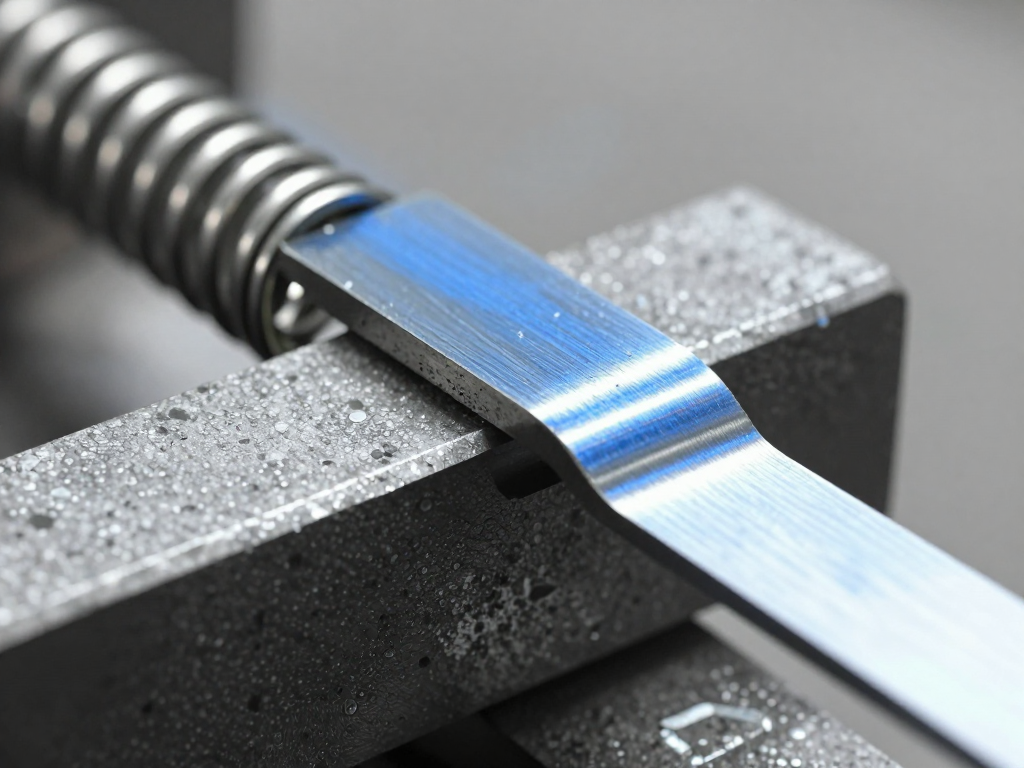
65Mn – the Cost-Default for Thin and Low-Cycle Springs
65Mn is a high-carbon manganese spring steel – the cheapest and most widely available grade in the spring-steel family. After quench-and-temper it reaches ~1,000-1,300 MPa tensile with good elastic behavior, and it cold-draws and cold-rolls into thin wire and strip cleanly. Its limitation is hardenability: manganese alone does not through-harden thick sections, so 65Mn is correct for thin, lower-stress, and lower-cycle springs and wrong for heavy or high-cycle ones. Typical applications:
- Flat spring clips, retainers, and snap rings stamped from cold-rolled strip.
- Small coil springs and torsion springs in mechanisms, locks, and hand tools.
- Music-wire-adjacent applications and general hardware springs where cycle count is modest.
- Band saw blades, cutting strips, and wear parts that benefit from high carbon and moderate toughness.
65Mn is the right answer when the spring is thin, the load is moderate, and the cycle count is in the thousands-to-hundreds-of-thousands rather than millions. Pushing it into a heavy truck leaf spring or a high-cycle valve spring is where it fails. Our 65Mn spring steel wire and 65Mn spring steel coil cover the common wire and strip forms.
60Si2Mn – the Automotive Workhorse (Leaf and Coil Springs)
60Si2Mn (close to SAE 9260) is a silicon-manganese alloy spring steel and the default grade for automotive and machinery springs of medium section. The silicon is the key addition: it raises the elastic limit and fatigue strength significantly over plain high-carbon steel, and it improves temper resistance so the spring holds its properties at moderate service temperature. Its hardenability is good enough to through-harden leaf springs and coil springs of typical automotive section. Typical applications:
- Automotive leaf springs (light and commercial vehicles) – the dominant use of 60Si2Mn.
- Automotive coil springs and suspension springs of medium section.
- Machinery die springs, valve springs (lower-cycle), and clutch/brake springs.
- Flat springs and stamped spring components where higher elastic limit than 65Mn is needed.
60Si2Mn is the grade to specify when the spring is medium-section, cyclically loaded, and must hold load over real service life. It is the cost-engineered default for automotive suspension. Our 60Si2Mn spring steel wire covers the wire form; for the broader context of how silicon-manganese compares with chromium-vanadium grades, see the SUP9 / 50CrV4 sections below.
SUP9 (55Cr3) and 50CrV4 (SUP10) – Heavier Section and High-Cycle
For heavier sections and higher cycle counts, the chromium-alloy spring steels take over:
- SUP9 (JIS) / 55Cr3 (EN) / ~5155 (ASTM) adds chromium for hardenability in heavier leaf and coil springs – larger truck and commercial-vehicle suspension springs where 60Si2Mn would not through-harden. The chromium gives deeper hardenability and good fatigue performance in thicker sections.
- 50CrV4 (EN) / SUP10 (JIS) / 6150 (ASTM) adds vanadium to the chromium base, which refines the grain and substantially improves fatigue life and temper resistance. This is the grade for the most demanding cyclic springs – engine valve springs, high-cycle clutch springs, die springs, and heavy-duty suspension springs – where 60Si2Mn or SUP9 would not meet the fatigue life target.
The cross-standard naming is a frequent source of confusion: SUP9 (JIS) = 55Cr3 (EN) = ~5155 (ASTM); SUP10 (JIS) = 51CrV4 / 50CrV4 (EN) = 6150 (ASTM). Our standards cross-reference guide walks through the JIS/EN/ASTM/GB mapping that prevents a wrong-grade spring-steel shipment.
Heat Treatment, Surface, and the Fatigue Decision
Three realities dominate spring-steel selection and spring life:
- Quench-and-temper defines the spring. A spring steel is only a spring after it is austenitized, quenched (oil or water per grade), and tempered to the target tempered-martensite structure (~40-50 HRC for most spring applications). The grade sets the ceiling; the heat treatment realizes it. A poorly heat-treated 60Si2Mn spring performs worse than a well-treated 65Mn one. Hardness targets and cross-spec conversions are covered in our HB/HRC/HV hardness guide.
- Decarburization is the silent spring killer. Spring steel is high-carbon; if the surface decarburizes during hot rolling or heat treatment, the surface layer loses carbon, drops in hardness, and becomes a fatigue-initiation site. Specify a controlled, low-decarburization surface (and for strip, a cold-rolled or peeled surface) for any cyclic spring. Surface condition matters more than the grade number for fatigue life.
- Form and route. Spring steel is bought as hot-rolled round/flat bar (for leaf springs and heavy coils), cold-drawn wire (oil-tempered wire for coil and valve springs), or cold-rolled strip (for flat clip springs). The substrate route – hot-rolled vs cold-rolled – decides surface and tolerance; our cold-rolled vs hot-rolled guide and the carbon-steel sheet for bending and forming guide cover the substrate logic that spring strip sits on top of.
Practical tip from the engineering desk: when a spring takes a permanent set early in service, the cause is almost never “the grade is wrong” – it is one of (a) hardenability mismatched to section (a 65Mn leaf spring too thick to through-harden), (b) under-tempered or over-tempered heat treatment, or (c) surface decarburization. Fix the section-grade match and the heat treatment first; only step up the alloy if the corrected spring still misses the fatigue target.
What to Lock in Your RFQ: Grade, Form, Surface, Heat-Treat State
The most common reason a spring-steel order disappoints is a vague RFQ that leaves heat-treat state and surface open. Specify all of the following:
- Grade with standard: e.g., “65Mn per GB/T 1222,” “60Si2Mn per GB/T 1222 / EN 10089,” “SUP9 per JIS G4801,” “50CrV4 per EN 10089.” Confirm cross-standard equivalents via the standards cross-reference guide. Do not write “spring steel” alone.
- Form: hot-rolled round/flat bar, cold-drawn wire, oil-tempered wire, or cold-rolled strip – the form follows the spring type.
- Dimensions and tolerance: wire diameter or strip thickness x width with tolerance; for strip, thickness tolerance dominates spring-rate consistency.
- Surface and decarburization limit: cold-drawn/peeled/cold-rolled surface for cyclic springs; specify a maximum decarburization depth (per the standard) – this is the single most important fatigue-related clause. Surface roughness targets are covered in our Ra vs RMS roughness guide.
- Heat-treat delivery state: annealed (for the buyer to form and heat-treat), or pre-quenched-and-tempered / oil-tempered (for the buyer to form cold from pre-hardened material). State which.
- Hardness target (if pre-hardened): e.g., 42-48 HRC, with the conversion basis in our hardness guide.
- Standard and MTC: EN 10204 3.1 MTC with chemistry (C, Si, Mn, Cr, V) and mechanicals (hardness, tensile if applicable) per heat; for reading the certificate, our MTC guide is the companion read.
For the RFQ structure, the quote-request template guide gives the spec format (grade, form, size, heat-treat state, qty, Incoterm) that returns a clean, comparable quotation, and the quality inspection checklist covers the receipt-inspection points (dimensional, surface/decarburization, hardness, certificate match) that catch a wrong-grade or decarburized shipment before it reaches the spring line.
How Yihang Metal Supplies Spring Steel Wire, Strip, and Bar
We supply the full spring-steel grade range – 65Mn, 60Si2Mn, SUP9 (55Cr3), and 50CrV4 (SUP10) – so you can buy the correct grade per spring type and section in one RFQ. Here is what a Yihang Metal spring-steel quotation includes as standard:
- Grade range per GB/T 1222 / EN 10089 / JIS G4801: 65Mn (thin, low-cycle), 60Si2Mn (automotive leaf/coil), SUP9/55Cr3 (heavier suspension), and 50CrV4/SUP10 (high-cycle valve and die springs). Adjacent alloy-steel bar grades like 40Cr alloy steel bar round out the alloy-steel offering.
- All forms – hot-rolled round/flat bar, cold-drawn wire, oil-tempered wire, and cold-rolled strip – matched to your spring type and downstream route.
- Controlled low-decarburization surface on cyclic spring grades, with surface class and roughness matched to fatigue-critical application.
- EN 10204 3.1 MTC with chemistry (C, Si, Mn, Cr, V) and mechanicals (hardness, tensile) per heat, and 3.2 third-party witnessed certificates for automotive-PPAP or project-critical programs.
- Custom wire diameters, strip thicknesses/widths, bar sizes, and heat-treat delivery states (annealed or pre-quenched-and-tempered), with tight tolerance for spring-rate consistency.
- Sea-worthy, moisture-barrier export packing – spring steel wire and strip rust and degrade in transit if exposed, and a rusted surface becomes a fatigue site, so packing matters; see our export-packing checklist for the standard we apply.
Because we ship the full grade range side by side, we can also give you a like-for-like cost-and-fatigue comparison at the exact section and cycle count each spring needs – so your spring BOM is driven by the section size and the fatigue target, not by which single grade a one-product mill wants to push.
Not sure which spring-steel grade to specify for your leaf, coil, flat, or valve spring? Tell us the spring type, the section size (wire dia or strip thickness x width), the cyclic load and target life, and the heat-treat route (form-then-harden or pre-hardened). The team at Yihang Metal will recommend the grade (65Mn / 60Si2Mn / SUP9 / 50CrV4), form, surface, and heat-treat state that gives you the target fatigue life at the lowest cost – and back it with full EN 10204 documentation. Send us your specifications today for a quoted price within 24 hours.